Residual Stress, Thermomechanics & Infrared Imaging, Hybrid Techniques and Inverse Problems, Volume 9 (eBook)
380 Seiten
Springer International Publishing (Verlag)
978-3-319-21765-9 (ISBN)
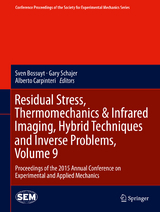
Residual Stress, Thermomechanics& Infrared Imaging, Hybrid Techniques and Inverse Problems, Volume 9 of the Proceedings of the 2015SEM Annual Conference & Exposition on Experimental and Applied Mechanics, the ninth volume of nine from the Conference, brings together contributions to this important area of research and engineering. The collection presents early findings and case studies on a wide range of areas, including:
Inverse Methods
Inverse Methods in Plasticity
Varying Length Scales
Harsh Environments
Opto-Acoustical Methods
Hybrid Experimental
Residual Stress Modelling and Advances in Measurements
Thermomechanics
General Material Response
Infrared Imaging
Preface 6
Contents 8
Chapter 1: Reconstruction of Spatially Varying Random Material Properties by Self-Optimizing Inverse Method 11
1.1 Introduction 11
1.2 Random Field Modeling and Self-OPTIM Methodology 12
1.3 Development of Self-OPTIM Software Framework 14
1.3.1 Parallelization of Self-OPTIM Simulations 14
1.3.2 Optimization Algorithm 15
1.4 Reconstruction of Random Fields by Self-OPTIM 16
1.4.1 Effects of the Number of DIC Measurements 16
1.4.2 Effect of Non-uniform Reaction Forces on Reconstruction of Random Fields 16
1.5 Conclusions 17
References 18
Chapter 2: Performance Assessment of Integrated Digital Image Correlation Versus FEM Updating 20
2.1 Introduction 20
2.2 Systematic Error 20
2.3 Virtual Experimentation 22
2.4 Results and Discussion 23
2.5 Conclusions 23
References 24
Chapter 3: IGMU: A Geometrically Consistent Framework for Identification from Full Field Measurement 25
3.1 Introduction 20
3.2 Virtual Experiment for Identification Porpuses 20
3.3 Iso-Geometric Model Updating (IGMU) Framework 22
3.4 Integrated CAD-based Stereo-DIC 23
3.5 Conclusions 23
References 24
Chapter 4: Characterization of the Dynamic Strain Hardening Behavior from Full-field Measurements 30
4.1 Introduction 30
4.2 Identification Procedure 30
4.2.1 Logarithmic (True) Strain 31
4.2.2 Constitutive Model 31
4.2.3 The Virtual Fields Method 32
4.2.4 Speed and Acceleration 32
4.3 Results 32
4.3.1 FE Model 32
4.3.2 Effect of Strain Rates 33
4.4 Conclusion 34
References 35
Chapter 5: Bridging Kinematic Measurements and Crystal Plasticity Models in Austenitic Stainless Steels 36
5.1 Introduction 36
5.2 Kinematic Measurements Using Digital Image Correlation 36
5.3 Simulation Using a Crystal Plasticity Model 38
5.4 Parameter Identification 38
5.5 Conclusions 41
References 41
Chapter 6: Inverse Identification of Plastic Material Behavior Using Multi-Scale Virtual Experiments 43
6.1 Introduction 43
6.2 Material 44
6.3 Virtual Material Tests 45
6.4 Finite Element Simulation 46
6.5 Conclusions 47
References 48
Chapter 7: An Effective Experimental-Numerical Procedure for Damage Assessment of Ti6Al4V 49
7.1 Introduction 49
7.2 Experimental Campaign 50
7.3 Numerical Models Formulation and Calibration Procedure 50
7.4 Results and Discussion 52
7.5 Conclusion and Further Development 54
References 54
Chapter 8: Identification of the YLD2000-2D Model with the Virtual Fields Method 56
8.1 Introduction 56
8.2 Theory 57
8.3 Experiments 59
8.4 Results and Discussion 60
8.5 Conclusion 61
References 61
Chapter 9: Identification of Post-necking Strain Hardening Behavior of Pure Titanium Sheet 63
9.1 Introduction 63
9.2 Material 64
9.3 Method 65
9.4 Validation: Pre-necking Hardening Behaviour 66
9.5 Results: Post-necking Hardening Behaviour 67
9.6 Conclusions 68
References 68
Chapter 10: Challenges for High-Pressure High-Temperature Applications of Rubber Materials in the Oil and Gas Industry 69
10.1 Introduction 20
10.2 Applications of Rubber Materials in the Oil and Gas Industry 20
10.3 High Temperature/High Pressure Environments 22
10.4 Challenges for Rubber Materials in HPHT Applications 23
10.5 Some Current Approaches for HPHT Applications 23
10.5.1 Nano Material Reinforced Rubber 78
10.5.2 Improved PEEK for HPHT Backup 78
10.5.3 Improved Packer Designs for HPHT Applications 80
10.5.4 Alternate Seal Design Concepts 81
10.6 Concluding Remarks 81
References 24
Chapter 11: Full-Field Strain Imaging of Ultrasonic Waves in Solids 84
11.1 Introduction 20
11.2 Experimental Set-Up 20
11.3 Results 22
11.4 Conclusion 23
References 24
Chapter 12: Acoustic Emission Analysis in Titanium Grade 5 Samples During Fatigue Test 84
12.1 Introduction 20
12.2 Materials and Methods 20
12.3 Results and Discussion 22
12.4 Conclusions 23
References 24
Chapter 13: Analysis of High-Frequency Vibrational Modes Through Laser Pulses 94
13.1 Introduction 20
13.2 Compression Tests on Calcite Samples by the MTS Machine 20
13.3 Raman Spectroscopy 22
13.4 Compression Tests on Crystal Samples by a Manual Press Machine 23
13.5 Ultrasonic Tests Performed by a Sonotrode 23
13.6 Conclusions 78
References 24
Chapter 14: Acquisition of Audio Information from Silent High Speed Video 106
14.1 Introduction 106
14.2 Acquisition Process 107
14.3 Experimental Procedure 109
14.4 Conclusion 112
References 112
Chapter 15: Overview of the Effects of Process Parameters on the Accuracy in Residual Stress Measurements by Using HD and ESPI 113
15.1 Introduction 20
15.2 Sources of Errors in ESPI-HDM 20
15.2.1 Geometrical Parameters 22
15.2.2 Sensitivity Vector 23
15.2.3 Drilling Speed 23
15.3 Conclusions 78
References 24
Chapter 16: Near Weld Stress Analysis with Optical and Acoustic Methods 119
16.1 Introduction 119
16.2 Theoretical 120
16.3 Experimental 121
16.4 Results and Discussions 122
16.5 Conclusions 126
References 126
Chapter 17: Nondestructive Characterization of Thin Film System with Dual-Beam Interferometer 128
17.1 Introduction 128
17.2 Theoretical 131
17.2.1 Physical Model 131
17.2.2 Michelson Interferometer and Principle of Operation 131
17.3 Experimental 133
17.3.1 Information of Pt Specimens 133
17.3.2 Operation Acoustic Frequency and Transducer Calibration 133
17.3.3 Experiment with Treated/Untreated Ti-Pt Thin-Film Specimens 135
17.4 Summary 136
References 136
Chapter 18: Effect of Horn Tip Geometry on Ultrasonic Cavitation Peening 137
18.1 Introduction 137
18.2 Experimental Procedure 137
18.3 Result and Discussion 139
18.3.1 Impact Force Caused by Cavitation Bubbles 139
18.3.2 Effect of Concave Radius on Impact Force 140
18.3.3 Behavior of Cavitation Bubbles Near Horn-Tip 141
18.4 Summary 143
References 144
Chapter 19: Fatigue Damage Analysis of Aluminum Alloy by ESPI 145
19.1 Introduction 145
19.2 Experimental Procedure 146
19.2.1 Specimen 146
19.2.2 Observation of Deformation Behavior of Pre-fatigued Specimen 146
19.2.3 Measurement of Surface Acoustic Wave Velocity 147
19.3 Result and Discussion 148
19.3.1 Influence of Fatigue Damage on Macroscopic Deformation 148
19.3.2 Surface Acoustic Velocity on the Surface of Pre-fatigued Specimen 149
19.4 Summary 152
References 152
Chapter 20: Dynamic Failure Mechanisms in Woven Ceramic Fabric Reinforced Metal Matrix Composites During Ballistic Impact 153
20.1 Introduction 153
20.2 Experimental 153
20.3 Numerical Modeling 154
20.4 Results and Discussion 155
20.5 Conclusions 157
References 157
Chapter 21: Digital Image Correlation Analysis and Numerical Simulation of the Aluminum Alloys under Quasi-static Tension afte... 158
21.1 Introduction 158
21.2 Material and Methods 159
21.3 Analysis 160
21.4 Results and Discussion 162
21.5 Conclusions 163
References 163
Chapter 22: Robust Intermediate Strain Rate Experimentation Using the Serpentine Transmitted Bar 164
22.1 Introduction 164
22.2 Design Strategy 165
22.2.1 Bar System Methodology 165
22.2.2 The Serpentine Bar Approach 166
22.3 Prototype Fabrication 166
22.4 Experiments 167
22.4.1 Dynamic Joint Behavior 167
22.4.2 Intermediate Strain Rate Experiment 168
22.4.3 Long Bar Verification Experiment 168
22.5 Conclusion 170
References 170
Chapter 23: Testing Program for Crashworthiness Assessment of Cutaway Buses 171
23.1 Introduction 171
23.2 Initial Testing and Material Characterization 172
23.3 Component Testing 173
23.4 Full Scale Testing 175
23.5 Computational Testing 175
23.6 Summary 178
References 178
Chapter 24: In-Situ DIC and Strain Gauges to Isolate the Deficiencies in a Model for Indentation Including Anisotropic Plastic... 179
24.1 Introduction 179
24.2 Backstory 179
24.3 Purpose 181
24.4 Methods 182
24.4.1 Experimental 182
24.4.2 Finite Element Modeling 185
24.4.3 Material Models 186
24.5 Results and Discussion 187
24.6 Conclusions 192
References 192
Chapter 25: Analysis of Laser Weld Induced Stress in a Hermetic Seal 194
25.1 Introduction 194
25.2 Experimental 195
25.2.1 Experimental Procedure 195
25.2.2 Experimental Results 196
25.3 Finite Element Model 197
25.3.1 Material Models 197
25.3.2 Boundary Conditions 198
25.3.3 Sealing Cycle 199
25.3.4 Laser Weld 200
25.4 Conclusion 201
References 201
Chapter 26: A Summary of Failures Caused by Residual Stresses 203
26.1 Introduction 203
26.2 Methods 203
26.3 Results and Discussion 204
26.3.1 Temporal Analysis 204
26.3.2 Material Analysis 205
26.3.3 Failure Mechanism Analysis 206
26.4 Impact of Failures on Industry 207
References 208
Chapter 27: Comparative Analysis of Shot-Peened Residual Stresses Using Micro-Hole Drilling, Micro-Slot Cutting, X-ray Diffrac... 209
27.1 Introductions 209
27.2 Materials and Methods 210
27.3 Results and Discussion 213
27.4 Conclusions 216
References 216
Chapter 28: Thermal Deformation Analysis of an Aluminum Alloy Utilizing 3D DIC 218
28.1 Introduction 218
28.2 Experimental Procedures and Techniques 219
28.2.1 Tension Experiments 219
28.2.2 Bend Testing 220
28.2.3 Thermal Testing 221
28.3 Experimental Results 222
28.4 Summary and Conclusions 227
References 227
Chapter 29: Hybrid Full-Field Stress Analysis of Loaded Perforated Asymmetrical Plate 228
29.1 Introduction 228
29.2 Prior Relevant Analyses 228
29.3 Experimental Details 232
References 234
Chapter 30: Automated Detection of CFRP Defects by Infrared Thermography and Image Analysis 235
30.1 Introduction 235
30.2 Materials and Methods 236
30.2.1 IRT 236
30.2.2 IRT Experimental System 236
30.2.3 Specimens and Test 236
30.2.4 Software Development 237
30.3 Test Results and Discussion 239
30.4 Conclusion 240
References 240
Chapter 31: Modelling the Residual Stress Field Ahead of the Notch Root in Shot Peened V-Notched Samples 241
31.1 Introduction 241
31.2 Material and Experimental Procedures 242
31.2.1 Sample Preparation 242
31.2.2 Stress Field Around the Notch 243
31.3 Experimental Results 244
31.4 Numerical Reconstruction of the Residual Stress Field 246
31.5 Conclusions 251
References 252
Chapter 32: Numerical Prediction of Temperature and Residual Stress Fields in LFSW 254
32.1 Introduction 254
32.2 Material and Methods 255
32.2.1 Temperature Measurement 257
32.2.2 Residual Stresses Measurement 258
32.2.3 Numerical Model 258
32.3 Results 259
32.4 Conclusion 263
References 263
Chapter 33: Residual Stress Measurement on Shot Peened Samples Using FIB-DIC 265
33.1 Introduction 265
33.2 Experimental Procedure and Data Analysis 266
33.2.1 Sample Description and Measurement Locations 266
33.2.2 FIB Milling Procedure 267
33.2.3 DIC Analysis and Fitting Procedure 268
33.3 Eigenstrain Modelling 269
33.4 Results and Discussion 270
33.5 Conclusion 272
References 273
Chapter 34: Residual Stress in Injection Stretch Blow Molded PET Bottles 274
34.1 Introduction 274
34.2 Material and Experimental Setup 275
34.3 Result and Discussion 275
34.4 Photo-Elasticity Observation of Residual Hoop Stress 276
34.5 Time-Dependence of Stresses in the Polymer Film 276
34.6 Combined Photoelasticity and Residual Stress Measurement 277
34.7 Conclusion 278
References 279
Chapter 35: Applying Infrared Thermography and Heat Source Reconstruction for the Analysis of the Portevin-Le Chatelier Effect... 280
35.1 Introduction 280
35.2 Experimental Conditions and Image Processing 281
35.3 Results 281
35.4 Conclusion 283
References 283
Chapter 36: Applying a Gad Filter to Calculate Heat Sources from Noisy Temperature Fields 285
36.1 Introduction 285
36.2 Heat Diffusion Equation and Processing by GAD Filter 286
36.3 Simulated Data 287
36.4 Experimental Data 289
36.5 Conclusion 290
References 290
Chapter 37: Contour Method Residual Stress Measurement Uncertainty in a Quenched Aluminum Bar and a Stainless Steel Welded Pla... 291
37.1 Introduction 291
37.2 Methods 292
37.2.1 Model Error 292
37.2.2 Displacement Error 293
37.2.3 Total Uncertainty 293
37.2.4 Experiments 294
37.3 Results 295
37.4 Discussion 297
37.5 Summary/Conclusions 298
References 300
Chapter 38: On the Separation of Complete Triaxial Strain/Stress Profiles from Diffraction Experiments 301
38.1 Introduction 301
38.2 Goniometers 301
38.2.1 Fundamental Equations 301
38.2.2 Simulation 303
References 305
Chapter 39: Residual Stress Mapping with Multiple Slitting Measurements 306
39.1 Introduction 306
39.2 Methods 308
39.3 Results 311
39.4 Discussion 315
39.5 Summary/Conclusions 316
References 317
Chapter 40: A Novel Approach for Biaxial Residual Stress Mapping Using the Contour and Slitting Methods 318
40.1 Introduction 318
40.2 Methods 319
40.2.1 Measurement Approach 319
40.2.2 Biaxial Mapping 320
40.2.3 Confirmation Measurements 321
40.3 Results 322
40.3.1 Biaxial Mapping 322
40.3.2 Confirmation Measurements 324
40.4 Discussion 325
40.5 Summary 326
References 327
Chapter 41: Measurement of Residual Stresses in B4C-SiC-Si Ceramics Using Raman Spectroscopy 328
41.1 Introduction 328
41.2 Materials 329
41.3 Experimental 330
41.4 Results and Discussion 330
41.5 Conclusion 331
References 331
Chapter 42: Hole Drilling Determination of Residual Stresses Varying Along a Surface 333
42.1 Introduction 333
42.2 Displacements from Hole Drilling 334
42.3 Phase-Displacement-Stress Relations 337
42.4 Experiments 337
42.5 Discussion 338
42.6 Conclusions 339
References 339
Chapter 43: Sensitivity Analysis of i-DIC Approach for Residual Stress Measurement in Orthotropic Materials 340
43.1 Introduction 340
43.2 Integrated Digital Image Correlation for Residual Stress Measurement 341
43.3 Orthotropic Material 342
43.4 (A Sort of) Sensitivity Analysis 343
43.5 Conclusions 346
References 346
Chapter 44: Stress Measurement Repeatability in ESPI Hole-Drilling 348
44.1 Background 348
44.2 Experimental 348
44.3 Results 349
44.4 Discussion 350
References 354
Chapter 45: Some Aspects of the Application of the Hole Drilling Method on Plastic Materials 355
45.1 Introduction 355
45.2 Thermal Effects 355
45.3 Stiffening Effects 358
45.4 Effects of Viscoelastic Behavior 362
45.5 Conclusion 364
Reference 364
| Erscheint lt. Verlag | 29.10.2015 |
|---|---|
| Reihe/Serie | Conference Proceedings of the Society for Experimental Mechanics Series | Conference Proceedings of the Society for Experimental Mechanics Series |
| Zusatzinfo | IX, 380 p. 353 illus., 263 illus. in color. |
| Verlagsort | Cham |
| Sprache | englisch |
| Themenwelt | Mathematik / Informatik ► Mathematik ► Wahrscheinlichkeit / Kombinatorik |
| Technik ► Bauwesen | |
| Technik ► Maschinenbau | |
| Schlagworte | Conf. Pro. of the Society for Experimental Mechanics • DiC • Digital Image Coorelation • FEM • Finite Element Method • Residual stresses |
| ISBN-10 | 3-319-21765-8 / 3319217658 |
| ISBN-13 | 978-3-319-21765-9 / 9783319217659 |
| Informationen gemäß Produktsicherheitsverordnung (GPSR) | |
| Haben Sie eine Frage zum Produkt? |
 PDF (Wasserzeichen)
DRM: Digitales Wasserzeichen
Dieses eBook enthält ein digitales Wasserzeichen und ist damit für Sie personalisiert. Bei einer missbräuchlichen Weitergabe des eBooks an Dritte ist eine Rückverfolgung an die Quelle möglich.
Dateiformat: PDF (Portable Document Format)
Mit einem festen Seitenlayout eignet sich die PDF besonders für Fachbücher mit Spalten, Tabellen und Abbildungen. Eine PDF kann auf fast allen Geräten angezeigt werden, ist aber für kleine Displays (Smartphone, eReader) nur eingeschränkt geeignet.
Systemvoraussetzungen:
PC/Mac: Mit einem PC oder Mac können Sie dieses eBook lesen. Sie benötigen dafür einen PDF-Viewer - z.B. den Adobe Reader oder Adobe Digital Editions.
eReader: Dieses eBook kann mit (fast) allen eBook-Readern gelesen werden. Mit dem amazon-Kindle ist es aber nicht kompatibel.
Smartphone/Tablet: Egal ob Apple oder Android, dieses eBook können Sie lesen. Sie benötigen dafür einen PDF-Viewer - z.B. die kostenlose Adobe Digital Editions-App.
Buying eBooks from abroad
For tax law reasons we can sell eBooks just within Germany and Switzerland. Regrettably we cannot fulfill eBook-orders from other countries.
aus dem Bereich