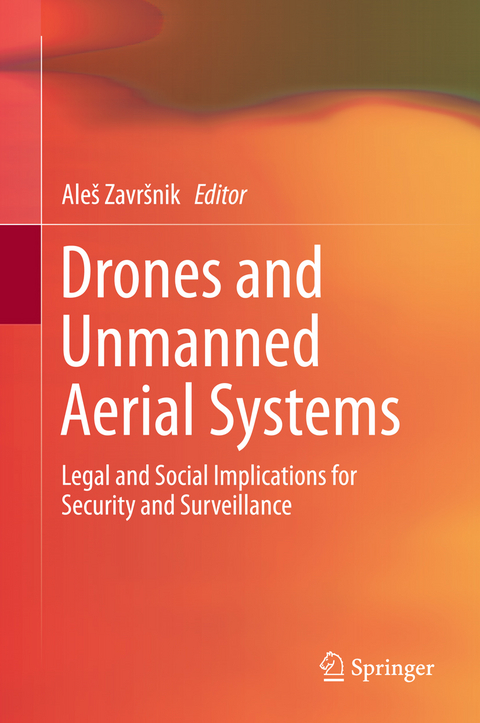
Drones and Unmanned Aerial Systems (eBook)
XI, 275 Seiten
Springer International Publishing (Verlag)
9783319237602 (ISBN)
This book tackles the regulatory issues of Unmanned Aerial Systems (UAS) or Remotely-Piloted Aerial Systems (RPAS), which have profound consequences for privacy, security and other fundamental liberties. Collectively known as 'drones,' they were initially deployed for military purposes: reconnaissance, surveillance and extrajudicial executions. Today, we are witnessing a growth of their use into the civilian and humanitarian domain. They are increasingly used for goals as diverse as news gathering, aerial inspection of oil refinery flare stacks, mapping of the Amazonian rain-forest, crop spraying and search and rescue operations.
The civil use of drones is becoming a reality in the European Union and in the US.The drone revolution may be a new technological revolution. Proliferation of the next generation of 'recreational' drones show how drones will be sold as any other consumer item. The cultural perception of the technology is shifting, as drones are increasingly being used for humanitarian activities, on one hand, but they can also firmly be situated in the prevailing modes of postmodern governance on the other hand.This work will be of interest to researchers in Criminology and Criminal Justice interested in issues related to surveillance, security, privacy, and technology. It will also provide a criminological background for related legal issues, such as privacy law, aviation law, international criminal law, and comparative law.
Aleš Završnik Doctor of Law ( LL.D.), Assistant Professor, is researcher at the Institute of Criminology at the Faculty of Law in Ljubljana. He is a postdoctoral Yggdrasil fellow at the Department of Criminology and Sociology of Law at University of Oslo (2012) and was a postdoctoral fellow at the Max-Planck-Institute für ausländisches und internationals Strafrecht, Freiburg i. Br. (2009) and a fellow of the World Federation of Scientists, Geneva (2008). At the moment he collaborates in the European Cooperation in Science and Technology (COST) Action 'Living in Surveillance Societies' and the COST Action 'Cyberbullying'. Aleš Završnik edited a book Crime and Technology: How Computers Transform Surveillance and Privacy, Crime and Crime Control? (2010) and published a book Homo Criminalis: Images of a Criminal in High- Tech Risk Society (2009). He has researched and published on theoretical criminology, criminal law and 'law and technology', i.e. cybercrime, cyber-law and surveillance. He is a member of the editorial board of the Masaryk University Journal of Law and Technology. Contact information: Institute of Criminology at the Faculty of Law, Ljubljana, Poljanski nasip 2, SI-1000 Ljubljana, Slovenia.
Aleš Završnik Doctor of Law ( LL.D.), Assistant Professor, is researcher at the Institute of Criminology at the Faculty of Law in Ljubljana. He is a postdoctoral Yggdrasil fellow at the Department of Criminology and Sociology of Law at University of Oslo (2012) and was a postdoctoral fellow at the Max-Planck-Institute für ausländisches und internationals Strafrecht, Freiburg i. Br. (2009) and a fellow of the World Federation of Scientists, Geneva (2008). At the moment he collaborates in the European Cooperation in Science and Technology (COST) Action “Living in Surveillance Societies” and the COST Action “Cyberbullying”. Aleš Završnik edited a book Crime and Technology: How Computers Transform Surveillance and Privacy, Crime and Crime Control? (2010) and published a book Homo Criminalis: Images of a Criminal in High- Tech Risk Society (2009). He has researched and published on theoretical criminology, criminal law and “law and technology”, i.e. cybercrime, cyber-law and surveillance. He is a member of the editorial board of the Masaryk University Journal of Law and Technology. Contact information: Institute of Criminology at the Faculty of Law, Ljubljana, Poljanski nasip 2, SI-1000 Ljubljana, Slovenia.
Introduction: Situating drones in surveillance societies.- I. Political Technology of Drones.- 1. Mark Andrejevic: Theorizing Drones and Droning Theory.- 2. Kristin Bergtora Sandvik: The Political and Moral Economies of Dual Technology Transfers: Arming Police Drones.- II. Drones Between Privacy and Security.- 3. Primož Gorkič: The (F)Utility of Privacy Laws: The Case of Drones.- 4. Sanja Milivojevič: Re-bordering the Peripheral Global North and Global South: Game of Drones, Immobilising Mobile Bodies and Decentring Perspectives on Drones in Border Policing.- 5. Luisa Marin and Kamila Krajčíková: Deploying Drones in Policing Southern European Borders: Constraints and Challenges for Data Protection and Human Rights.- III. Drones, the “War on Terror” and Public International Law.- 6. Mélanie De Groof: Death from the Sky: International Legal and Practical Issues on the Use of Armed Drones.- 7. Vasja Badalič: The Predators’ Rule of Terror.- IV. Drones and International Air Law.- 8. Pablo Mendes de Leon and Benjamyn Ian Scott: An Analysis of Unmanned Aircraft Systems Under Air Law.- V. Domain-Specific Uses of Drones.- 9. David Goldberg: Droning on about Journalism: Remotely Piloted Aircraft and Newsgathering.- 10. Aleš Završnik: Drones, Resistance, and Counter-Surveillance.
| Erscheint lt. Verlag | 23.12.2015 |
|---|---|
| Zusatzinfo | XI, 275 p. 5 illus., 4 illus. in color. |
| Verlagsort | Cham |
| Sprache | englisch |
| Themenwelt | Informatik ► Theorie / Studium ► Künstliche Intelligenz / Robotik |
| Recht / Steuern ► EU / Internationales Recht | |
| Recht / Steuern ► Strafrecht | |
| Schlagworte | drones • Drones and Civil Use • Drones and Law • Security and Survellience • Unmanned Aerial System (UAS) • unmanned aerial vehicle (UAV) |
| ISBN-13 | 9783319237602 / 9783319237602 |
| Informationen gemäß Produktsicherheitsverordnung (GPSR) | |
| Haben Sie eine Frage zum Produkt? |
 PDF (Wasserzeichen)
DRM: Digitales Wasserzeichen
Dieses eBook enthält ein digitales Wasserzeichen und ist damit für Sie personalisiert. Bei einer missbräuchlichen Weitergabe des eBooks an Dritte ist eine Rückverfolgung an die Quelle möglich.
Dateiformat: PDF (Portable Document Format)
Mit einem festen Seitenlayout eignet sich die PDF besonders für Fachbücher mit Spalten, Tabellen und Abbildungen. Eine PDF kann auf fast allen Geräten angezeigt werden, ist aber für kleine Displays (Smartphone, eReader) nur eingeschränkt geeignet.
Systemvoraussetzungen:
PC/Mac: Mit einem PC oder Mac können Sie dieses eBook lesen. Sie benötigen dafür einen PDF-Viewer - z.B. den Adobe Reader oder Adobe Digital Editions.
eReader: Dieses eBook kann mit (fast) allen eBook-Readern gelesen werden. Mit dem amazon-Kindle ist es aber nicht kompatibel.
Smartphone/Tablet: Egal ob Apple oder Android, dieses eBook können Sie lesen. Sie benötigen dafür einen PDF-Viewer - z.B. die kostenlose Adobe Digital Editions-App.
Buying eBooks from abroad
For tax law reasons we can sell eBooks just within Germany and Switzerland. Regrettably we cannot fulfill eBook-orders from other countries.
aus dem Bereich