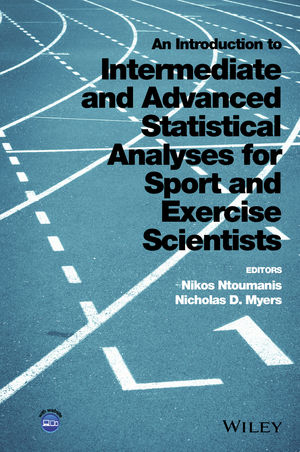
An Introduction to Intermediate and Advanced Statistical Analyses for Sport and Exercise Scientists (eBook)
John Wiley & Sons (Verlag)
978-1-118-96206-0 (ISBN)
'Ntoumanis and Myers have done sport and exercise science researchers and students a tremendous service in producing An Introduction to Intermediate and Advanced Statistical Analyses for Sport and Exercise Scientists. This book has an outstanding compilation of comprehensible chapters dealing with the important concepts and technical minutia of the statistical analyses that sport and exercise science scholars use (or should be using!) in their efforts to conduct meaningful research in the field. It is a resource that all sport and exercise scientists and their students should have on their book shelves.'
-Robert Eklund, School of Sport, University of Stirling, UK
'Motivating, to have a statistics text devoted to enabling researchers studying sport and exercise science to apply the most sophisticated analytical techniques to their data. Authors hit the mark between using technical language as necessary and user-friendly terms or translations to keep users encouraged. Text covers traditional and well-used tools but also less common and more complex tools, but always with familiar examples to make their explanations come alive. As a dynamic systems theorist and developmentalist, I would love to see more researchers in my area create study designs that would enable the use of tools outlined here, such as multilevel structural equation modeling (MSEM) or mediation & moderation analyses, to uncover cascades of relations among subsystems contributing to motor performance, over time. This text can facilitate that outcome.'
-Beverly D. Ulrich, School of Kinesiology, University of Michigan, USA
'The domain of quantitative methods is constantly evolving and expanding. This means that there is tremendous pressure on researchers to stay current, both in terms of best practices and improvements in more traditional methods as well as increasingly complex new methods. With this volume Ntoumanis and Myers present a nice cross-section of both, helping sport and exercise science researchers to address old questions in better ways, and, even more excitingly, to address new questions entirely. I have no doubt that this volume will quickly become a lovingly dog-eared companion for students and researchers, helping them to continue to move the field forward.'
-Gregory R. Hancock, University of Maryland and Center for Integrated Latent Variable Research (CILVR), USA
Nikos Ntoumanis, School of Sport, Exercise and Rehabilitation Sciences, University of Birmingham, Birmingham, UK. Nikos has been teaching statistics to sport and exercise sciences university students for 14 years in two UK universities and delivered statistics workshops in the UK and overseas.
Nicholas Daniel Myers, Department of Educational and Psychological Studies, University of Miami, Florida, USA. His expertise is in advanced statistical methods with an emphasis on applications in sport and exercise science. Nicholas serves as Director of the Research, Measurement, and Evaluation (RME) doctoral program at the University of Miami. The RME doctoral program has been rated a top-20 program nationally by Academic Analytics since 2006 and has served as a statistical consultant for the Research Methodology Services component of the Dunspaugh-Dalton Community and Educational Well-Being (CEW) Research Centre at the University of Miami.
"e;Ntoumanis and Myers have done sport and exercise science researchers and students a tremendous service in producing An Introduction to Intermediate and Advanced Statistical Analyses for Sport and Exercise Scientists. This book has an outstanding compilation of comprehensible chapters dealing with the important concepts and technical minutia of the statistical analyses that sport and exercise science scholars use (or should be using!) in their efforts to conduct meaningful research in the field. It is a resource that all sport and exercise scientists and their students should have on their book shelves."e; Robert Eklund, School of Sport, University of Stirling, UK "e;Motivating, to have a statistics text devoted to enabling researchers studying sport and exercise science to apply the most sophisticated analytical techniques to their data. Authors hit the mark between using technical language as necessary and user-friendly terms or translations to keep users encouraged. Text covers traditional and well-used tools but also less common and more complex tools, but always with familiar examples to make their explanations come alive. As a dynamic systems theorist and developmentalist, I would love to see more researchers in my area create study designs that would enable the use of tools outlined here, such as multilevel structural equation modeling (MSEM) or mediation & moderation analyses, to uncover cascades of relations among subsystems contributing to motor performance, over time. This text can facilitate that outcome."e; Beverly D. Ulrich, School of Kinesiology, University of Michigan, USA "e;The domain of quantitative methods is constantly evolving and expanding. This means that there is tremendous pressure on researchers to stay current, both in terms of best practices and improvements in more traditional methods as well as increasingly complex new methods. With this volume Ntoumanis and Myers present a nice cross-section of both, helping sport and exercise science researchers to address old questions in better ways, and, even more excitingly, to address new questions entirely. I have no doubt that this volume will quickly become a lovingly dog-eared companion for students and researchers, helping them to continue to move the field forward."e; Gregory R. Hancock, University of Maryland and Center for Integrated Latent Variable Research (CILVR), USA
Nikos Ntoumanis, School of Sport, Exercise and Rehabilitation Sciences, University of Birmingham, Birmingham, UK. Nikos has been teaching statistics to sport and exercise sciences university students for 14 years in two UK universities and delivered statistics workshops in the UK and overseas. Nicholas Daniel Myers, Department of Educational and Psychological Studies, University of Miami, Florida, USA. His expertise is in advanced statistical methods with an emphasis on applications in sport and exercise science. Nicholas serves as Director of the Research, Measurement, and Evaluation (RME) doctoral program at the University of Miami. The RME doctoral program has been rated a top-20 program nationally by Academic Analytics since 2006 and has served as a statistical consultant for the Research Methodology Services component of the Dunspaugh-Dalton Community and Educational Well-Being (CEW) Research Centre at the University of Miami.
Title Page 5
Copyright Page 6
Contents 9
About the editors 15
List of contributors 17
Foreword 21
Preface 23
Chapter 1 Factorial ANOVA and MANOVA 27
General Introduction 27
Hypothesis Testing 28
Alpha Level 28
Assumptions 29
Further Considerations 30
Utility in Sport and Exercise Sciences 32
Treatment Conditions 32
Existing Conditions 32
Individual Characteristics 33
Recent Usage 33
The Substantive Example 33
Univariate: Factorial ANOVA 34
Univariate Assumptions 34
The Synergy 36
Factorial ANOVA Analysis Plan 36
Example of a Write-Up Compatible with the APA Publication Manual 37
Factorial MANOVA Analysis Plan 39
Example of a Write-Up Compatible with the APA Publication Manual 39
Summary 42
Acknowledgment 44
References 44
Chapter 2 Repeated measures ANOVA and MANOVA 45
General Introduction 45
Between- versus Within-Subjects Variables 45
Hypothesis Testing 46
Assumptions 46
Further Considerations 47
Utility in Sport and Exercise Sciences 48
Multiple Treatment Conditions 49
Multiple Assessments 49
Longitudinal Studies 49
Recent Usage 50
The Substantive Example 50
Univariate: Repeated Measures ANOVA 50
Univariate Assumptions 51
Multivariate: Repeated Measures MANOVA 52
Multivariate Assumptions 52
The Synergy 53
Repeated Measures ANOVA Analysis Plan 53
Example of a Write-Up Compatible with the APA Publication Manual 55
Repeated Measures MANOVA Analysis Plan 55
Example of a Write-Up Compatible with the APA Publication Manual 57
Summary 58
Acknowledgment 60
References 60
Chapter 3 Mediation and moderation via regression analysis 61
General Introduction 61
Utility of the Methods in Sport and Exercise Science 62
The Substantive Example 64
Mediation 64
The Synergy 64
Mediation 64
The Substantive Example 70
Moderation 70
The Synergy 71
Moderation 71
Summary 79
References 81
Chapter 4 Item response theory and its applications in Kinesiology 83
General Introduction 83
What Is IRT? 85
Other Commonly Used IRT Models 86
Assumptions Related to IRT 88
Unidimensionality 88
Local Independence 88
Addressing Model-Data Fit 88
Inspecting Model Assumptions 89
Inspecting Expected Model Features 89
Inspecting Overall Model-Data Fit 90
Computer Simulation for Model-Data Fit Testing 90
Unique Features and Advantages of IRT 91
Estimation Invariance 91
Common Metric Scale 91
Item and Test Information 92
Test Relative Efficiency 94
Global “Reliability” Is no Longer a Concern 95
Item Bank and IRT-Based Test Construction 95
Parameter Estimation and Software 97
Utility of the Methodology in Kinesiology 97
IRT Limitations and Future Direction 98
Conclusion 99
References 100
Chapter 5 Introduction to factor analysis and structural equation modeling 105
General Introduction 105
Utility of the Method in Sport and Exercise Science 106
Terminology and Methodology 109
Evaluating Model Fit 112
Interpreting Parameter Estimates 114
The Substantive Example 115
The Synergy 117
EFA: Establishing the Factor Structure 117
CFA: Testing the Measurement Models 119
Structural Equation Modeling: Adding the Regression Paths 122
Summary 124
References 125
Chapter 6 Invariance testing across samples and time: Cohort-sequence analysis of perceived body composition 127
General Introduction to the Importance of Measurement Invariance 128
Cohort-Sequential Designs: Longitudinal Invariance across Samples and Time 132
Substantive Application: Physical Self-Concept 133
Methodology 137
The PSDQ Instrument 137
Statistical Analyses 137
Goodness of Fit 138
Results 139
Basic Cohort-Sequence Model: Four Cohort Groups and Four Waves 139
Cohort-Sequence Design of Multiple Indicators, Multiple Causes Models 141
Use of Model Constraint with Orthogonal Polynomial Contrasts to Evaluate Cohort Sequence and MIMIC Latent Means 142
Use of Latent Growth Curve Models to Evaluate Stability/Change over Time 145
LGC Results 149
Summary, Implications, and Further Directions 149
Methodological Implications, Limitations, and Further Directions 149
References 151
Chapter 7 Cross-lagged structural equation modeling and latent growth modeling 157
General Introduction 157
A Theoretical Framework for the Study of Change 158
Utility of the Method in Sport and Exercise Science 158
Analysis of Change 158
The Substantive Example 160
Theoretical Background 160
The Data: Participants and Measurement 160
The Synergy 161
CLPM 161
CLPM Example 163
Latent Growth Modeling 166
LGM Example 167
Model 2a: Unconditional LGM 169
Model 2b: Conditional LGM 171
Model 2c: Unconditional LGM with TVCs 171
Model 3: Parallel Process LGM 172
Model 4: Second-Order LGM 174
Summary 176
References 177
Chapter 8 Exploratory structural equation modeling and Bayesian estimation 181
General Introduction 181
Utility of the Methods in Sport and Exercise Science 182
The Substantive Example(s) 185
The Motivational Correlates of Mentally Tough Behavior 185
Developing Synergies through Statistical Modeling 187
ESEM 187
Bayesian Estimation 194
Summary 205
References 206
Chapter 9 A gentle introduction to mixture modeling using physical fitness performance data 209
General Introduction 209
Utility of the Method in Sport and Exercise Science 212
The Substantive Example(s) 213
Class Enumeration in Mixture Models 214
The Estimation of Mixture Models 216
The Synergy 216
LPA of Grade 5 Students and Tests of Invariance across Gender Groups 216
Inclusion of Covariates in LPA Solutions 221
LTA 222
Mixture Regression Analyses of Grade 5 Students 224
Latent Basis Growth Mixture Analyses: Cardiovascular Fitness 228
Piecewise Growth Mixture Analyses: Physical Strength 229
Summary 230
Acknowledgments 231
References 232
Chapter 10 Multilevel (structural equation) modeling 237
General Introduction 237
Multilevel Structural Equation Modeling 238
Utility of the Methodology in Sport and Exercise Science 240
The Substantive Examples 241
Coaching Competency–Collective Efficacy–Team Performance: 1–1–2 242
Action Planning Intervention–Physical Activity Action Plans–Physical Activity: 2–1–1 243
The Synergy 244
Coaching Competency–Collective Efficacy–Team Performance: 1–1–2 245
Action Planning Intervention–Physical Activity Action Plans–Physical Activity: 2–1–1 248
Summary 255
References 256
Chapter 11 Application of meta-analysis in sport and exercise science 259
General Introduction 259
Stages of Meta-Analysis 259
Key Elements of Meta-Analysis 260
Goals of Meta-Analysis 262
Utility of the Methodology in Sport and Exercise Science 264
The Substantive Example 264
The Synergy 267
Univariate Meta-Analysis 267
Multivariate Meta-Analysis 271
Summary 275
Acknowledgment 277
References 277
Chapter 12 Reliability and stability of variables/instruments used in sport science and sport medicine 281
Introduction 281
A. Assessment of Test–Retest Agreement Using Interval/Ratio Data 282
A Worked Example Using the Test–Retest Differences of the Biceps Skinfold Measurements 283
B. Utility of the Assessment of Test-Retest Stability Using Categorical/Likert-Type Data 286
The Substantive Example 287
Utility of the Test–Retest Stability Using Nonparametric Data 287
The Synergy 288
Utility of the Item by Item Approach to Test–Retest Stability 289
The Synergy 289
Summary 291
References 292
Chapter 13 Sample size determination and power estimation in structural equation modeling 293
General Introduction 293
Power 294
Power Analysis in SEM 294
Utility of the Methodology in Sport and Exercise Science 295
Power Analysis Regarding Model-Data Fit: An Introduction 295
Power Analysis Regarding Focal Parameters: An Introduction 296
The Substantive Example 298
Bifactor Model in Sport and Exercise Science 298
Bifactor Model and the PETES 299
The Synergy 301
Power Analysis Regarding Model-Data Fit: A Demonstration 302
Power Analysis Regarding Focal Parameters: A Demonstration 304
Summary 307
References 308
Index 311
EULA 315
| Erscheint lt. Verlag | 24.11.2015 |
|---|---|
| Sprache | englisch |
| Themenwelt | Mathematik / Informatik ► Mathematik |
| Medizin / Pharmazie ► Allgemeines / Lexika | |
| Medizin / Pharmazie ► Gesundheitsfachberufe | |
| Medizin / Pharmazie ► Medizinische Fachgebiete ► Sportmedizin | |
| Sozialwissenschaften ► Pädagogik | |
| Schlagworte | Angewandte Wahrscheinlichkeitsrechnung u. Statistik • Applied Probability & Statistics • Bildungswesen • Education • Educational Research & Statistics • Medical Science • Medizin • Pädagogik • Pädagogik / wissenschaftliche Studien u. Statistik • Pädagogik • Pädagogik / wissenschaftliche Studien u. Statistik • sport science, exercise science, kinesiology, statistical analysis, • Sports Science • Sportwissenschaft • Statistics • Statistik |
| ISBN-10 | 1-118-96206-0 / 1118962060 |
| ISBN-13 | 978-1-118-96206-0 / 9781118962060 |
| Informationen gemäß Produktsicherheitsverordnung (GPSR) | |
| Haben Sie eine Frage zum Produkt? |
 PDF (Adobe DRM)
Kopierschutz: Adobe-DRM
Adobe-DRM ist ein Kopierschutz, der das eBook vor Mißbrauch schützen soll. Dabei wird das eBook bereits beim Download auf Ihre persönliche Adobe-ID autorisiert. Lesen können Sie das eBook dann nur auf den Geräten, welche ebenfalls auf Ihre Adobe-ID registriert sind.
Details zum Adobe-DRM
Dateiformat: PDF (Portable Document Format)
Mit einem festen Seitenlayout eignet sich die PDF besonders für Fachbücher mit Spalten, Tabellen und Abbildungen. Eine PDF kann auf fast allen Geräten angezeigt werden, ist aber für kleine Displays (Smartphone, eReader) nur eingeschränkt geeignet.
Systemvoraussetzungen:
PC/Mac: Mit einem PC oder Mac können Sie dieses eBook lesen. Sie benötigen eine
eReader: Dieses eBook kann mit (fast) allen eBook-Readern gelesen werden. Mit dem amazon-Kindle ist es aber nicht kompatibel.
Smartphone/Tablet: Egal ob Apple oder Android, dieses eBook können Sie lesen. Sie benötigen eine
Geräteliste und zusätzliche Hinweise
Buying eBooks from abroad
For tax law reasons we can sell eBooks just within Germany and Switzerland. Regrettably we cannot fulfill eBook-orders from other countries.
aus dem Bereich