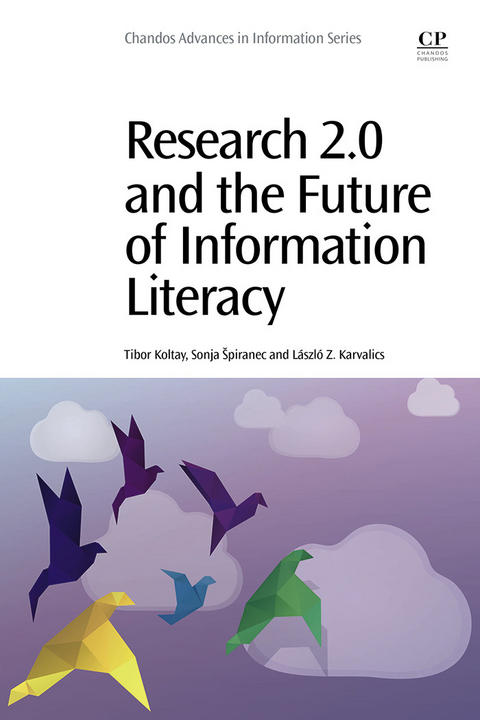
Research 2.0 and the Future of Information Literacy (eBook)
190 Seiten
Elsevier Science (Verlag)
9780081000892 (ISBN)
Tibor Koltay, PhD, is Professor at the Department of Information and Library Studies of Szent István University, Hungary. In 2010, he published Abstracts and Abstracting. A Genre and Set of Skills for the Twenty-first Century with Chandos Publishing.
Research 2.0 and the Future of Information Literacy examines possible congruencies between information literacy and Research 2.0, because the work of today's researcher mobilizes a number of literacies. From among the various types of relevant literacies, at least three types of literacies can be mentioned in this relation: information literacy, scientific literacy and academic literacy. This book addresses these literacies in the light of the changing research landscape. Broad contexts of the researcher's abilities, as adaptive and innovative thinking, problem solving skills, self-management and design mindset are also examined. Computational thinking and the computational paradigm in a number of fields of research are taken into consideration, as well. Researchers differ to non-researchers when populating social media, which means that these two different groups require different literacies. The relationship between information literacy and information is approached in a new way. Among the multitude of issues, we introduce a new interface between information literacy and Research 2.0. It encompasses the issues of research data management and data literacy, which represent also a challenge both for the academic library and for the communities of researchers. Similarly, the questions of new metrics of scientific output are addressed in the book. - Summarizes the most important and up-to date approaches towards Research 2.0, including researchers' skills and abilities, the data-intensive paradigm of scientific research, open science, not forgetting about factors that inhibit a wider uptake of Research 2.0- Discusses the nature of information literacy in the light of its definitions, declarations and related frameworks and by outlining the new literacies context, reading and writing, the cultural context, and the turns of library and information science- Numerous literacies, other than information literacy, its relationship to information overload and personal information management are also subject of the book- Theoretical and practical perspectives are given to enable the understanding of the transformations of information literacy and its relationship to Research 2.0
| Erscheint lt. Verlag | 22.1.2016 |
|---|---|
| Sprache | englisch |
| Themenwelt | Geisteswissenschaften ► Sprach- / Literaturwissenschaft |
| Mathematik / Informatik ► Informatik ► Theorie / Studium | |
| Sozialwissenschaften ► Kommunikation / Medien ► Buchhandel / Bibliothekswesen | |
| Sozialwissenschaften ► Soziologie | |
| ISBN-13 | 9780081000892 / 9780081000892 |
| Informationen gemäß Produktsicherheitsverordnung (GPSR) | |
| Haben Sie eine Frage zum Produkt? |
 EPUB (Adobe DRM)
Kopierschutz: Adobe-DRM
Adobe-DRM ist ein Kopierschutz, der das eBook vor Mißbrauch schützen soll. Dabei wird das eBook bereits beim Download auf Ihre persönliche Adobe-ID autorisiert. Lesen können Sie das eBook dann nur auf den Geräten, welche ebenfalls auf Ihre Adobe-ID registriert sind.
Details zum Adobe-DRM
Dateiformat: EPUB (Electronic Publication)
EPUB ist ein offener Standard für eBooks und eignet sich besonders zur Darstellung von Belletristik und Sachbüchern. Der Fließtext wird dynamisch an die Display- und Schriftgröße angepasst. Auch für mobile Lesegeräte ist EPUB daher gut geeignet.
Systemvoraussetzungen:
PC/Mac: Mit einem PC oder Mac können Sie dieses eBook lesen. Sie benötigen eine
eReader: Dieses eBook kann mit (fast) allen eBook-Readern gelesen werden. Mit dem amazon-Kindle ist es aber nicht kompatibel.
Smartphone/Tablet: Egal ob Apple oder Android, dieses eBook können Sie lesen. Sie benötigen eine
Geräteliste und zusätzliche Hinweise
Buying eBooks from abroad
For tax law reasons we can sell eBooks just within Germany and Switzerland. Regrettably we cannot fulfill eBook-orders from other countries.
aus dem Bereich