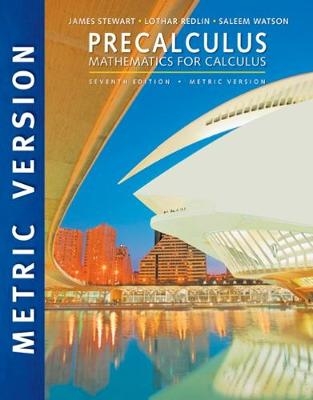
Precalculus: Mathematics for Calculus, International Metric Edition
Brooks/Cole (Verlag)
978-1-305-99998-5 (ISBN)
- Titel erscheint in neuer Auflage
- Artikel merken
James Stewart received the M.S. degree from Stanford University and the Ph.D. from the University of Toronto. After two years as a postdoctoral fellow at the University of London, he became Professor of Mathematics at McMaster University. His research has been in harmonic analysis and functional analysis. Stewart’s books include a series of high school textbooks as well as a best-selling series of calculus textbooks published by Cengage Learning. He is also co-author, with Lothar Redlin and Saleem Watson, of a series of college algebra and precalculus textbooks. Translations of his books include those into Spanish, Portuguese, French, Italian, Korean, Chinese, Greek, Indonesian and Japanese. A talented violinist, Stewart was concertmaster of the McMaster Symphony Orchestra for many years and played professionally in the Hamilton Philharmonic Orchestra. He has given more than 20 talks worldwide on mathematics and music. Stewart was named a Fellow of the Fields Institute in 2002 and was awarded an honorary D.Sc. in 2003 by McMaster University. The library of the Fields Institute is named after him. The James Stewart Mathematics Centre was opened in October, 2003, at McMaster University. The late Lothar Redlin grew up on Vancouver Island and received a bachelor of science degree from the University of Victoria and a Ph.D. from McMaster University. He subsequently did research and taught at the University of Washington and the University of Waterloo as well as California State University, Long Beach. He was most recently a professor of mathematics at The Pennsylvania State University, Abington Campus. His research focused on topology. Dr. Redlin was a valued co-author for Dr. Stewart's best-selling calculus textbook series and his popular precalculus, college algebra and trigonometry texts. Saleem Watson received his bachelor of science degree from Andrews University in Michigan. He completed his graduate studies at Dalhousie University and McMaster University, where he received his Ph.D. Dr. Watson conducted subsequently research at the Mathematics Institute of the University of Warsaw in Poland. He taught mathematics at Pennsylvania State University before serving at California State University, Long Beach, where he is currently professor emeritus. Dr. Watson's research encompasses the field of functional analysis. Dr. Watson is an important co-author for Dr. Stewart's best-selling calculus textbook series as well as his popular precalculus, college algebra and trigonometry texts.
Preface.
To the Student.
Prologue: Principles of Problem Solving.
1.FUNDAMENTALS.
Chapter Overview.
Real Numbers. Exponents and Radicals. Algebraic Expressions. Rational Expressions. Equations. Complex Numbers. Modeling with Equations. Inequalities. The Coordinate Plane; Graphs of Equations; Circles. Lines. Solving Equations and Inequalities Graphically. Modeling Variation. Chapter 1 Review. Chapter 1 Test.
FOCUS ON MODELING: FITTING LINES TO DATA.
2. FUNCTIONS.
Chapter Overview. Functions. Graphs of Functions. Getting Information from the Graph of a Function. Average Rate of Change of a Function. Linear Functions and Models. Transformations of Functions. Combining Functions. One-to-One Functions and Their Inverses. Chapter 2 Review. Chapter 2 Test.
FOCUS ON MODELING: MODELING WITH FUNCTIONS.
3. POLYNOMIAL AND RATIONAL FUNCTIONS.
Chapter Overview. Quadratic Functions and Models. Polynomial Functions and Their Graphs. Dividing Polynomials. Real Zeros of Polynomials. Complex Zeros and the Fundamental Theorem of Algebra. Rational Functions. Polynomial and Rational Inequalities. Chapter 3 Review. Chapter 3 Test.
FOCUS ON MODELING: FITTING POLYNOMIAL CURVES TO DATA.
4. EXPONENTIAL AND LOGARITHMIC FUNCTIONS.
Chapter Overview. Exponential Functions. The Natural Exponential Function. Logarithmic Functions. Laws of Logarithms. Exponential and Logarithmic Equations. Modeling with Exponential Functions. Logarithmic Scales. Chapter 4 Review. Chapter 4 Test. FOCUS ON MODELING: FITTING EXPONENTIAL AND POWER CURVES TO DATA.
5. TRIGONOMETRIC FUNCTIONS: UNIT CIRCLE APPROACH.
Chapter Overview. The Unit Circle. Trigonometric Functions of Real Numbers. Trigonometric Graphs. More Trigonometric Graphs. Inverse Trigonometric Functions and Their Graphs. Modeling Harmonic Motion. Chapter 5 Review. Chapter 5 Test.
FOCUS ON MODELING: FITTING SINUSOIDAL CURVES TO DATA.
6. TRIGONOMETRIC FUNCTIONS: RIGHT TRIANGLE APPROACH.
Chapter Overview. Angle Measure. Trigonometry of Right Triangles. Trigonometric Functions of Angles. Inverse Trigonometric Functions and Triangles. The Law of Sines. The Law of Cosines. Chapter 6 Review. Chapter 6 Test.
FOCUS ON MODELING: SURVEYING.
7. ANALYTIC TRIGONOMETRY.
Chapter Overview. Trigonometric Identities. Addition and Subtraction Formulas. Double-Angle, Half-Angle, and Sum-Product Formulas. Basic Trigonometric Equations. More Trigonometric Equations. Chapter 7 Review. Chapter 7 Test.
FOCUS ON MODELING: TRAVELING AND STANDING WAVES.
8. POLAR COORDINATES AND PARAMETRIC EQUATIONS.
Chapter Overview. Polar Coordinates. Graphs of Polar Equations. Polar Form of Complex Numbers; DeMoivre’s Theorem. Plane Curves and Parametric Equations. Chapter 8 Review. Chapter 8 Test.
FOCUS ON MODELING: The Path of a Projectile.
9. VECTORS IN TWO AND THREE DIMENSIONS .
Chapter Overview. Vectors in Two Dimensions. The Dot Product. Three –Dimensional Coordinate Geometry. Vectors in Three Dimensions. The Cross Product. Equations of Lines and Planes. Chapter 9 Review. Chapter 9 Test.
FOCUS ON MODELING: VECTOR FIELDS.
10. SYSTEMS OF EQUATIONS AND INEQUALITIES.
Chapter Overview. Systems of Linear Equations in Two Variables. Systems of Linear Equations in Several Variables. Matrices and Systems of Linear Equations. The Algebra of Matrices. Inverses of Matrices and Matrix Equations. Determinants and Cramer’s Rule. Partial Fractions. Systems of Non-Linear Equations. Systems of Inequalities. Chapter 10 Review. Chapter 10 Test.
FOCUS ON MODELING: LINEAR PROGRAMMING.
11. CONIC SECTIONS.
Chapter Overview. Parabolas. Ellipses. Hyperbolas. Shifted Conics. Rotation of Axes. Polar Equations of Conics. Chapter 11 Review. Chapter 11 Test.
FOCUS ON MODELING: CONICS IN ARCHITECTURE.
12. SEQUENCES AND SERIES.
Chapter Overview. Sequences and Summation Notation. Arithmetic Sequences. Geometric Sequences. Mathematics of Finance. Mathematical Induction. The Binomial Theorem. Chapter 12 Review. Chapter 12 Test.
FOCUS ON MODELING: MODELING WITH RECURSIVE SEQUENCES
| Erscheinungsdatum | 14.01.2016 |
|---|---|
| Verlagsort | CA |
| Sprache | englisch |
| Maße | 218 x 45 mm |
| Gewicht | 2359 g |
| Themenwelt | Mathematik / Informatik ► Mathematik ► Analysis |
| ISBN-10 | 1-305-99998-3 / 1305999983 |
| ISBN-13 | 978-1-305-99998-5 / 9781305999985 |
| Zustand | Neuware |
| Informationen gemäß Produktsicherheitsverordnung (GPSR) | |
| Haben Sie eine Frage zum Produkt? |
aus dem Bereich