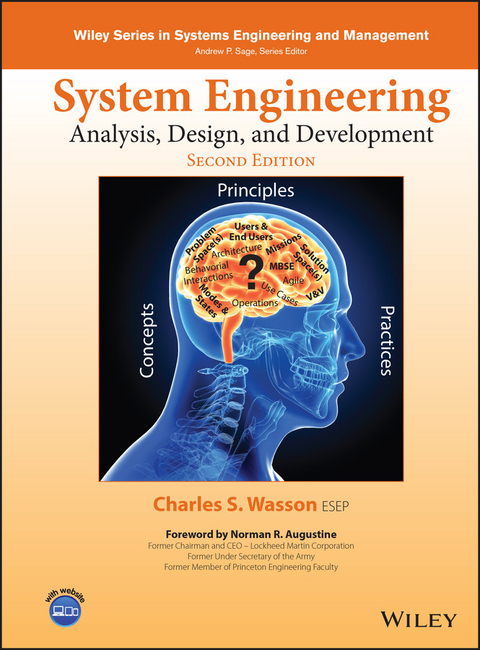
System Engineering Analysis, Design, and Development (eBook)
John Wiley & Sons (Verlag)
9781118967157 (ISBN)
Praise for the first edition:
'This excellent text will be useful to every system engineer (SE) regardless of the domain. It covers ALL relevant SE material and does so in a very clear, methodical fashion. The breadth and depth of the author's presentation of SE principles and practices is outstanding.'
-Philip Allen
This textbook presents a comprehensive, step-by-step guide to System Engineering analysis, design, and development via an integrated set of concepts, principles, practices, and methodologies. The methods presented in this text apply to any type of human system -- small, medium, and large organizational systems and system development projects delivering engineered systems or services across multiple business sectors such as medical, transportation, financial, educational, governmental, aerospace and defense, utilities, political, and charity, among others.
- Provides a common focal point for 'bridging the gap' between and unifying System Users, System Acquirers, multi-discipline System Engineering, and Project, Functional, and Executive Management education, knowledge, and decision-making for developing systems, products, or services
- Each chapter provides definitions of key terms, guiding principles, examples, author's notes, real-world examples, and exercises, which highlight and reinforce key SE&D concepts and practices
- Addresses concepts employed in Model-Based Systems Engineering (MBSE), Model-Driven Design (MDD), Unified Modeling Language (UMLTM) / Systems Modeling Language (SysMLTM), and Agile/Spiral/V-Model Development such as user needs, stories, and use cases analysis; specification development; system architecture development; User-Centric System Design (UCSD); interface definition & control; system integration & test; and Verification & Validation (V&V)
- Highlights/introduces a new 21st Century Systems Engineering & Development (SE&D) paradigm that is easy to understand and implement.
- Provides practices that are critical staging points for technical decision making such as Technical Strategy Development; Life Cycle requirements; Phases, Modes, & States; SE Process; Requirements Derivation; System Architecture Development, User-Centric System Design (UCSD); Engineering Standards, Coordinate Systems, and Conventions; et al.
Thoroughly illustrated, with end-of-chapter exercises and numerous case studies and examples, Systems Engineering Analysis, Design, and Development, Second Edition is a primary textbook for multi-discipline, engineering, system analysis, and project management undergraduate/graduate level students and a valuable reference for professionals.
CHARLES S. WASSON, BSEE, MBA, INCOSE FELLOW and ESEP, is a member of the INCOSE, ASEE, PMI, IEEE, and Tau Beta Pi and is President/Principal Consultant of Wasson Strategics, LLC. His professional career spans over 40 years of leadership in program/project management; system, hardware, and software design, development, integration, and test; and organizational and team development. Wasson Strategics (www. wassonstrategics.com) is a provider of multi-discipline SE, technical project management, and organizational and team development training and consulting services for clients ranging from small or medium to large Fortune 100 & 500 Enterprises striving to achieve System Engineering and Development excellence.
Praise for the first edition: "e;This excellent text will be useful to every system engineer (SE) regardless of the domain. It covers ALL relevant SE material and does so in a very clear, methodical fashion. The breadth and depth of the author's presentation of SE principles and practices is outstanding."e; Philip Allen This textbook presents a comprehensive, step-by-step guide to System Engineering analysis, design, and development via an integrated set of concepts, principles, practices, and methodologies. The methods presented in this text apply to any type of human system -- small, medium, and large organizational systems and system development projects delivering engineered systems or services across multiple business sectors such as medical, transportation, financial, educational, governmental, aerospace and defense, utilities, political, and charity, among others. Provides a common focal point for bridging the gap between and unifying System Users, System Acquirers, multi-discipline System Engineering, and Project, Functional, and Executive Management education, knowledge, and decision-making for developing systems, products, or services Each chapter provides definitions of key terms, guiding principles, examples, author s notes, real-world examples, and exercises, which highlight and reinforce key SE&D concepts and practices Addresses concepts employed in Model-Based Systems Engineering (MBSE), Model-Driven Design (MDD), Unified Modeling Language (UMLTM) / Systems Modeling Language (SysMLTM), and Agile/Spiral/V-Model Development such as user needs, stories, and use cases analysis; specification development; system architecture development; User-Centric System Design (UCSD); interface definition & control; system integration & test; and Verification & Validation (V&V) Highlights/introduces a new 21st Century Systems Engineering & Development (SE&D) paradigm that is easy to understand and implement. Provides practices that are critical staging points for technical decision making such as Technical Strategy Development; Life Cycle requirements; Phases, Modes, & States; SE Process; Requirements Derivation; System Architecture Development, User-Centric System Design (UCSD); Engineering Standards, Coordinate Systems, and Conventions; et al. Thoroughly illustrated, with end-of-chapter exercises and numerous case studies and examples, Systems Engineering Analysis, Design, and Development, Second Edition is a primary textbook for multi-discipline, engineering, system analysis, and project management undergraduate/graduate level students and a valuable reference for professionals.
CHARLES S. WASSON, BSEE, MBA, INCOSE FELLOW and ESEP, is a member of the INCOSE, ASEE, PMI, IEEE, and Tau Beta Pi and is President/Principal Consultant of Wasson Strategics, LLC. His professional career spans over 40 years of leadership in program/project management; system, hardware, and software design, development, integration, and test; and organizational and team development. Wasson Strategics (www. wassonstrategics.com) is a provider of multi-discipline SE, technical project management, and organizational and team development training and consulting services for clients ranging from small or medium to large Fortune 100 & 500 Enterprises striving to achieve System Engineering and Development excellence.
Preface To The Second Edition
Welcome to the Second Edition of System Engineering, Analysis, Design, and Development written for anyone who is accountable for specifying, analyzing, designing, and developing systems, products, or services. This Second Edition is a landmark text intended to take System Engineering (SE) to new levels of 21st-Century System Thinking. Systems Thinking that goes beyond what some refer to as “outdated, old school, and parochial” paradigms such as “Engineering the (Hardware/Software) Box” promulgated by institutions and Enterprises.
Traditional “Engineering the Box” mindsets fail to approach SE&D from the standpoint of “Engineering the System” based on User capabilities and limitations. Contrary to public perceptions, system failures are often attributable to poor System Design – “Engineering the Box” – that influences “human error” publicized as the “root cause.” The reality is system failures are typically the result of a series of latent defects in the System “Box” Design that lie dormant until the right set of enabling circumstances occur and proliferate via a chain of events culminating in an incident or accident. This text goes beyond traditional “Engineering the Box” and fosters Systems Thinking to broaden insights about how to “Engineer the System” and the “Box.”
The Systems Engineering concepts, principles, practices, and problem-solving and solution-development methods presented in this text apply to any discipline irrespective of type of discipline. This includes:
- 1. System Engineers (SE);
- 2. Multi-discipline Engineers—Electrical, Mechanical, Software, BioMedical, Nuclear, Industrial, Chemical, Civil, and others.
- 3. Specialty Engineers—Manufacturing, Test, Human Factors (HF); Reliability, Maintainability, and Availability (RMA); Safety; Logistics; Environmental, and others.
- 4. System and Business Analysts.
- 5. Quality Assurance (QA) and Software QAs.
- 6. Project Engineers.
- 7. Project Managers (PMs).
- 8. Functional Managers and Executives.
System Engineering Analysis, Design, and Development is intended to fill the SE void in Engineering education and to provide the concepts, principles, and practices required to perform SE. Based on the bestselling, international award-winning First Edition, this Second Edition builds on those foundational concepts, principles, and practices. This text has three key objectives:
- 1. To help educate Engineers who have a vision of becoming an SE or a better SE through course instruction or self-study.
- 2. To equip discipline Engineers and System Analysts—EEs, MEs, SwEs, etc.—with SE problem-solving and solution development methods that help them better understand the context of their work within the overall framework of the system, product, or service they are Engineering.
- 3. To provide Project Managers (PMs) with an understanding of SE & Development (SE&D) to facilitate better project integration with Engineering.
During the past 70 years, Systems Engineering has evolved from roots in fields such Aerospace and Defense (A&D) and proliferated into new business domains such as energy; medical products and healthcare; transportation—land, sea, air, and space; telecommunications; financial, educational, and many others. Worldwide awareness and recognition of Systems Engineering, its application, and benefits have placed it at the forefront of one of the most sought-after fields of study and employment. In 2009, Money Magazine identified Systems Engineering as #1 in its list of Best Jobs in America with a 10-year job growth forecast of 45%. Besides being #1, the criticality of this profession is in stark contrast to the second place job, which had a 10-year job growth projection of 27%.
Despite its rapidly expanding growth potential, Systems Engineering is still evolving in terms of its methodology, discipline, and application by Users. Its application in many Enterprises is often ad hoc, experiential, and characterized by semantics and methods that often exist in lofty marketing brochures and websites. Yet, produce limited objective evidence that SE has been performed. Based on the author's experience:
- Most Engineers, in general, spend from 50% to 75% of their total career hours on average making systems decisions for which they have little or no formal Systems Engineering coursework.
- Less than 3% of the personnel—one person out of 30—in most Enterprise SE organizations possess the requisite knowledge of the concepts, principles, and practices identified in this text.
- What most people and Enterprises perceive to be System Engineering (SE) is actually an ad hoc, trial-and-error, endless loop, Specify-Design-Build-Test-Fix (SDBTF) Paradigm. Compounding the problem is the fact that embedded within the SDBTF Paradigm is another trial-and-error endless loop Design Process Model (DPM) documented in the 1960s. Users of the SDBTF-DPM paradigm acknowledge it is inconsistent, inefficient, ineffective, and chaotic in developing systems, products, or services. Yet, they continue to employ it despite the fact that it is not scalable to moderate or large, complex systems projects.
- The underlying rationale to the SDBTF-DPM Paradigm is that since they have used it to to develop “systems,” it must be—by definition—Systems Engineering. Based on those misperceptions, the SDBTF-DPM Paradigm becomes the “core engine” within an SE “wrapper.” When the SDBTF-DPM Paradigm is applied to System Development and the deliverable system fails or the customer does not like the system, they rationalize the root cause to be … Systems Engineering.
- Within these Enterprises anyone who has electrically, electronically, or mechanically integrated two hardware components or compiled two software modules is “knighted” as a Systems Engineer by their manager whether they have exhibited SE skills and competence in the discipline or not … everyone is “Systems Engineer.”
Frightening isn't it! Unfortunately, executives and managers are often unaware or refuse to acknowledge the existence of the SDBTF-DPM Paradigm as the defacto “SE Process” within their Enterprise.
These Enterprises are easily identifiable. Ignoring or oblivious to the problem, executives and managers will challenge the SDBTF-DPM Engineering Paradigm observation. They recite metrics that quantify how they have trained XX personnel in an SE short course, YY personnel obtained a Master's degree in SE or higher, and ZZ personnel have been certified as Systems Engineering professionals within the past year. This is mindful of an old cliché that “owning a paint brush does not make someone an artist.”
Despite their proclamations, project performance issues traceable to a lack of true SE education or SE courses in Engineering education refute any evidence to the contrary. There are, however, Enterprises and professionals who do understand SE and perform it reasonably well. What are the differences between Enterprises that perform SE well versus those where the SDBTF-DPM Engineering Paradigm thrives?
First, SE knowledge is often learned experientially through personal self-study and “On-the-Job Training” (OJT). Despite its significance as a critical workplace Engineering skill, the fundamentals of SE are not taught as a course in most undergraduate Engineering programs. Undergraduate or graduate level courses that are labeled as SE: (1) often focus on Systems Acquisition and Management or (2) specialty engineering equation-based courses. These courses are fine … when staged and sequenced … after … a strong, requisite foundation in understanding what a system is coupled with the ability to perform the problem-solving and solution development to actually develop a system.
Secondly, Engineering has always wrapped itself in a cloak of equations; that's the perception of Engineering by many. 21st Century System Engineering and Development (SE&D) in industry and government demands a combination of problem-solving and solution-development decision-making soft skills that precede, enable, and facilitate the equation-based hard skills. Engineers erroneously “knighted” as SEs who spend their days plugging and chugging equations either have a highly specialized instance of SE, misplaced priorities, or simply do not understand what is required to develop a system on-schedule, within budget, and compliant with its technical requirements!
Missing is the requisite knowledge Engineers and System Analysts need to serve as a foundation for transforming a User's abstract operational needs into the physical realization of a system, product, or service. Most SEs will emphatically state that is what they do. However, their misinformed perception of SE and actions reveal that they typically take a quantum leap from requirements directly to a physical solution and implementation...
| Erscheint lt. Verlag | 16.11.2015 |
|---|---|
| Reihe/Serie | Wiley Series in Systems Engineering and Management |
| Wiley Series in Systems Engineering and Management | Wiley Series in Systems Engineering and Management |
| Sprache | englisch |
| Themenwelt | Mathematik / Informatik ► Informatik ► Theorie / Studium |
| Technik ► Elektrotechnik / Energietechnik | |
| Schlagworte | Betriebswirtschaft u. Operationsforschung • Business & Management • Electrical & Electronics Engineering • Elektrotechnik u. Elektronik • Management Science/Operational Research • Systemanalyse • System engineering, organizations, operations, system entity, system architecture, system verification and validation (V&V), workflow strategies, system analysis, system development, system design • Systems Engineering & Management • Systemtechnik • Systemtechnik u. -management • Wirtschaft u. Management |
| ISBN-13 | 9781118967157 / 9781118967157 |
| Informationen gemäß Produktsicherheitsverordnung (GPSR) | |
| Haben Sie eine Frage zum Produkt? |
 EPUB (Adobe DRM)
Kopierschutz: Adobe-DRM
Adobe-DRM ist ein Kopierschutz, der das eBook vor Mißbrauch schützen soll. Dabei wird das eBook bereits beim Download auf Ihre persönliche Adobe-ID autorisiert. Lesen können Sie das eBook dann nur auf den Geräten, welche ebenfalls auf Ihre Adobe-ID registriert sind.
Details zum Adobe-DRM
Dateiformat: EPUB (Electronic Publication)
EPUB ist ein offener Standard für eBooks und eignet sich besonders zur Darstellung von Belletristik und Sachbüchern. Der Fließtext wird dynamisch an die Display- und Schriftgröße angepasst. Auch für mobile Lesegeräte ist EPUB daher gut geeignet.
Systemvoraussetzungen:
PC/Mac: Mit einem PC oder Mac können Sie dieses eBook lesen. Sie benötigen eine
eReader: Dieses eBook kann mit (fast) allen eBook-Readern gelesen werden. Mit dem amazon-Kindle ist es aber nicht kompatibel.
Smartphone/Tablet: Egal ob Apple oder Android, dieses eBook können Sie lesen. Sie benötigen eine
Geräteliste und zusätzliche Hinweise
Buying eBooks from abroad
For tax law reasons we can sell eBooks just within Germany and Switzerland. Regrettably we cannot fulfill eBook-orders from other countries.
aus dem Bereich