Zum Hauptinhalt springen
Nicht aus der Schweiz? Besuchen Sie lehmanns.de
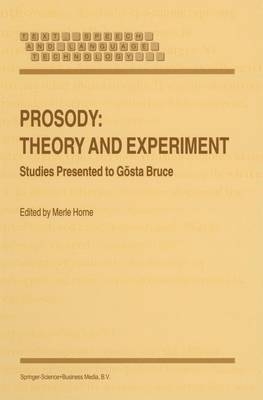
Prosody: Theory and Experiment -

Prosody: Theory and Experiment (eBook)

Studies Presented to Gosta Bruce

M. Horne (Herausgeber)

eBook Download: PDF
2013
Springer Netherlands (Verlag)
9789401594134 (ISBN)
Systemvoraussetzungen
157,00 inkl. MwSt
(CHF 153,35)
Der eBook-Verkauf erfolgt durch die Lehmanns Media GmbH (Berlin) zum Preis in Euro inkl. MwSt.
  • Download sofort lieferbar
  • Zahlungsarten anzeigen
The study of prosody is perhaps the area of speech research which has undergone the most noticeable development during the past ten to fifteen years. As an indication of this, one can note, for example, that at the latest International Conference on Spoken Language Processing in Philadelphia (October 1996), there were more sessions devoted to prosody than to any other area. Not only that, but within other sessions, in particular those dealing with dialogue, several of the presentations dealt specifically with prosodic aspects of dialogue research. Even at the latest Eurospeech meeting in Rhodes (September 1997), prosody, together with speech recognition (where several contributions dealt with how prosodic cues can be exploited to improve recognition processes) were the most frequent session topics, despite the fact that th'ere was a separate ESCA satellite workshop on intonation in conjunction with the main Eurospeech meeting which included over 80 contributions. This focus on prosodic research is partly due to the fact that developments in speech technology have made it possible to examine the acoustic parameters associated with prosodic phenomena (in particular fundamental frequency and duration) to an extent which has not been possible in other domains of speech research. It is also due to the fact that significant theoretical advances in linguistics and phonetics have been made during this time which have made it possible to obtain a better understanding of how prosodic parameters function in expressing different kinds of meaning in the languages of the world.
PDFPDF (Adobe DRM)

Kopierschutz: Adobe-DRM
Adobe-DRM ist ein Kopierschutz, der das eBook vor Mißbrauch schützen soll. Dabei wird das eBook bereits beim Download auf Ihre persönliche Adobe-ID autorisiert. Lesen können Sie das eBook dann nur auf den Geräten, welche ebenfalls auf Ihre Adobe-ID registriert sind.
Details zum Adobe-DRM

Dateiformat: PDF (Portable Document Format)
Mit einem festen Seiten­layout eignet sich die PDF besonders für Fach­bücher mit Spalten, Tabellen und Abbild­ungen. Eine PDF kann auf fast allen Geräten ange­zeigt werden, ist aber für kleine Displays (Smart­phone, eReader) nur einge­schränkt geeignet.

Systemvoraussetzungen:
PC/Mac: Mit einem PC oder Mac können Sie dieses eBook lesen. Sie benötigen eine Adobe-ID und die Software Adobe Digital Editions (kostenlos). Von der Benutzung der OverDrive Media Console raten wir Ihnen ab. Erfahrungsgemäß treten hier gehäuft Probleme mit dem Adobe DRM auf.
eReader: Dieses eBook kann mit (fast) allen eBook-Readern gelesen werden. Mit dem amazon-Kindle ist es aber nicht kompatibel.
Smartphone/Tablet: Egal ob Apple oder Android, dieses eBook können Sie lesen. Sie benötigen eine Adobe-ID sowie eine kostenlose App.
Geräteliste und zusätzliche Hinweise

Buying eBooks from abroad
For tax law reasons we can sell eBooks just within Germany and Switzerland. Regrettably we cannot fulfill eBook-orders from other countries.

Mehr entdecken
aus dem Bereich
Begriffe - Verfahren - Arbeitstechniken

von Ralf Klausnitzer

eBook Download (2024)
De Gruyter (Verlag)
CHF 24,35
Einführung in die vergleichende Literaturwissenschaft

von Peter V. Zima

eBook Download (2025)
UTB GmbH (Verlag)
CHF 28,30