Zum Hauptinhalt springen
Nicht aus der Schweiz? Besuchen Sie lehmanns.de
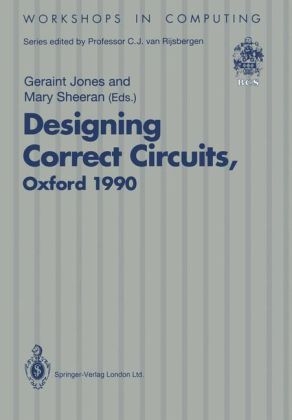
Designing Correct Circuits -

Designing Correct Circuits (eBook)

Workshop jointly organised by the Universities of Oxford and Glasgow, 26-28 September 1990, Oxford
eBook Download: PDF
2013
Springer London (Verlag)
9781447135449 (ISBN)
Systemvoraussetzungen
55,06 inkl. MwSt
(CHF 53,75)
Der eBook-Verkauf erfolgt durch die Lehmanns Media GmbH (Berlin) zum Preis in Euro inkl. MwSt.
  • Download sofort lieferbar
  • Zahlungsarten anzeigen
These proceedings contain the papers presented at a workshop on Designing Correct Circuits, jointly organised by the Universities of Oxford and Glasgow, and held in Oxford on 26-28 September 1990. There is a growing interest in the application to hardware design of the techniques of software engineering. As the complexity of hardware systems grows, and as the cost both in money and time of making design errors becomes more apparent, so there is an eagerness to build on the success of mathematical techniques in program develop- ment. The harsher constraints on hardware designers mean both that there is a greater need for good abstractions and rigorous assurances of the trustworthyness of designs, and also that there is greater reason to expect that these benefits can be realised. The papers presented at this workshop consider the application of mathematics to hardware design at several different levels of abstraction. At the lowest level of this spectrum, Zhou and Hoare show how to describe and reason about synchronous switching circuits using UNilY, a formalism that was developed for reasoning about parallel programs. Aagaard and Leeser use standard mathematical tech- niques to prove correct their implementation of an algorithm for Boolean simplification. The circuits generated by their formal synthesis system are thus correct by construction. Thuau and Pilaud show how the declarative language LUSTRE, which was designed for program- ming real-time systems, can be used to specify synchronous circuits.
PDFPDF (Adobe DRM)

Kopierschutz: Adobe-DRM
Adobe-DRM ist ein Kopierschutz, der das eBook vor Mißbrauch schützen soll. Dabei wird das eBook bereits beim Download auf Ihre persönliche Adobe-ID autorisiert. Lesen können Sie das eBook dann nur auf den Geräten, welche ebenfalls auf Ihre Adobe-ID registriert sind.
Details zum Adobe-DRM

Dateiformat: PDF (Portable Document Format)
Mit einem festen Seiten­layout eignet sich die PDF besonders für Fach­bücher mit Spalten, Tabellen und Abbild­ungen. Eine PDF kann auf fast allen Geräten ange­zeigt werden, ist aber für kleine Displays (Smart­phone, eReader) nur einge­schränkt geeignet.

Systemvoraussetzungen:
PC/Mac: Mit einem PC oder Mac können Sie dieses eBook lesen. Sie benötigen eine Adobe-ID und die Software Adobe Digital Editions (kostenlos). Von der Benutzung der OverDrive Media Console raten wir Ihnen ab. Erfahrungsgemäß treten hier gehäuft Probleme mit dem Adobe DRM auf.
eReader: Dieses eBook kann mit (fast) allen eBook-Readern gelesen werden. Mit dem amazon-Kindle ist es aber nicht kompatibel.
Smartphone/Tablet: Egal ob Apple oder Android, dieses eBook können Sie lesen. Sie benötigen eine Adobe-ID sowie eine kostenlose App.
Geräteliste und zusätzliche Hinweise

Buying eBooks from abroad
For tax law reasons we can sell eBooks just within Germany and Switzerland. Regrettably we cannot fulfill eBook-orders from other countries.

Mehr entdecken
aus dem Bereich
Die Grundlage der Digitalisierung

von Knut Hildebrand; Michael Mielke; Marcus Gebauer

eBook Download (2025)
Springer Fachmedien Wiesbaden (Verlag)
CHF 29,30
Die materielle Wahrheit hinter den neuen Datenimperien

von Kate Crawford

eBook Download (2024)
C.H.Beck (Verlag)
CHF 17,55