Zum Hauptinhalt springen
Nicht aus der Schweiz? Besuchen Sie lehmanns.de
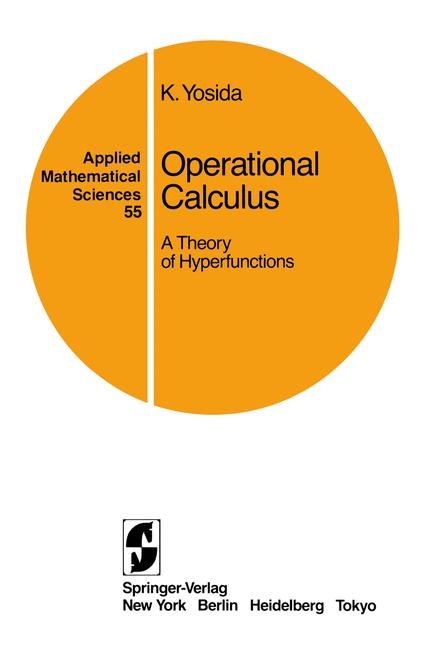
Operational Calculus -  Kosaku Yosida

Operational Calculus (eBook)

A Theory of Hyperfunctions
eBook Download: PDF
2012
Springer New York (Verlag)
978-1-4612-1118-1 (ISBN)
Systemvoraussetzungen
54,73 inkl. MwSt
(CHF 53,45)
Der eBook-Verkauf erfolgt durch die Lehmanns Media GmbH (Berlin) zum Preis in Euro inkl. MwSt.
  • Download sofort lieferbar
  • Zahlungsarten anzeigen
In the end of the last century, Oliver Heaviside inaugurated an operational calculus in connection with his researches in electromagnetic theory. In his operational calculus, the operator of differentiation was denoted by the symbol "e;p"e;. The explanation of this operator p as given by him was difficult to understand and to use, and the range of the valid- ity of his calculus remains unclear still now, although it was widely noticed that his calculus gives correct results in general. In the 1930s, Gustav Doetsch and many other mathematicians began to strive for the mathematical foundation of Heaviside's operational calculus by virtue of the Laplace transform -pt e f(t)dt. ( However, the use of such integrals naturally confronts restrictions con- cerning the growth behavior of the numerical function f(t) as t ~ ~. At about the midcentury, Jan Mikusinski invented the theory of con- volution quotients, based upon the Titchmarsh convolution theorem: If f(t) and get) are continuous functions defined on [O,~) such that the convolution f~ f(t-u)g(u)du =0, then either f(t) =0 or get) =0 must hold. The convolution quotients include the operator of differentiation "e;s"e; and related operators. Mikusinski's operational calculus gives a satisfactory basis of Heaviside's operational calculus; it can be applied successfully to linear ordinary differential equations with constant coefficients as well as to the telegraph equation which includes both the wave and heat equa- tions with constant coefficients.
Erscheint lt. Verlag 6.12.2012
Sprache englisch
Themenwelt Mathematik / Informatik Mathematik Analysis
ISBN-10 1-4612-1118-2 / 1461211182
ISBN-13 978-1-4612-1118-1 / 9781461211181
Informationen gemäß Produktsicherheitsverordnung (GPSR)
Haben Sie eine Frage zum Produkt?
PDFPDF (Adobe DRM)

Kopierschutz: Adobe-DRM
Adobe-DRM ist ein Kopierschutz, der das eBook vor Mißbrauch schützen soll. Dabei wird das eBook bereits beim Download auf Ihre persönliche Adobe-ID autorisiert. Lesen können Sie das eBook dann nur auf den Geräten, welche ebenfalls auf Ihre Adobe-ID registriert sind.
Details zum Adobe-DRM

Dateiformat: PDF (Portable Document Format)
Mit einem festen Seiten­layout eignet sich die PDF besonders für Fach­bücher mit Spalten, Tabellen und Abbild­ungen. Eine PDF kann auf fast allen Geräten ange­zeigt werden, ist aber für kleine Displays (Smart­phone, eReader) nur einge­schränkt geeignet.

Systemvoraussetzungen:
PC/Mac: Mit einem PC oder Mac können Sie dieses eBook lesen. Sie benötigen eine Adobe-ID und die Software Adobe Digital Editions (kostenlos). Von der Benutzung der OverDrive Media Console raten wir Ihnen ab. Erfahrungsgemäß treten hier gehäuft Probleme mit dem Adobe DRM auf.
eReader: Dieses eBook kann mit (fast) allen eBook-Readern gelesen werden. Mit dem amazon-Kindle ist es aber nicht kompatibel.
Smartphone/Tablet: Egal ob Apple oder Android, dieses eBook können Sie lesen. Sie benötigen eine Adobe-ID sowie eine kostenlose App.
Geräteliste und zusätzliche Hinweise

Buying eBooks from abroad
For tax law reasons we can sell eBooks just within Germany and Switzerland. Regrettably we cannot fulfill eBook-orders from other countries.

Mehr entdecken
aus dem Bereich