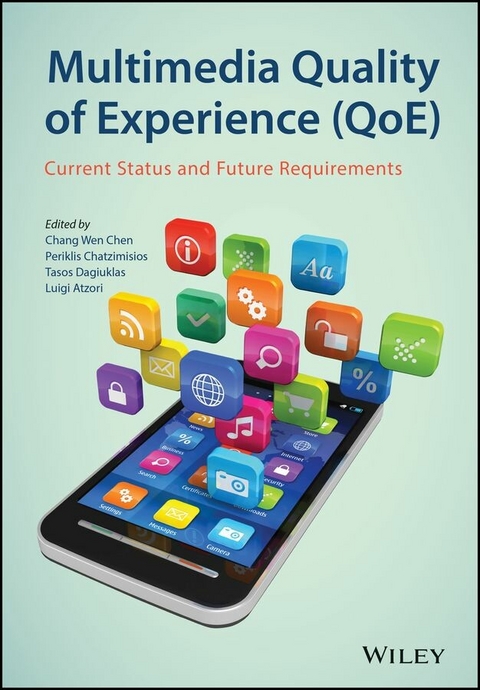
Multimedia Quality of Experience (QoE) (eBook)
John Wiley & Sons (Verlag)
978-1-118-73612-8 (ISBN)
This book discusses the current status of QoE research; reporting latest advances from various standardisation bodies (ITU, ETSI, IEEE, IETF)
Multimedia Quality of Experience (QoE): Current Status and Future Requirements discusses the current status of QoE (Quality of Experience) research, providing guidelines on QoE assessment and management practice. Moreover, the book covers many different aspects of QoE research, including definition, standardization (ITU, ETSI, IEEE, IETF, etc.), measurement, management, and architectures. In addition, the authors bring together contributions from recognized experts (worldwide) in the area of subjective and objective QoE video assessment. Topics/chapters include: (1) QoE Definition and its relation/mapping to QoS; QoE Standardization activities; QoE Metrics for various media applications; QoE Subjective and Objective Evaluation Methodologies; QoE Control, Monitoring and Management strategies; End-to-End QoE Architectures in heterogeneous environments.
- Discusses the current status of QoE research; reporting latest advances from various standardisation bodies (e.g. ITU, ETSI, IEEE, IETF)
- Provides guidelines on QoE assessment and management practice
- Explores methods, means and architectures of QoE
- Addresses multiple technologies and requires input from multiple disciplines such as engineering, sociology and psychology
- Brings together contributions from recognized experts (worldwide) in the area of subjective and objective QoE video assessment
- Considers future requirements of QoE
Chang Wen Chen, State University of New York at Buffalo, USA
Periklis Chatzimisios, Alexander Technological Educational Institute, Thessaloniki, Greece
Tasos Dagiuklas, Hellenic Open University, Greece
Luigi Atzori, University of Cagliari, Italy
Multimedia Quality of Experience (QoE) Current Status and Future Requirements Multimedia Quality of Experience (QoE): Current Status and Future Requirements discusses the current status of QoE (Quality of Experience) research, providing guidelines on QoE assessment and management practice. Moreover, it covers many different aspects of QoE research, including definitions, standardization (ITU, ETSI, IEEE, IETF), measurement, management, and architectures. In addition, the authors bring together contributions from recognized experts (worldwide) in the area of subjective and objective QoE video assessment. Discusses the current status of QoE research; reporting the latest advances from various standardization bodies Provides guidelines on QoE assessment and management practice Explores methods, means, and architectures of QoE Considers future requirements of QoE
Edited By Chang Wen Chen, State University of New York at Buffalo, USA Periklis Chatzimisios, Alexander Technological Educational Institute, Thessaloniki, Greece Tasos Dagiuklas, Hellenic Open University, Greece Luigi Atzori, University of Cagliari, Italy
About the Editors ix
List of Contributors xi
Preface xiii
1 Introduction 1
Tasos Dagiuklas, Luigi Atzori, Chang Wen Chen and Periklis Chatzimisios
2 QoE.Defining a User-Centric Concept for Service Quality 5
Mart´yn Varela, Lea Skorin-Kapov, Katrien De Moor and Peter Reichl
2.1 Introduction 5
2.2 Definitions of QoE 6
2.3 Differences Between QoE and QoS 7
2.4 Factors Influencing QoE 9
2.5 Service QoE 12
2.6 Human Factors and QoE 15
2.7 The Role of QoE in Communication Ecosystems 19
2.8 Conclusions 24
Acknowledgments 24
References 25
Acronyms 28
3 Review of Existing Objective QoE Methodologies 29
Yuming Fang, Weisi Lin and Stefan Winkler
3.1 Overview 29
3.2 Quality Metric Taxonomy 30
3.3 Basic Computational Modules for Perceptual Quality Metrics 35
3.4 Quality Metrics for Images 43
3.5 Quality Metrics for Video 46
3.6 Quality Metrics for Audio/Speech 50
3.7 Joint Audiovisual Quality Metrics 52
3.8 Concluding Remarks 53
References 54
Acronyms 66
4 Quality of Experience for HTTP Adaptive Streaming Services 69
Ozgur Oyman, Vishwanath Ramamurthi, Utsaw Kumar, Mohamed Rehan and Rana Morsi
4.1 Introduction 69
4.2 HAS Concepts and Standardization Overview 71
4.3 QoE in 3GPP DASH 74
4.4 Link-Aware Adaptive Streaming 77
4.5 Video-Aware Radio Resource Allocation 81
4.6 DASH over e-MBMS 87
4.7 Server-Client Signaling Interface Enhancements for DASH 90
4.8 Conclusion 95
References 96
Acronyms 97
5 No-Reference Approaches to Image and Video Quality Assessment 99
Anish Mittal, Anush K. Moorthy and Alan C. Bovik
5.1 Introduction 99
5.2 No-Reference Quality Assessment 101
5.3 Image and Video Quality Databases 107
5.4 Performance Evaluation 109
5.5 Applications 111
5.6 Challenges and Future Directions 113
5.7 Conclusion 115
References 116
Acronyms 121
6 QoE Subjective and Objective Evaluation Methodologies 123
Hong Ren Wu
6.1 Human Visual Perception and QoE Assessment 125
6.2 Models and Approaches to QoE Assessment 130
6.3 Offline and Online Evaluation 141
6.4 Remarks 141
Acknowledgments 143
References 143
Acronyms 147
7 QoE Control, Monitoring, and Management Strategies 149
Maria G. Martini, Chaminda T.E.R. Hewage, Moustafa M. Nasrall and Ognen Ognenoski
7.1 Introduction 149
7.2 QoE Monitoring 150
7.3 QoE Management and Control 155
7.4 Conclusion 162
Acknowledgment 163
References 163
Further Reading 166
Acronyms 167
8 Conclusions 169
Tasos Dagiuklas, Luigi Atzori, Chang Wen Chen and Periklis Chatzimisios
Index 173
1
Introduction
Tasos Dagiuklas1, Luigi Atzori2, Chang Wen Chen3 and Periklis Chatzimisios4
1Hellenic Open University, Greece
2University of Cagliari, Italy
3State University of New York at Buffalo, USA
4Alexander Technological Educational Institute, Thessaloniki, Greece
During recent years, Quality of Experience (QoE) has established itself as a topic in its own right for both industrial and academic research. With its focus on the end-user in terms of acceptability, delight, and performance, it is about to take over the role of Quality of Service (QoS) as the key paradigm for provisioning and managing services and networks.
According to Wikipedia, “Quality in business, engineering and manufacturing has a pragmatic interpretation as the non-inferiority or superiority of something; it is also defined as fitness for purpose. Quality is a perceptual, conditional, and somewhat subjective attribute and may be understood differently by different people. Consumers may focus on the specification quality of a product/service, or how it compares to competitors in the marketplace.” Quality is a term that has been defined since ancient times. In philosophy, quality (from the Latin qualitas) is an attribute or property. The Ancient Greek philosopher Aristotle analyzed qualities in his logical work Categories, where all objects of human comprehension are classified into ten categories. Quality is one of these categories.
The term “quality” appears in various standardization fora. As an example, the International Organization for Standardization (ISO) has defined various standards related to quality, as indicated below:
- ISO 8402-1986 standard defines quality as “the totality of features and characteristics of a product or service that bears its ability to satisfy stated or implied needs.”
- ISO 9000 is a series of standards that define, establish, and maintain a quality assurance system for manufacturing and service industries. The ISO 9000 family addresses various aspects of quality management and contains some of the ISO's best-known standards. The standards provide guidance and tools for companies and organizations who want to ensure that their products and services consistently meet customers' requirements, and that quality is consistently improved. Standards in the ISO 9000 family include the following:
- ISO 9001:2008 – sets out the requirements of a quality management system.
- ISO 9000:2005 – covers the basic concepts and language.
- ISO 9004:2009 – focuses on how to make a quality management system more efficient and effective.
- ISO 19011:2011 – sets out guidance on internal and external audits of quality management systems.
In order to lead in today's communications services market, network operators and content/service providers must offer customers the best user experience for premium services. In the past, networks have been examined objectively by measuring a number of criteria to determine network quality using QoS. In effect, QoS refers to the ability of a network to achieve more deterministic behavior, so data can be transported by optimizing parameters such as packet loss, delay, jitter, and bandwidth consumption. One should note that QoS does not consider the end-user's perception.
The perceived quality of media services is a crucial subject for service and content providers, with growing market competition. QoE for next-generation multimedia applications will be a combination of measurable QoS parameters considering both network and service environment and non-quality parameters. Network-based parameters include bandwidth, delay, jitter, packet loss, and PER (Packet Error Rate); service-oriented parameters (especially in the case of video services) may be metrics such as PSNR (Peak Signal-to-Noise Ratio) or MSE (Mean Square Error). Other factors that are not quality based but are important to quantify QoE include: screen size (e.g., mobile phone vs. large TV set), screen illumination (e.g., mobile terminal on a cloudy day vs. high contrast in a cinema environment), viewing distance, content (e.g., movie with action vs. news from a broadcaster), application (e.g., social networking vs. medical vs. distance learning), price (Skype videoconferencing vs. regular cellular video call), user profile (e.g., teenager vs. professional).
QoE is a new research topic that is currently being addressed by the various standardization fora. In the networked media delivery industry, guarantee of user experience is a key factor for many media-aware applications and services. Therefore, contrary to QoS, the concept of QoE has highlighted concerns for the media delivery industry – referring to “the overall acceptability of an application or service, as perceived subjectively by the end user.” The media delivery industry views end-user QoE monitoring as either “critical” or “very important” to their media initiatives; meanwhile, the foremost issue reported by industry is that the current QoE assessment solutions are too costly and not accurate enough to measure end-user experience.
QoE is a subjective metric that involves human dimensions; it ties together user perceptions, expectations, and experiences of applications and network performance. It is now widely acknowledged that the adoption of new multimodal media necessitates mechanisms to assess and evaluate perceived multimedia quality. QoE is defined as a metric to assess end-user experience at the perceptual pseudo-layer located above application and network layers.
Considerable effort has been devoted to assessing QoE via objective or subjective means for new and emerging multimedia services over modern fixed/mobile devices (e.g., IPTV/HDTV/3DTV, tablet, 3D smartphone). Many researchers have looked at this as a usability problem, while others have studied the correlation between specific technological settings and user-perceived QoE. As of today, we do not know how to manage and control QoE in a diverse heterogeneous environment. The variables that affect QoE are just too wide and too many. Hence, managing and controlling user QoE is still an open issue. Currently, services and applications offer QoE as a by-product of QoS management. Most commonly, QoE is achieved by over-provisioning and over-committing network and computational resources. Therefore, QoE is still a best-effort service. As applications become multimodal, resources will have to be managed and controlled more accurately and proactively for successful QoE-assured service delivery.
The overall structure of the book is as follows:
Chapter 2 outlines the QoE defining a user-centric concept of service quality. It provides QoE in various standardization fora such as ITU, ETSI, and IETF. It provides factors influencing QoE such as human Influencing Factors (IFs), system IFs, and context IFs. QoE is defined for different services such as speech, video, HTTP streaming, and cloud-based services. Moreover, it outlines a set of factors at the human, system, and context level that – either independently or interlinked – may influence QoE. Finally, the role of QoE in communication ecosystems is defined so that the user experience is optimized.
Chapter 3 reviews existing objective QoE methodologies and provides a taxonomy of objective quality metrics that may be grouped using the characteristics of the human visual system and the availability of the original signal. The chapter also presents the basic computational modules for perceptual quality metrics; quality metrics for images, video, and audio/speech; and joint audiovisual quality metrics.
Chapter 4 describes QoE for HTTP adaptive streaming services and presents QoE-based optimization strategies for Internet video. As a relatively new technology in comparison with traditional push-based adaptive streaming techniques, the deployment of Http Adaptive Streaming (HAS) services presents new challenges and opportunities for content developers, service providers, network operators, and device manufacturers. One of these important challenges is developing evaluation methodologies and performance metrics to accurately assess user QoE for HAS services, as well as effectively utilizing these metrics for service provision and optimization of network adaptation.
Chapter 5 emphasizes visual quality assessment covering both opinion-aware and opinion-unaware models. Most of the approaches are based on understanding and modeling the underlying statistics of natural images and/or distortions using perceptual principles. These approaches measure deviations from statistical regularities and quantify such deviations, leading to estimates of quality. The chapter presents the motivation and principles underlying such statistical descriptions of quality, and describes such algorithms in detail. Exhaustive comparative analysis of these approaches is provided, together with a discussion of the potential applications of no-reference algorithms.
The discussions so far have highlighted an increasing emphasis on QoE compared with QoS in audiovisual communication, broadcasting, and entertainment applications, which signals a transition from technology-driven services to user-centric (or perceived) quality-assured services. Chapter 6 focuses on...
| Erscheint lt. Verlag | 11.11.2015 |
|---|---|
| Sprache | englisch |
| Themenwelt | Mathematik / Informatik ► Informatik ► Grafik / Design |
| Mathematik / Informatik ► Informatik ► Netzwerke | |
| Informatik ► Software Entwicklung ► User Interfaces (HCI) | |
| Technik ► Elektrotechnik / Energietechnik | |
| Schlagworte | Addition • area • Aspects • Communication Technology - Networks • Computer Science • Contributions • Current • Different • Drahtlose Kommunikation • Electrical & Electronics Engineering • Elektrotechnik u. Elektronik • Experience • Experts • Informatik • Kommunikationsnetz • Kommunikationsnetze • latest advances • many • Mobile & Wireless Communications • multimedia quality • Networking • Netzwerk • Netzwerke • QoE • qoe research • recognized • Requirements • Research • Status • subjective • Video • Worldwide |
| ISBN-10 | 1-118-73612-5 / 1118736125 |
| ISBN-13 | 978-1-118-73612-8 / 9781118736128 |
| Informationen gemäß Produktsicherheitsverordnung (GPSR) | |
| Haben Sie eine Frage zum Produkt? |
 EPUB (Adobe DRM)
Kopierschutz: Adobe-DRM
Adobe-DRM ist ein Kopierschutz, der das eBook vor Mißbrauch schützen soll. Dabei wird das eBook bereits beim Download auf Ihre persönliche Adobe-ID autorisiert. Lesen können Sie das eBook dann nur auf den Geräten, welche ebenfalls auf Ihre Adobe-ID registriert sind.
Details zum Adobe-DRM
Dateiformat: EPUB (Electronic Publication)
EPUB ist ein offener Standard für eBooks und eignet sich besonders zur Darstellung von Belletristik und Sachbüchern. Der Fließtext wird dynamisch an die Display- und Schriftgröße angepasst. Auch für mobile Lesegeräte ist EPUB daher gut geeignet.
Systemvoraussetzungen:
PC/Mac: Mit einem PC oder Mac können Sie dieses eBook lesen. Sie benötigen eine
eReader: Dieses eBook kann mit (fast) allen eBook-Readern gelesen werden. Mit dem amazon-Kindle ist es aber nicht kompatibel.
Smartphone/Tablet: Egal ob Apple oder Android, dieses eBook können Sie lesen. Sie benötigen eine
Geräteliste und zusätzliche Hinweise
Buying eBooks from abroad
For tax law reasons we can sell eBooks just within Germany and Switzerland. Regrettably we cannot fulfill eBook-orders from other countries.
aus dem Bereich