Zum Hauptinhalt springen
Nicht aus der Schweiz? Besuchen Sie lehmanns.de
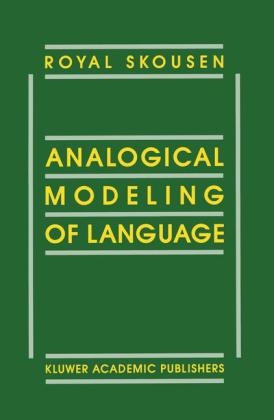
Analogical Modeling of Language -  R. Skousen

Analogical Modeling of Language (eBook)

(Autor)

eBook Download: PDF
2012
Springer Netherlands (Verlag)
9789400919068 (ISBN)
Systemvoraussetzungen
108,50 inkl. MwSt
(CHF 105,95)
Der eBook-Verkauf erfolgt durch die Lehmanns Media GmbH (Berlin) zum Preis in Euro inkl. MwSt.
  • Download sofort lieferbar
  • Zahlungsarten anzeigen
1. Structuralist Versus Analogical Descriptions ONE important purpose of this book is to compare two completely dif- ferent approaches to describing language. The first of these approaches, commonly called stnlctllralist, is the traditional method for describing behavior. Its methods are found in many diverse fields - from biological taxonomy to literary criticism. A structuralist description can be broadly characterized as a system of classification. The fundamental question that a structuralist description attempts to answer is how a general contextual space should be partitioned. For each context in the partition, a rule is defined. The rule either specifies the behavior of that context or (as in a taxonomy) assigns a name to that context. Structuralists have implicitly assumed that descriptions of behavior should not only be correct, but should also minimize the number of rules and permit only the simplest possible contextual specifications. It turns out that these intuitive notions can actually be derived from more fundamental statements about the uncertainty of rule systems. Traditionally, linguistic analyses have been based on the idea that a language is a system of rules. Saussure, of course, is well known as an early proponent of linguistic structuralism, as exemplified by his characterization of language as "e;a self-contained whole and principle of classification"e; (Saussure 1966:9). Yet linguistic structuralism did not originate with Saussure - nor did it end with "e;American structuralism"e;.
PDFPDF (Adobe DRM)

Kopierschutz: Adobe-DRM
Adobe-DRM ist ein Kopierschutz, der das eBook vor Mißbrauch schützen soll. Dabei wird das eBook bereits beim Download auf Ihre persönliche Adobe-ID autorisiert. Lesen können Sie das eBook dann nur auf den Geräten, welche ebenfalls auf Ihre Adobe-ID registriert sind.
Details zum Adobe-DRM

Dateiformat: PDF (Portable Document Format)
Mit einem festen Seiten­layout eignet sich die PDF besonders für Fach­bücher mit Spalten, Tabellen und Abbild­ungen. Eine PDF kann auf fast allen Geräten ange­zeigt werden, ist aber für kleine Displays (Smart­phone, eReader) nur einge­schränkt geeignet.

Systemvoraussetzungen:
PC/Mac: Mit einem PC oder Mac können Sie dieses eBook lesen. Sie benötigen eine Adobe-ID und die Software Adobe Digital Editions (kostenlos). Von der Benutzung der OverDrive Media Console raten wir Ihnen ab. Erfahrungsgemäß treten hier gehäuft Probleme mit dem Adobe DRM auf.
eReader: Dieses eBook kann mit (fast) allen eBook-Readern gelesen werden. Mit dem amazon-Kindle ist es aber nicht kompatibel.
Smartphone/Tablet: Egal ob Apple oder Android, dieses eBook können Sie lesen. Sie benötigen eine Adobe-ID sowie eine kostenlose App.
Geräteliste und zusätzliche Hinweise

Buying eBooks from abroad
For tax law reasons we can sell eBooks just within Germany and Switzerland. Regrettably we cannot fulfill eBook-orders from other countries.

Mehr entdecken
aus dem Bereich
Die Grundlage der Digitalisierung

von Knut Hildebrand; Michael Mielke; Marcus Gebauer

eBook Download (2025)
Springer Fachmedien Wiesbaden (Verlag)
CHF 29,30
Die materielle Wahrheit hinter den neuen Datenimperien

von Kate Crawford

eBook Download (2024)
C.H.Beck (Verlag)
CHF 17,55