Zum Hauptinhalt springen
Nicht aus der Schweiz? Besuchen Sie lehmanns.de
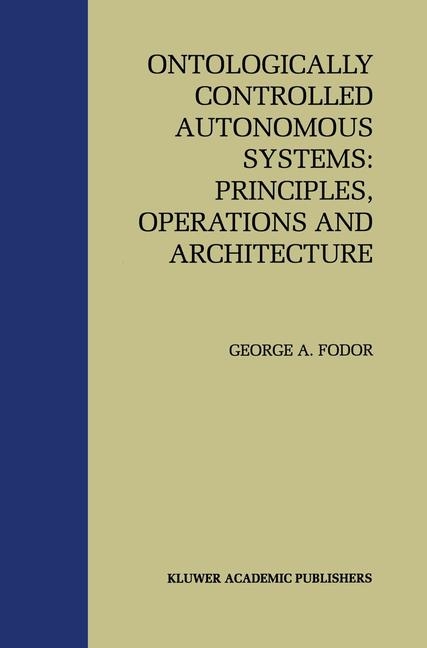
Ontologically Controlled Autonomous Systems: Principles, Operations, and Architecture -  George A. Fodor

Ontologically Controlled Autonomous Systems: Principles, Operations, and Architecture (eBook)

Principles, Operations, and Architecture
eBook Download: PDF
2013
Springer US (Verlag)
9781461554752 (ISBN)
Systemvoraussetzungen
219,70 inkl. MwSt
(CHF 214,65)
Der eBook-Verkauf erfolgt durch die Lehmanns Media GmbH (Berlin) zum Preis in Euro inkl. MwSt.
  • Download sofort lieferbar
  • Zahlungsarten anzeigen
Kevin M. Passino When confronted with a control problem for complicated physical process, a control engineer usually follows a predetermined design procedure. This procedure often begins with the engineer seeking to understand the process and the primary control objectives. A simple example ofa control problem is an automobile "e;cruise control"e; that provides the automobile with the capability of regulating its own speed at a driver-specified set-point (e. g. , 55 mph). One solution to the automotive cruise control problem involves adding an electronic controller that can sense the speed of the vehicle via the speedometer and actuate the throttle position so as to regulate the vehicle speed at the driver-specified value. Such speed regulation must be accurate even if there are road grade changes, head-winds, or variations in the number of passengers in the automobile. After gaining an intuitive understanding of the plant's dynamics and establishing the design objectives, the control engineer typically solves the cruise control problem by using an established design procedure. In particular, this control engineering design methodology involves: 1. Modeling/understanding the plant, 2. Construction of a controller to meet specifications (such as stability, rise-time, overshoot, and steady state error), 3. Analysis to make sure that the system will meet the performance objectives (e. g. , we might use mathematical, simulation-based, or experimental analysis), and 4. Iterating on the design until it is possible to "e;commission"e; the control system.
PDFPDF (Adobe DRM)

Kopierschutz: Adobe-DRM
Adobe-DRM ist ein Kopierschutz, der das eBook vor Mißbrauch schützen soll. Dabei wird das eBook bereits beim Download auf Ihre persönliche Adobe-ID autorisiert. Lesen können Sie das eBook dann nur auf den Geräten, welche ebenfalls auf Ihre Adobe-ID registriert sind.
Details zum Adobe-DRM

Dateiformat: PDF (Portable Document Format)
Mit einem festen Seiten­layout eignet sich die PDF besonders für Fach­bücher mit Spalten, Tabellen und Abbild­ungen. Eine PDF kann auf fast allen Geräten ange­zeigt werden, ist aber für kleine Displays (Smart­phone, eReader) nur einge­schränkt geeignet.

Systemvoraussetzungen:
PC/Mac: Mit einem PC oder Mac können Sie dieses eBook lesen. Sie benötigen eine Adobe-ID und die Software Adobe Digital Editions (kostenlos). Von der Benutzung der OverDrive Media Console raten wir Ihnen ab. Erfahrungsgemäß treten hier gehäuft Probleme mit dem Adobe DRM auf.
eReader: Dieses eBook kann mit (fast) allen eBook-Readern gelesen werden. Mit dem amazon-Kindle ist es aber nicht kompatibel.
Smartphone/Tablet: Egal ob Apple oder Android, dieses eBook können Sie lesen. Sie benötigen eine Adobe-ID sowie eine kostenlose App.
Geräteliste und zusätzliche Hinweise

Buying eBooks from abroad
For tax law reasons we can sell eBooks just within Germany and Switzerland. Regrettably we cannot fulfill eBook-orders from other countries.

Mehr entdecken
aus dem Bereich
Design scalable and high-performance Java applications with Spring

von Wanderson Xesquevixos

eBook Download (2025)
Packt Publishing (Verlag)
CHF 31,65