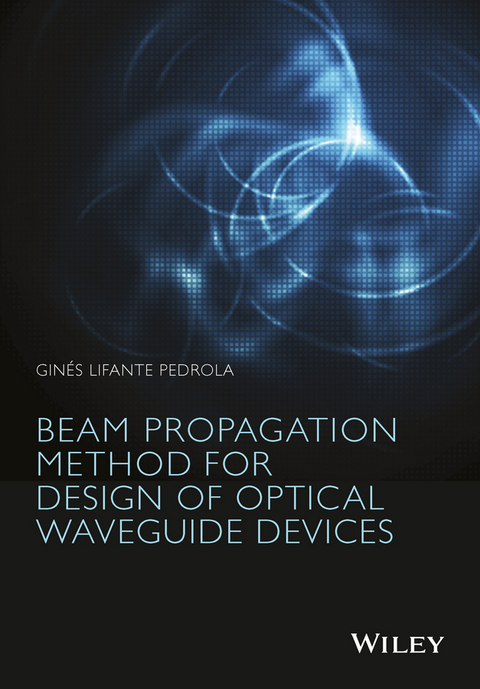
Beam Propagation Method for Design of Optical Waveguide Devices (eBook)
John Wiley & Sons (Verlag)
978-1-119-08338-2 (ISBN)
The basic of the BPM technique in the frequency domain relies on treating the slowly varying envelope of the monochromatic electromagnetic field under paraxial propagation, thus allowing efficient numerical computation in terms of speed and allocated memory. In addition, the BPM based on finite differences is an easy way to implement robust and efficient computer codes. This book presents several approaches for treating the light: wide-angle, scalar approach, semivectorial treatment, and full vectorial treatment of the electromagnetic fields. Also, special topics in BPM cover the simulation of light propagation in anisotropic media, non-linear materials, electro-optic materials, and media with gain/losses, and describe how BPM can deal with strong index discontinuities or waveguide gratings, by introducing the bidirectional-BPM. BPM in the time domain is also described, and the book includes the powerful technique of finite difference time domain method, which fills the gap when the standard BPM is no longer applicable. Once the description of these numerical techniques have been detailed, the last chapter includes examples of passive, active and functional integrated photonic devices, such as waveguide reflectors, demultiplexers, polarization converters, electro-optic modulators, lasers or frequency converters. The book will help readers to understand several BPM approaches, to build their own codes, or to properly use the existing commercial software based on these numerical techniques.
Ginés Lifante Pedrola, Professor, Dept. of Materials Science, Universidad Autónoma de Madrid, Spain. Lifante has been working in the area of integrated photonic devices; optical properties of active materials for over 30 years, and has taught Optics (undergraduate level) and Integrated Photonics (graduate level). He has published 177 Articles and is the author of Integrated Photonics: Fundamentals (Wiley, 2003).
The basic of the BPM technique in the frequency domain relies on treating the slowly varying envelope of the monochromatic electromagnetic field under paraxial propagation, thus allowing efficient numerical computation in terms of speed and allocated memory. In addition, the BPM based on finite differences is an easy way to implement robust and efficient computer codes. This book presents several approaches for treating the light: wide-angle, scalar approach, semivectorial treatment, and full vectorial treatment of the electromagnetic fields. Also, special topics in BPM cover the simulation of light propagation in anisotropic media, non-linear materials, electro-optic materials, and media with gain/losses, and describe how BPM can deal with strong index discontinuities or waveguide gratings, by introducing the bidirectional-BPM. BPM in the time domain is also described, and the book includes the powerful technique of finite difference time domain method, which fills the gap when the standard BPM is no longer applicable. Once the description of these numerical techniques have been detailed, the last chapter includes examples of passive, active and functional integrated photonic devices, such as waveguide reflectors, demultiplexers, polarization converters, electro-optic modulators, lasers or frequency converters. The book will help readers to understand several BPM approaches, to build their own codes, or to properly use the existing commercial software based on these numerical techniques.
Ginés Lifante Pedrola, Professor, Dept. of Materials Science, Universidad Autónoma de Madrid, Spain. Lifante has been working in the area of integrated photonic devices; optical properties of active materials for over 30 years, and has taught Optics (undergraduate level) and Integrated Photonics (graduate level). He has published 177 Articles and is the author of Integrated Photonics: Fundamentals (Wiley, 2003).
Preface
List of Symbols
List of Acronyms
1 Electromagnetic theory of light
2 The beam propagation method
3 Vectorial and three dimensional beam propagation techniques
4 Special topics on BPM
5 BPM analysis of integrated photonic devices.
Appendix I Finite difference approximations of derivatives
Appendix II Tridiagonal system: the Thomas method algorithm
Appendix III Correlation and relative power between optical fields
Appendix IV Poynting vector associated to an electromagnetic wave using the SVE fields
Appendix V Finite difference FV-BPM based on the electric field using the scheme parameter control
Appendix VI Linear electro-optic effect
Appendix VII Electro-optic effect in GaAs crystal
Appendix VIII Electro-optic effect in LiNbO3 crystal
Appendix IX Padé polynomials for wide-band TD-BPM
Appendix X Obtaining the dispersion relation for a monomode waveguide using FDTD
Appendix XI Electric field distribution in coplanar electrodes
Appendix XII Three dimensional anisotropic BPM based on the electric field formulation
Appendix XIII Rate equations in a four-level atomic system
Appendix XIV Overlap integrals method
Index
| Erscheint lt. Verlag | 13.10.2015 |
|---|---|
| Sprache | englisch |
| Themenwelt | Mathematik / Informatik ► Mathematik |
| Naturwissenschaften ► Physik / Astronomie ► Mechanik | |
| Technik ► Elektrotechnik / Energietechnik | |
| Schlagworte | absorbing • Acronyms • Electrical & Electronics Engineering • Electromagnetic • Elektrotechnik u. Elektronik • helmholtzs • homogeneous • Index • Inhomogeneous • Introduction • light • List • Numerical Methods & Algorithms • Numerische Methoden u. Algorithmen • Optical Communications • Optische Nachrichtentechnik • Photonics & Lasers • Photonik u. Laser • propagation • refractive • symbols xvi • theory • Wave Equations • XII |
| ISBN-10 | 1-119-08338-9 / 1119083389 |
| ISBN-13 | 978-1-119-08338-2 / 9781119083382 |
| Informationen gemäß Produktsicherheitsverordnung (GPSR) | |
| Haben Sie eine Frage zum Produkt? |
 PDF (Adobe DRM)
Kopierschutz: Adobe-DRM
Adobe-DRM ist ein Kopierschutz, der das eBook vor Mißbrauch schützen soll. Dabei wird das eBook bereits beim Download auf Ihre persönliche Adobe-ID autorisiert. Lesen können Sie das eBook dann nur auf den Geräten, welche ebenfalls auf Ihre Adobe-ID registriert sind.
Details zum Adobe-DRM
Dateiformat: PDF (Portable Document Format)
Mit einem festen Seitenlayout eignet sich die PDF besonders für Fachbücher mit Spalten, Tabellen und Abbildungen. Eine PDF kann auf fast allen Geräten angezeigt werden, ist aber für kleine Displays (Smartphone, eReader) nur eingeschränkt geeignet.
Systemvoraussetzungen:
PC/Mac: Mit einem PC oder Mac können Sie dieses eBook lesen. Sie benötigen eine
eReader: Dieses eBook kann mit (fast) allen eBook-Readern gelesen werden. Mit dem amazon-Kindle ist es aber nicht kompatibel.
Smartphone/Tablet: Egal ob Apple oder Android, dieses eBook können Sie lesen. Sie benötigen eine
Geräteliste und zusätzliche Hinweise
Buying eBooks from abroad
For tax law reasons we can sell eBooks just within Germany and Switzerland. Regrettably we cannot fulfill eBook-orders from other countries.
aus dem Bereich