


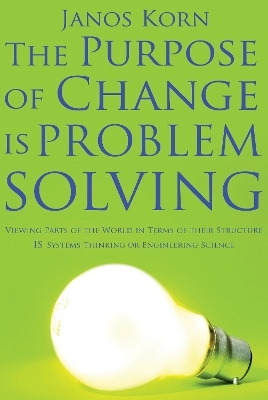
The Purpose of Change is Problem Solving
Viewing parts of the world in terms of their structure is systems thinking or engineering science
Seiten
2016
Matador (Verlag)
978-1-78589-106-9 (ISBN)
Matador (Verlag)
978-1-78589-106-9 (ISBN)
- Titel ist leider vergriffen;
keine Neuauflage - Artikel merken
This book suggests that the 'structural part' of the world is empirical, pervasive throughout experience and as such results in a single domain as opposed to conventional science which consists of many domains like mechanics, electricity etc.
Any part of the world can be viewed and modelled in terms of its chosen qualitative and/or quantitative properties, OR its structure. The former approach has been used by nearly the whole of ‘human intellectual endeavor’, i.e conventional science of physics, the arts etc. Development of the latter or the ‘systemic view’ is the subject matter of the current work. The Purpose of Change is Problem Solving suggests that the ‘structural view’ is empirical, pervasive throughout experience and as such results in a single domain as opposed to conventional science which consists of many domains like mechanics, electricity etc. Thus, a unique approach is required which is based on ‘general principles of systems’ translated into operational form by the symbolism of processed natural language called ‘linguistic modelling of scenarios’ which can carry mathematics and uncertainties. To model scenarios with complex structure, a description or story in natural language is expressed in terms of homogenous language of one – and two – place sentences, the ‘elementary constituents’ of which complex structures can be constructed [like a variety of buildings from bricks]. To correspond to the single domain, based on the logic of causation, a single scheme of ‘Management/producers – Product – User/consumer’ is proposed which is immediately applicable to structuring scenarios and guides their detailed linguistic modelling or design. The approach, subject to debate, can have significant impact on society and education, especially that of engineering which lacks a ‘comprehensive theory of structure’ of problematic scenarios.
Any part of the world can be viewed and modelled in terms of its chosen qualitative and/or quantitative properties, OR its structure. The former approach has been used by nearly the whole of ‘human intellectual endeavor’, i.e conventional science of physics, the arts etc. Development of the latter or the ‘systemic view’ is the subject matter of the current work. The Purpose of Change is Problem Solving suggests that the ‘structural view’ is empirical, pervasive throughout experience and as such results in a single domain as opposed to conventional science which consists of many domains like mechanics, electricity etc. Thus, a unique approach is required which is based on ‘general principles of systems’ translated into operational form by the symbolism of processed natural language called ‘linguistic modelling of scenarios’ which can carry mathematics and uncertainties. To model scenarios with complex structure, a description or story in natural language is expressed in terms of homogenous language of one – and two – place sentences, the ‘elementary constituents’ of which complex structures can be constructed [like a variety of buildings from bricks]. To correspond to the single domain, based on the logic of causation, a single scheme of ‘Management/producers – Product – User/consumer’ is proposed which is immediately applicable to structuring scenarios and guides their detailed linguistic modelling or design. The approach, subject to debate, can have significant impact on society and education, especially that of engineering which lacks a ‘comprehensive theory of structure’ of problematic scenarios.
Janos Korn graduated in mechanical engineering at Queen Mary College, University of London, in 1960, followed by MPhil and PhD degrees. After a few years in industry as a development engineer, he became a lecturer, a position he retained until retirement from Middlesex University in 1996. He also held the position of part time tutor at the Open University. He was a member of the institutions of Mechanical and Electrical Engineers and has previously published Science and Design of Systems (2009), Network Modelling of Engineering Systems (2012) and Linguistic Modelling of Scenarios (2013) (all Matador.)
| Erscheinungsdatum | 03.03.2016 |
|---|---|
| Verlagsort | Leicester |
| Sprache | englisch |
| Maße | 156 x 234 mm |
| Themenwelt | Mathematik / Informatik ► Mathematik |
| Sozialwissenschaften ► Pädagogik | |
| Technik | |
| ISBN-10 | 1-78589-106-5 / 1785891065 |
| ISBN-13 | 978-1-78589-106-9 / 9781785891069 |
| Zustand | Neuware |
| Informationen gemäß Produktsicherheitsverordnung (GPSR) | |
| Haben Sie eine Frage zum Produkt? |
Mehr entdecken
aus dem Bereich



aus dem Bereich
Von Logik und Mengenlehre bis Zahlen, Algebra, Graphen und …
Buch | Softcover (2024)
De Gruyter Oldenbourg (Verlag)
CHF 104,90
Grundlagen für das Bachelor-Studium
Buch | Hardcover (2023)
Hanser (Verlag)
CHF 55,95
Analysis und Lineare Algebra mit Querverbindungen
Buch | Hardcover (2022)
Springer Spektrum (Verlag)
CHF 97,95


