


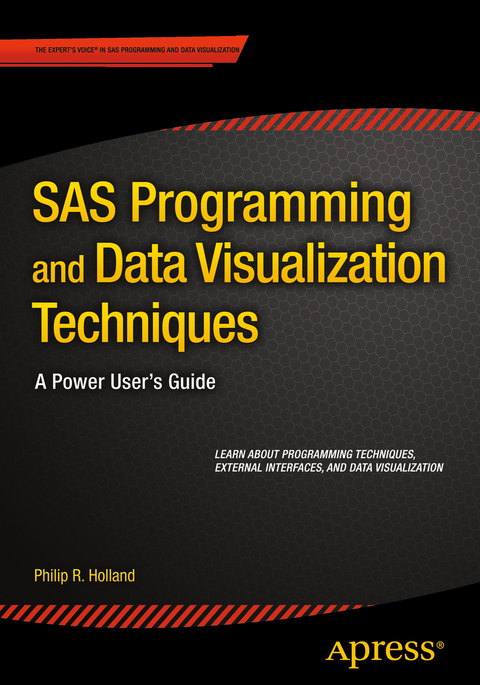
SAS Programming and Data Visualization Techniques (eBook)
XXI, 245 Seiten
Apress (Verlag)
978-1-4842-0568-6 (ISBN)

SAS Programming and Data Visualization Techniques: A Power User's Guide brings together a wealth of ideas about strategic and tactical solutions to everyday situations experienced when transferring, extracting, processing, analyzing, and reporting the valuable data you have at your fingertips. Best, you can achieve most of the solutions using the SAS components you already license, meaning that this book's insights can keep you from throwing money at problems needlessly.
Author Philip R. Holland advises a broad range of clients throughout Europe and the United States as an independent consultant and founder of Holland Numerics Ltd, a SAS technical consultancy. In this book he explains techniques-through code samples and example-that will enable you to increase your knowledge of all aspects of SAS programming, improve your coding productivity, and interface SAS with other programs.
He also provides an expert's overview of Graph Templates, which was recently moved into Base SAS. You will learn to create attractive, standardized, reusable, and platform-independent graphs-both statistical and non-statistical-to help you and your business users explore, visualize, and capitalize on your company's data. In addition, you will find many examples and cases pertaining to healthcare, finance, retail, and other industries.
Among other things, SAS Programming and Data Visualization Techniques will show you how to:
- Write efficient and reus
SAS Programming and Data Visualization Techniques prepares you to make better use of your existing SAS components by learning to use the newest features, improve your coding efficiency, help you develop applications that are easier to maintain, and make data analysis easier. In other words, it will save you time, money, and effort-and make you a more valuable member of the development team.
What You'll Learn
- How to write more efficient SAS code-either code that runs quicker, code that is easier to maintain, or both
- How to do more with the SAS components you already license
- How to take advantage of the newest features in SAS
- How to interface external applications with SAS software
- How to create graphs using SAS ODS Graphics
Who This Book Is For
SAS programmers wanting to improve their existing programming skills, and programming managers wanting to make better use of the SAS software they already license.
Philip R. Holland has over 25 years of experience of working with SAS software. Having started in 1981 as an MVS Systems Programmer for the University of London Computer Centre (ULCC), he moved on to Prudential Assurance where, as an MVS Systems Programmer and Performance Analyst, he was the company's SAS technical support representative. His third and final permanent SAS position as a Capacity Planner to Centrefile ended in 1992, when he formed his own consultancy company, Holland Numerics Ltd. Since then, he has provided SAS technical consultancy on all the major platforms that support SAS software in the financial, retail and pharmaceutical sectors in the UK, Belgium, Holland, and Germany.Holland, the author of thirty articles and conference papers relating to SAS, is an enthusiastic software developer, not only using SAS, but also Perl, Java, JavaScript and Visual Basic. The author of three books, his latest project has been to develop SAS-related eBook apps.
SAS Programming and Data Visualization Techniques: A Power User's Guide brings together a wealth of ideas about strategic and tactical solutions to everyday situations experienced when transferring, extracting, processing, analyzing, and reporting the valuable data you have at your fingertips. Best, you can achieve most of the solutions using the SAS components you already license, meaning that this book's insights can keep you from throwing money at problems needlessly.Author Philip R. Holland advises a broad range of clients throughout Europe and the United States as an independent consultant and founder of Holland Numerics Ltd, a SAS technical consultancy. In this book he explains techniques-through code samples and example-that will enable you to increase your knowledge of all aspects of SAS programming, improve your coding productivity, and interface SAS with other programs. He also provides an expert's overview of Graph Templates, which was recently moved into Base SAS. You will learn to create attractive, standardized, reusable, and platform-independent graphs-both statistical and non-statistical-to help you and your business users explore, visualize, and capitalize on your company's data. In addition, you will find many examples and cases pertaining to healthcare, finance, retail, and other industries.Among other things, SAS Programming and Data Visualization Techniques will show you how to:Write efficient and reusable SAS codeCombine look-up data sets with larger data sets effectivelyRun R and Perl from SASRun SAS programs from SAS Studio and Enterprise GuideOutput data into insightful, valuable charts and graphsSAS Programming and Data Visualization Techniques prepares you to make better use of your existing SAS components by learning to use the newest features, improve your coding efficiency, help you develop applications that are easier to maintain, and make data analysis easier. In other words, it will save you time, money, and effort-and make you a more valuable member of the development team.What You'll LearnHow to write more efficient SAS code-either code that runs quicker, code that is easier to maintain, or bothHow to do more with the SAS components you already licenseHow to take advantage of the newest features in SASHow to interface external applications with SAS softwareHow to create graphs using SAS ODS GraphicsWho This Book Is For SAS programmers wanting to improve their existing programming skills, and programming managers wanting to make better use of the SAS software they already license.
Philip R. Holland has over 25 years of experience of working with SAS software. Having started in 1981 as an MVS Systems Programmer for the University of London Computer Centre (ULCC), he moved on to Prudential Assurance where, as an MVS Systems Programmer and Performance Analyst, he was the company's SAS technical support representative. His third and final permanent SAS position as a Capacity Planner to Centrefile ended in 1992, when he formed his own consultancy company, Holland Numerics Ltd. Since then, he has provided SAS technical consultancy on all the major platforms that support SAS software in the financial, retail and pharmaceutical sectors in the UK, Belgium, Holland, and Germany.Holland, the author of thirty articles and conference papers relating to SAS, is an enthusiastic software developer, not only using SAS, but also Perl, Java, JavaScript and Visual Basic. The author of three books, his latest project has been to develop SAS-related eBook apps.
Part One: Programming Efficiency TechniquesHow to make use of SAS programming techniques to match the way SAS programs and data are going to be used.Chapter 1: The Basics of Efficient SAS CodingHow to write SAS programs to balance the demands of execution speed and maintenance.Chapter 2: How to Use Look-up Tables EffectivelyThere are many different ways to combine small look-up data sets with larger SAS data sets; this chapter shows how to use the most appropriate and efficient method depending on the circumstances.Chapter 3: Case: SAS Skills in EpidemiologyIn epidemiology, most data sets from SAS and other databases are big, and SAS programmers need particular skills to work with data. This case illustrates principles that work for programmers dealing with large databases in all industries.Part Two: External InterfacesThis part shows how to interface SAS with external applications.Chapter 4: SAS to R to SASHow to run R programs from SAS programs, and then combine the results into a single output.Chapter 5: Knit Perl and SAS for DIY Web ApplicationsHow to run SAS programs from web pages by using a server-based dispatching program written in Perl.Chapter 6: Case: Running Clinical Trials Programs in Enterprise GuideEnterprise Guide is a Windows-based client for SAS, which has a number of features that can assist SAS programmers to run suites of programs together—for example in clinical trials. This chapter shows the use of Enterprise Guide in healthcare and other industries. Chapter 7: Running SAS Programs in SAS StudioSAS Studio was first included in the latest maintenance release, 9.4. This chapter explains how to best employ SAS Studio, a browser-based client for SAS that has many similarities with Enterprise Guide but also many differences, including the ability to be run on platforms other than Windows. Chapter 8: Everyday Uses for SAS Output Delivery System (ODS)This chapter shows how to prepare SAS program output suitable for Microsoft Office, Adobe Reader, or web browsers by just changing a few program statements.Part Three: Data VisualizationThis part demonstrates how to generate high-quality graphs using SAS ODS Graphics.Chapter 9: Introduction to Graph TemplatesThis chapter offers a simple introduction to the facilities provided by Graph Templates and how and when to use them.Chapter 10: Introduction to ODS Graphics ProceduresThis chapter provides a simple introduction to the different ODS Graphics procedures and how to make your data come alive for colleagues and business users.Chapter 11: Generating Graph TemplatesThis chapter explores the different SAS facilities to auto-generate simple Graph Templates.Chapter 12: Converting SAS/GRAPH Plots to ODS GraphicsYou may already have a suite of SAS/GRAPH programs that create your standard plots and charts. Could these graphs be generated using ODS Graphics, included in SAS Base, so that you would not have to license SAS/GRAPH next time? Of course, and this chapter explains how.Chapter 13: Customizing Graph TemplatesThis chapter shows how to take simple Graph Templates and customize them for the projects you are pursuing.Chapter 14: ODS GRAPHICS StatementIn the same way that ODS can be used to prepare output suitable for other applications, the ODS GRAPHICS statement can be used to create graphs in specific formats depending on your need. This chapter explains them all.
| Erscheint lt. Verlag | 19.8.2015 |
|---|---|
| Zusatzinfo | XXI, 245 p. 150 illus. |
| Verlagsort | Berkeley |
| Sprache | englisch |
| Themenwelt | Mathematik / Informatik ► Informatik ► Datenbanken |
| Mathematik / Informatik ► Informatik ► Programmiersprachen / -werkzeuge | |
| Schlagworte | SAS Code • SAS Data Visualization • SAS Graph Templates • SAS ODS Graphics • SAS Programming |
| ISBN-10 | 1-4842-0568-5 / 1484205685 |
| ISBN-13 | 978-1-4842-0568-6 / 9781484205686 |
| Informationen gemäß Produktsicherheitsverordnung (GPSR) | |
| Haben Sie eine Frage zum Produkt? |
 PDF (Wasserzeichen)
DRM: Digitales Wasserzeichen
Dieses eBook enthält ein digitales Wasserzeichen und ist damit für Sie personalisiert. Bei einer missbräuchlichen Weitergabe des eBooks an Dritte ist eine Rückverfolgung an die Quelle möglich.
Dateiformat: PDF (Portable Document Format)
Mit einem festen Seitenlayout eignet sich die PDF besonders für Fachbücher mit Spalten, Tabellen und Abbildungen. Eine PDF kann auf fast allen Geräten angezeigt werden, ist aber für kleine Displays (Smartphone, eReader) nur eingeschränkt geeignet.
Systemvoraussetzungen:
PC/Mac: Mit einem PC oder Mac können Sie dieses eBook lesen. Sie benötigen dafür einen PDF-Viewer - z.B. den Adobe Reader oder Adobe Digital Editions.
eReader: Dieses eBook kann mit (fast) allen eBook-Readern gelesen werden. Mit dem amazon-Kindle ist es aber nicht kompatibel.
Smartphone/Tablet: Egal ob Apple oder Android, dieses eBook können Sie lesen. Sie benötigen dafür einen PDF-Viewer - z.B. die kostenlose Adobe Digital Editions-App.
Buying eBooks from abroad
For tax law reasons we can sell eBooks just within Germany and Switzerland. Regrettably we cannot fulfill eBook-orders from other countries.
aus dem Bereich


