


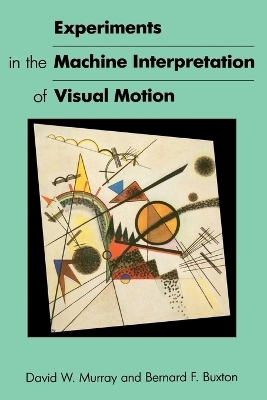
Experiments in the Machine Interpretation of Visual Motion
Seiten
1990
MIT Press (Verlag)
978-0-262-52816-0 (ISBN)
MIT Press (Verlag)
978-0-262-52816-0 (ISBN)
- Lieferbar
- Versandkostenfrei
- Auch auf Rechnung
- Artikel merken
This book describes experimental advances made in the interpretation of visual motion over the last few years that have moved researchers closer to emulating the way in which we recover information about the surrounding world.
If robots are to act intelligently in everyday environments, they must have a perception of motion and its consequences. This book describes experimental advances made in the interpretation of visual motion over the last few years that have moved researchers closer to emulating the way in which we recover information about the surrounding world. It describes algorithms that form a complete, implemented, and tested system developed by the authors to measure two-dimensional motion in an image sequence, then to compute three-dimensional structure and motion, and finally to recognize the moving objects.
The authors develop algorithms to interpret visual motion around four principal constraints. The first and simplest allows the scene structure to be recovered on a pointwise basis. The second constrains the scene to a set of connected straight edges. The third makes the transition between edge and surface representations by demanding that the wireframe recovered is strictly polyhedral. And the final constraint assumes that the scene is comprised of planar surfaces, and recovers them directly.
Contents
Image, Scene, and Motion * Computing Image Motion * Structure from Motion of Points * The Structure and Motion of Edges * From Edges to Surfaces * Structure and Motion of Planes * Visual Motion Segmentation * Matching to Edge Models * Matching to Planar Surfaces
If robots are to act intelligently in everyday environments, they must have a perception of motion and its consequences. This book describes experimental advances made in the interpretation of visual motion over the last few years that have moved researchers closer to emulating the way in which we recover information about the surrounding world. It describes algorithms that form a complete, implemented, and tested system developed by the authors to measure two-dimensional motion in an image sequence, then to compute three-dimensional structure and motion, and finally to recognize the moving objects.
The authors develop algorithms to interpret visual motion around four principal constraints. The first and simplest allows the scene structure to be recovered on a pointwise basis. The second constrains the scene to a set of connected straight edges. The third makes the transition between edge and surface representations by demanding that the wireframe recovered is strictly polyhedral. And the final constraint assumes that the scene is comprised of planar surfaces, and recovers them directly.
Contents
Image, Scene, and Motion * Computing Image Motion * Structure from Motion of Points * The Structure and Motion of Edges * From Edges to Surfaces * Structure and Motion of Planes * Visual Motion Segmentation * Matching to Edge Models * Matching to Planar Surfaces
David W. Murray is University Lecturer in Engineering Science at the University of Oxford and Draper's Fellow in Robotics at St Anne's College, Oxford. Bernard F. Buxton is Senior Research Fellow at the General Electric Company's Hirst Research Centre, Wembley, UK, where he leads the Computer Vision Group in the Long Range Research Laboratory.
| Erscheinungsdatum | 20.10.2015 |
|---|---|
| Reihe/Serie | Artificial Intelligence Series |
| Zusatzinfo | 87 |
| Verlagsort | Cambridge, Mass. |
| Sprache | englisch |
| Maße | 152 x 229 mm |
| Themenwelt | Informatik ► Theorie / Studium ► Künstliche Intelligenz / Robotik |
| ISBN-10 | 0-262-52816-9 / 0262528169 |
| ISBN-13 | 978-0-262-52816-0 / 9780262528160 |
| Zustand | Neuware |
| Informationen gemäß Produktsicherheitsverordnung (GPSR) | |
| Haben Sie eine Frage zum Produkt? |
Mehr entdecken
aus dem Bereich


aus dem Bereich
Eine praxisorientierte Einführung
Buch | Softcover (2025)
Springer Vieweg (Verlag)
CHF 53,15
Künstliche Intelligenz, Macht und das größte Dilemma des 21. …
Buch | Softcover (2025)
C.H.Beck (Verlag)
CHF 25,20
Buch | Softcover (2025)
Reclam, Philipp (Verlag)
CHF 11,20


