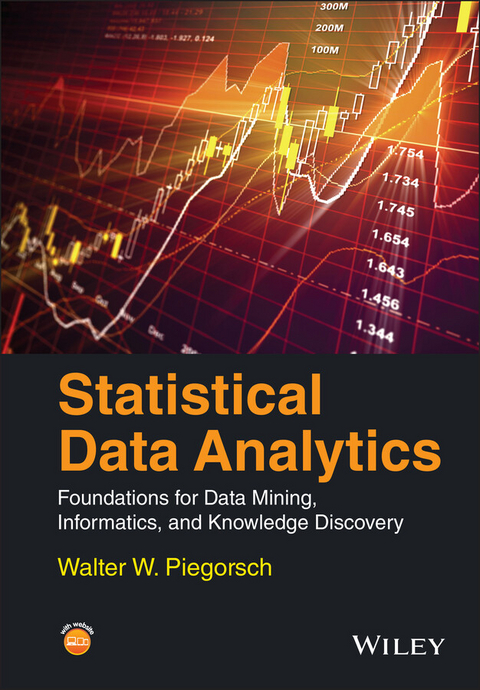
Statistical Data Analytics (eBook)
Walter W. Piegorsch is a Professor of Mathematics at the University of Arizona and the Director of Statistical Research & Education at its BIO5 Institute for Collaborative Bioresearch. Professor Piegorsch is an experienced and highly regarded author and editor. He has co-authored one previous book for Wiley, and is a founding and current co-Editor for Wiley's StatsRef: Statistics Reference Online, a comprehensive online reference resource which covers the fundamentals and applications of statistical theory, methods, and practice. He has also been on the editorial board of many scientific journals, and served as joint-Editor of the Journal of the American Statistical Association (Theory and Methods Section).
Over the course of a long and distinguished academic career Professor Piegorsch has taught and developed a number of courses in statistics and quantitative literacy, and he is in an ideal position to write this technical introduction to the use and application of statistical methods for informatics, statistical learning, and data mining.
.
Statistical Data Analytics Statistical Data Analytics Foundations for Data Mining, Informatics, and Knowledge Discovery A comprehensive introduction to statistical methods for data mining and knowledge discovery Applications of data mining and big data increasingly take center stage in our modern, knowledge-driven society, supported by advances in computing power, automated data acquisition, social media development and interactive, linkable internet software. This book presents a coherent, technical introduction to modern statistical learning and analytics, starting from the core foundations of statistics and probability. It includes an overview of probability and statistical distributions, basics of data manipulation and visualization, and the central components of standard statistical inferences. The majority of the text extends beyond these introductory topics, however, to supervised learning in linear regression, generalized linear models, and classification analytics. Finally, unsupervised learning via dimension reduction, cluster analysis, and market basket analysis are introduced. Extensive examples using actual data (with sample R programming code) are provided, illustrating diverse informatic sources in genomics, biomedicine, ecological remote sensing, astronomy, socioeconomics, marketing, advertising and finance, among many others. Statistical Data Analytics: Focuses on methods critically used in data mining and statistical informatics. Coherently describes the methods at an introductory level, with extensions to selected intermediate and advanced techniques. Provides informative, technical details for the highlighted methods. Employs the open-source R language as the computational vehicle along with its burgeoning collection of online packages to illustrate many of the analyses contained in the book. Concludes each chapter with a range of interesting and challenging homework exercises using actual data from a variety of informatic application areas. This book will appeal as a classroom or training text to intermediate and advanced undergraduates, and to beginning graduate students, with sufficient background in calculus and matrix algebra. It will also serve as a source-book on the foundations of statistical informatics and data analytics to practitioners who regularly apply statistical learning to their modern data.
WALTER W. PIEGORSCH University of Arizona, USA
Preface
Every data set tells a story. Data analytics, and in particular the statistical methods at their core, piece together that story's components, ostensibly to reveal the underlying message. This is the target paradigm of knowledge discovery: distill via statistical calculation and summarization the features in a data set/database that teach us something about the processes affecting our lives, the civilization which we inhabit, and the world around us. This text is designed as an introduction to the statistical practices that underlie modern data analytics.
Pedagogically, the presentation is separated into two broad themes: first, an introduction to the basic concepts of probability and statistics for novice users and second, a selection of focused methodological topics important in modern data analytics for those who have the basic concepts in hand. Most chapters begin with an overview of the theory and methods pertinent to that chapter's focal topic and then expand on that focus with illustrations and analyses of relevant data. To the fullest extent possible, data in the examples and exercises are taken from real applications and are not modified to simplify or “clean” the illustration. Indeed, they sometimes serve to highlight the “messy” aspects of modern, real-world data analytics. In most cases, sample sizes are on the order of 10–10, and numbers of variables do not usually exceed a dozen or so. Of course, far more massive data sets are used to achieve knowledge discovery in practice. The choice here to focus on this smaller range was made so that the examples and exercises remain manageable, illustrative, and didactically instructive. Topic selection is intended to be broad, especially among the exercises, allowing readers to gain a wider perspective on the use of the methodologies. Instructors may wish to use certain exercises as formal examples when their audience's interests coincide with the exercise topic(s).
Readers are assumed to be familiar with four semesters of college mathematics, through multivariable calculus and linear algebra. The latter is less crucial; readers with only an introductory understanding of matrix algebra can benefit from the refresher on vector and matrix relationships given in Appendix A. To review necessary background topics and to establish concepts and notation, Chapters 1–5 provide introductions to basic probability (Chapter 2), statistical description (Chapters 3 and 4), and statistical inference (Chapter 5). Readers familiar with these introductory topics may wish to move through the early chapters quickly, read only selected sections in detail (as necessary), and/or refer back to certain sections that are needed for better comprehension of later material. Throughout, sections that address more advanced material or that require greater familiarity with probability and/or calculus are highlighted with asterisks (*). These can be skipped or selectively perused on a first reading, and returned to as needed to fill in the larger picture.
The more advanced material begins in earnest in Chapter 6 with techniques for supervised learning, focusing on simple linear regression analysis. Chapters 7 and 8 follow with multiple linear regression and generalized linear regression models, respectively. Chapter 9 completes the tour of supervised methods with an overview of various methods for classification. The final two chapters give a complementary tour of methods for unsupervised learning, focusing on dimension reduction (Chapter 10) and clustering/association (Chapter 11).
Standard mathematical and statistical functions are used throughout. Unless indicated otherwise—usually by specifying a different base— indicates the natural logarithm, so that is interpreted as . All matrices, such as X or M, are presented in bold uppercase. Vectors will usually display as bold lowercase, for example, b, although some may appear as uppercase (typically, vectors of random variables). Most vectors are in column form, with the operator T used to denote transposition to row form. In selected instances, it will be convenient to deploy a vector directly in row form; if so, this is explicitly noted.
Much of modern data analytics requires appeal to the computer, and a variety of computer packages and programming languages are available to the user. Highlighted herein is the R statistical programming environment (R Core Team 2014). R's growing ubiquity and statistical depth make it a natural choice. Appendix B provides a short introduction to R for beginners, although it is assumed that a majority of readers will already be familiar with at least basic R mechanics or can acquire such skills separately. Dedicated introductions to R with emphasis on statistics are available in, for example, Dalgaard (2008) and Verzani (2005), or online at the Comprehensive R Archive Network (CRAN): http://cran.r-project.org/. Also see Wilson (2012).
Examples and exercises throughout the text are used to explicate concepts, both theoretical and applied. All examples end with a symbol. Many present sample R code, which is usually intended to illustrate the methods and their implementation. Thus the code may not be most efficient for a given problem but should at least give the reader some inkling into the process. Most of the figures and graphics also come from R. In some cases, the R code used to create the graphic is also presented, although, for simplicity, this may only be “base” code without accentuations/options used to stylize the display.
Throughout the text, data are generally presented in reduced tabular form to show only a few representative observations. If public distribution is permitted, the complete data sets have been archived online at http://www.wiley.com/go/piegorsch/data_analytics or their online source is listed. A number of the larger data sets came from from the University of California–Irvine (UCI) Machine Learning Repository at http://archive.ics.uci.edu/ml (Frank and Asuncion, 2010); appreciative thanks are due to this project and their efforts to make large-scale data readily available.
Instructors may employ the material in a number of ways, and creative manipulation is encouraged. For an intermediate-level, one-semester course introducing the methods of data analytics, one might begin with Chapter 1, then deploy Chapters 2–5, and possibly Chapter 6 as needed for background. Begin in earnest with Chapters 6 or 7 and then proceed through Chapters 8–11 as desired. For a more complete, two-semester sequence, use Chapters 1–6 as a (post-calculus) introduction to probability and statistics for data analytics in the first semester. This then lays the foundations for a second, targeted-methods semester into the details of supervised and unsupervised learning via Chapters 7–11. Portions of any chapter (e.g., advanced subsections with asterisks) can be omitted to save time and/or allow for greater focus in other areas.
Experts in data analytics may canvass the material and ask, how do these topics differ from any basic selection of statistical methods? Arguably, they do not. Indeed, whole books can be (and have been) written on the single theme of essentially every chapter. The focus in this text, however, is to highlight methods that have formed at the core of data analytics and statistical learning as they evolved in the twenty-first century. Different readers may find certain sections and chapters to be of greater prominence than others, depending on their own scholarly interests and training. This eclectic format is unavoidable, even intentional, in a single volume such as this. Nonetheless, it is hoped that the selections as provided will lead to an effective, unified presentation.
Of course, many important topics have been omitted or noted only briefly, in order to make the final product manageable. Omissions include methods for missing data/imputation, spurious data detection, novelty detection, robust and ordinal regression, generalized additive models, multivariate regression, and ANOVA (analysis of variance, including multivariate analysis of variance, MANOVA), partial least squares, perceptrons, artificial neural networks and Bayesian belief networks, self-organizing maps, classification rule mining, and text mining, to name a few. Useful sources that consider some of these topics include (a) for missing data/imputation, Abrahantes et al. (2011); (b) for novelty detection, Pimentel et al. (2014); (c) for generalized additive models, Wood (2006); (d) for MANOVA, Huberty and Olejnik (2006); (e) for partial least squares, Esposito Vinzi and Russolillo (2013); (f) for neural networks, Stahl and Jordanov (2012); (g) for Bayesian belief networks, Phillips (2005); (h) for self-organizing maps, Wehrens and Buydens (2007); and (i) for text mining, Martinez (2010), and the references all therein. Many of these topics are also covered in a trio of dedicated texts on statistical learning—also referenced regularly throughout the following chapters—by Hastie et al. (2009), Clarke et al. (2009), and James et al. (2013). Interested readers are encouraged to peruse all these various sources, as appropriate.
By way of acknowledgments, sincere and heartfelt thanks are due numerous colleagues, including Alexandra Abate, Euan Adie, D. Dean Billheimer and the statisticians of the Arizona Statistical Consulting Laboratory (John Bear, Isaac Jenkins, and Shripad Sinari), Susan L. Cutter, David B. Hitchcock, Fernando D. Martinez, James Ranger-Moore, Martin Sill, Debra A. Stern, Hao Helen Zhang, and a series of anonymous...
| Erscheint lt. Verlag | 21.8.2015 |
|---|---|
| Sprache | englisch |
| Themenwelt | Informatik ► Datenbanken ► Data Warehouse / Data Mining |
| Mathematik / Informatik ► Mathematik ► Statistik | |
| Mathematik / Informatik ► Mathematik ► Wahrscheinlichkeit / Kombinatorik | |
| Technik | |
| Schlagworte | Computational & Graphical Statistics • Computer Science • Database & Data Warehousing Technologies • Data Mining • Data Mining Statistics • Data Warehouse • Datenanalyse • Datenbanken u. Data Warehousing • Informatik • Rechnergestützte u. graphische Statistik • Rechnergestützte u. graphische Statistik • Statistics • Statistik |
| ISBN-13 | 9781119030669 / 9781119030669 |
| Informationen gemäß Produktsicherheitsverordnung (GPSR) | |
| Haben Sie eine Frage zum Produkt? |
 EPUB (Adobe DRM)
Kopierschutz: Adobe-DRM
Adobe-DRM ist ein Kopierschutz, der das eBook vor Mißbrauch schützen soll. Dabei wird das eBook bereits beim Download auf Ihre persönliche Adobe-ID autorisiert. Lesen können Sie das eBook dann nur auf den Geräten, welche ebenfalls auf Ihre Adobe-ID registriert sind.
Details zum Adobe-DRM
Dateiformat: EPUB (Electronic Publication)
EPUB ist ein offener Standard für eBooks und eignet sich besonders zur Darstellung von Belletristik und Sachbüchern. Der Fließtext wird dynamisch an die Display- und Schriftgröße angepasst. Auch für mobile Lesegeräte ist EPUB daher gut geeignet.
Systemvoraussetzungen:
PC/Mac: Mit einem PC oder Mac können Sie dieses eBook lesen. Sie benötigen eine
eReader: Dieses eBook kann mit (fast) allen eBook-Readern gelesen werden. Mit dem amazon-Kindle ist es aber nicht kompatibel.
Smartphone/Tablet: Egal ob Apple oder Android, dieses eBook können Sie lesen. Sie benötigen eine
Geräteliste und zusätzliche Hinweise
Buying eBooks from abroad
For tax law reasons we can sell eBooks just within Germany and Switzerland. Regrettably we cannot fulfill eBook-orders from other countries.
aus dem Bereich