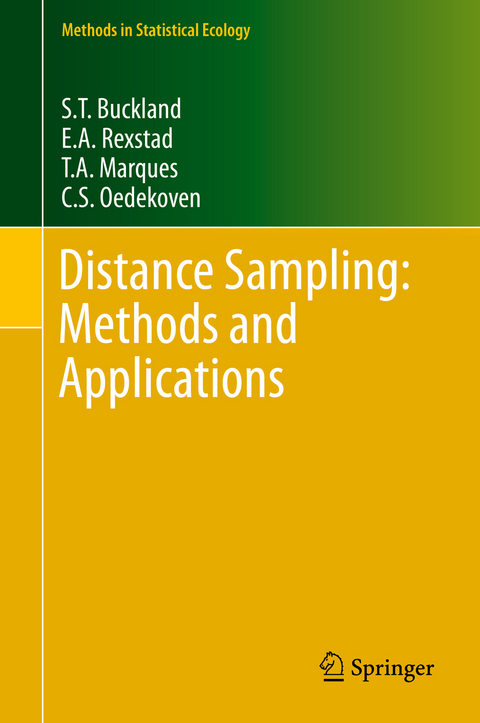
Distance Sampling: Methods and Applications (eBook)
XV, 277 Seiten
Springer International Publishing (Verlag)
978-3-319-19219-2 (ISBN)
In this book, the authors cover the basic methods and advances within distance sampling that are most valuable to practitioners and in ecology more broadly. This is the fourth book dedicated to distance sampling. In the decade since the last book published, there have been a number of new developments. The intervening years have also shown which advances are of most use. This self-contained book covers topics from the previous publications, while also including recent developments in method, software and application.
Distance sampling refers to a suite of methods, including line and point transect sampling, in which animal density or abundance is estimated from a sample of distances to detected individuals. The book illustrates these methods through case studies; data sets and computer code are supplied to readers through the book's accompanying website. Some of the case studies use the software Distance, while others use R code. The book is in three parts. The first part addresses basic methods, the design of surveys, distance sampling experiments, field methods and data issues. The second part develops a range of modelling approaches for distance sampling data. The third part describes variations in the basic method; discusses special issues that arise when sampling different taxa (songbirds, seabirds, cetaceans, primates, ungulates, butterflies, and plants); considers advances to deal with failures of the key assumptions; and provides a check-list for those conducting surveys.
Introduction.- The basic methods.- Designing surveys.- Designing distance sampling experiments.- Field methods and data checking.- Modelling detection functions.- Design-based estimation of animal density and abundance.- Model-based distance sampling: two-stage models.- Model-based distance sampling: full likelihood methods.- Variations on a theme.- Taxon-specific issues.- Exchanging assumptions for data.- Summary.
| Erscheint lt. Verlag | 8.8.2015 |
|---|---|
| Reihe/Serie | Methods in Statistical Ecology | Methods in Statistical Ecology |
| Zusatzinfo | XV, 277 p. 80 illus., 24 illus. in color. |
| Verlagsort | Cham |
| Sprache | englisch |
| Themenwelt | Mathematik / Informatik ► Mathematik ► Wahrscheinlichkeit / Kombinatorik |
| Medizin / Pharmazie ► Allgemeines / Lexika | |
| Schlagworte | Animal abundance • animal populations • capture-recapture • Distance sampling • Distance software • population density • R software • Survey Design |
| ISBN-10 | 3-319-19219-1 / 3319192191 |
| ISBN-13 | 978-3-319-19219-2 / 9783319192192 |
| Informationen gemäß Produktsicherheitsverordnung (GPSR) | |
| Haben Sie eine Frage zum Produkt? |
 PDF (Wasserzeichen)
DRM: Digitales Wasserzeichen
Dieses eBook enthält ein digitales Wasserzeichen und ist damit für Sie personalisiert. Bei einer missbräuchlichen Weitergabe des eBooks an Dritte ist eine Rückverfolgung an die Quelle möglich.
Dateiformat: PDF (Portable Document Format)
Mit einem festen Seitenlayout eignet sich die PDF besonders für Fachbücher mit Spalten, Tabellen und Abbildungen. Eine PDF kann auf fast allen Geräten angezeigt werden, ist aber für kleine Displays (Smartphone, eReader) nur eingeschränkt geeignet.
Systemvoraussetzungen:
PC/Mac: Mit einem PC oder Mac können Sie dieses eBook lesen. Sie benötigen dafür einen PDF-Viewer - z.B. den Adobe Reader oder Adobe Digital Editions.
eReader: Dieses eBook kann mit (fast) allen eBook-Readern gelesen werden. Mit dem amazon-Kindle ist es aber nicht kompatibel.
Smartphone/Tablet: Egal ob Apple oder Android, dieses eBook können Sie lesen. Sie benötigen dafür einen PDF-Viewer - z.B. die kostenlose Adobe Digital Editions-App.
Buying eBooks from abroad
For tax law reasons we can sell eBooks just within Germany and Switzerland. Regrettably we cannot fulfill eBook-orders from other countries.
aus dem Bereich