DIY Financial Advisor (eBook)
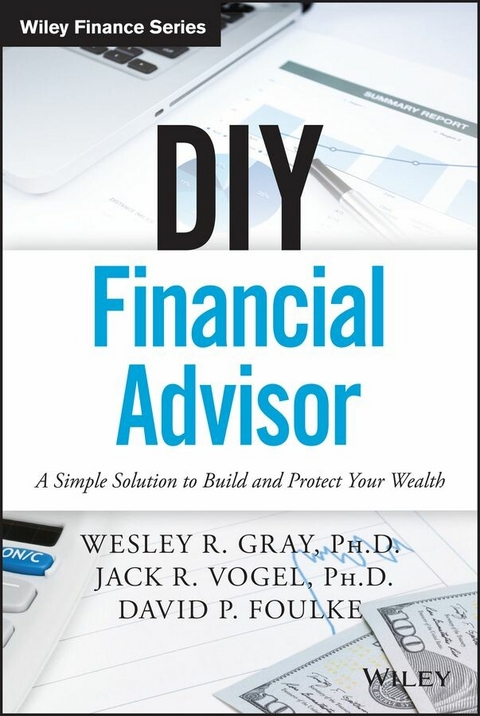
DIY Financial Advisor: A Simple Solution to Build and Protect Your Wealth
DIY Financial Advisor is a synopsis of our research findings developed while serving as a consultant and asset manager for family offices. By way of background, a family office is a company, or group of people, who manage the wealth a family has gained over generations. The term 'family office' has an element of cachet, and even mystique, because it is usually associated with the mega-wealthy. However, practically speaking, virtually any family that manages its investments—independent of the size of the investment pool—could be considered a family office. The difference is mainly semantic.
DIY Financial Advisor outlines a step-by-step process through which investors can take control of their hard-earned wealth and manage their own family office. Our research indicates that what matters in investing are minimizing psychology traps and managing fees and taxes. These simple concepts apply to all families, not just the ultra-wealthy.
But can—or should—we be managing our own wealth?
Our natural inclination is to succumb to the challenge of portfolio management and let an 'expert' deal with the problem. For a variety of reasons we discuss in this book, we should resist the gut reaction to hire experts. We suggest that investors maintain direct control, or at least a thorough understanding, of how their hard-earned wealth is managed. Our book is meant to be an educational journey that slowly builds confidence in one's own ability to manage a portfolio. We end our book with a potential solution that could be applicable to a wide-variety of investors, from the ultra-high net worth to middle class individuals, all of whom are focused on similar goals of preserving and growing their capital over time.
DIY Financial Advisor is a unique resource. This book is the only comprehensive guide to implementing simple quantitative models that can beat the experts. And it comes at the perfect time, as the investment industry is undergoing a significant shift due in part to the use of automated investment strategies that do not require a financial advisor's involvement. DIY Financial Advisor is an essential text that guides you in making your money work for you—not for someone else!
WESLEY R. GRAY, PHD, is the founder of Alpha Architect, LLC, where he is the executive managing member. Dr. Gray is the co-author of Quantitative Value: A Practitioner's Guide to Automating Intelligent Investment and Eliminating Behavioral Errors.
JACK R. VOGEL, PHD, is a managing member of Alpha Architect, LLC, where he heads the research department, writes papers on empirical asset pricing, and serves as the Chief Financial Officer.
DAVID P. FOULKE is a managing member of Alpha Architect, LLC. He assists in business development, firm operations, strategic initiatives, and developing papers on quantitative investing and behavioral finance topics.
DIY Financial Advisor: A Simple Solution to Build and Protect Your WealthDIY Financial Advisor is a synopsis of our research findings developed while serving as a consultant and asset manager for family offices. By way of background, a family office is a company, or group of people, who manage the wealth a family has gained over generations. The term 'family office' has an element of cachet, and even mystique, because it is usually associated with the mega-wealthy. However, practically speaking, virtually any family that manages its investments independent of the size of the investment pool could be considered a family office. The difference is mainly semantic. DIY Financial Advisor outlines a step-by-step process through which investors can take control of their hard-earned wealth and manage their own family office. Our research indicates that what matters in investing are minimizing psychology traps and managing fees and taxes. These simple concepts apply to all families, not just the ultra-wealthy. But can or should we be managing our own wealth? Our natural inclination is to succumb to the challenge of portfolio management and let an 'expert' deal with the problem. For a variety of reasons we discuss in this book, we should resist the gut reaction to hire experts. We suggest that investors maintain direct control, or at least a thorough understanding, of how their hard-earned wealth is managed. Our book is meant to be an educational journey that slowly builds confidence in one's own ability to manage a portfolio. We end our book with a potential solution that could be applicable to a wide-variety of investors, from the ultra-high net worth to middle class individuals, all of whom are focused on similar goals of preserving and growing their capital over time. DIY Financial Advisor is a unique resource. This book is the only comprehensive guide to implementing simple quantitative models that can beat the experts. And it comes at the perfect time, as the investment industry is undergoing a significant shift due in part to the use of automated investment strategies that do not require a financial advisor's involvement. DIY Financial Advisor is an essential text that guides you in making your money work for you not for someone else!
WESLEY R. GRAY, PHD, is the founder of Alpha Architect, LLC, where he is the executive managing member. Dr. Gray is the co-author of Quantitative Value: A Practitioner's Guide to Automating Intelligent Investment and Eliminating Behavioral Errors. JACK R. VOGEL, PHD, is a managing member of Alpha Architect, LLC, where he heads the research department, writes papers on empirical asset pricing, and serves as the Chief Financial Officer. DAVID P. FOULKE is a managing member of Alpha Architect, LLC. He assists in business development, firm operations, strategic initiatives, and developing papers on quantitative investing and behavioral finance topics.
Preface xi
Acknowledgments xiii
PART ONE Why You Can Beat the Experts 1
CHAPTER 1 Are Experts Trying Too Hard? 3
Why Do We Rely on Experts? 6
What Are the Experts' Incentives? 9
Are Experts Worthless? 11
The Expert's Hypothesis 13
Summary 14
Notes 15
CHAPTER 2 Simple Models Typically Beat the Experts 17
The Evidence Shows... 20
A Study of All the Studies 21
What if Experts Have the Model? 23
But Investing Is Different, Right? 24
Why Experts Fail to Beat Models 26
Summary 28
Notes 29
CHAPTER 3 Experts Are Biased and Overconfident 31
The Biased Brain 33
Summary 47
Notes 48
CHAPTER 4 Experts Tell Us Stories, Not Facts 49
Story-Based Investing 52
Evidence-Based Investing 53
The Recap: Why Experts Fail 60
Why Not Use Models? 62
Summary 63
Notes 64
PART TWO How You Can Beat the Experts 67
CHAPTER 5 A Framework for Investment Decisions 69
Assessing an Advisor Is Difficult 71
The FACTS Framework 75
We've Got the FACTS: Now What? 86
Summary 90
Notes 90
CHAPTER 6 A Simple Asset Allocation Model That Works 91
Asset Allocation 95
A Simple Asset Allocation Model That Works 98
But Which Assets Do We Choose? 103
Summary 104
Notes 105
CHAPTER 7 A Simple Risk Management Model That Works 107
A Simple Risk Management Model That Works 109
How Does ROBUST Work? 113
Summary 121
Risk Management Research (For Geeks Only) 121
Notes 129
CHAPTER 8 Simple Security Selection Models That Work 133
Value Investing 134
Momentum Investing 140
A Simple Momentum Model That Works 146
Combining Value and Momentum 148
International Stocks 151
Get 'Er Done 153
Summary 154
Notes 154
CHAPTER 9 The Do-It-Yourself (DIY) Solution 157
Exploring a Simple Equal-Weight Five Asset Class Model 159
Enhancing the Ivy 5 Concept 163
Finish Strong: The Ultimate DIY Solution 171
Get 'Er Done 175
Notes 176
CHAPTER 10 Some Practical Advice 179
Three Reasons We Will Not Be a DIY Investor 180
Three Reasons You Might Fail 183
But Don't Lose Hope! 185
Is DIY the Only Solution? 186
Notes 187
Appendix: Analysis Legend 189
About the Companion Website 191
About the Authors 193
Index 195
Chapter 1
Are Experts Trying Too Hard?
“A speculator can always be beset by an unfathomable event—a constellation of unpredictable and unforeseen events—that leads to a disaster that seemingly was impossible, and it's always important to keep this in mind.”
—Victor Niederhoffer, Commenting on the 1997 Asian Crisis1
It took Victor Niederhoffer many years of study and a lot of hard work to become widely known as an expert in financial markets. After graduating from Harvard and receiving his PhD in finance from the University of Chicago, he continued his ascent within academia, teaching at Berkeley for five years. As an academic, he authored numerous research papers on market anomalies and how one might profit from following clever trading strategies.
As Niederhoffer learned more, and became increasingly sophisticated, he sensed an opportunity to use his academic knowledge to make money. Retiring from academia in 1980, he chose to pursue a career as a practitioner in financial markets. His firm, Niederhoffer Investments, was so successful that he caught the notice of investing guru George Soros. Niederhoffer began working with Soros in the 1980s, advising him on commodities and fixed-income trading. Eventually, Soros allocated $100 million to his firm. During the early 1990s, it was rumored in the financial press that Niederhoffer had been generating returns of 30 percent, or more, per year.
In 1996, based on an illustrious track record and a distinguished trading career, Niederhoffer published his personal cookbook, The Education of a Speculator, in which he revealed his approach to trading and making money in the markets. Who couldn't learn from this titan of finance? And he was a titan. When his book hit the shelves, Niederhoffer was among the best-known hedge fund managers in the United States, was at the pinnacle of his profession, and had become known as one of the foremost experts on investing worldwide. Niederhoffer was not only an expert, he was an expert's expert.
And so, in 1997, as a widely respected expert in financial markets, Niederhoffer may have been surprised when he experienced steep losses on a Thai currency bet. But Niederhoffer had experienced volatility before; he just needed to apply his prodigious investing skill and pull yet another rabbit out of a hat. While Niederhoffer had fallen behind during early 1997, his real problems began when he chose a risky strategy to recover from those losses: He began selling out-of-the-money puts on the S&P 500.2
Selling out-of-the-money puts has been likened to picking up nickels in front of a steamroller. You get a little bit of money (the nickel) for the contract, but you agree to purchase a stock at a future price (the steamroller). Everything works so long as the steam roller doesn't accelerate. However, should our steam roller operator drop his sandwich and inadvertently step on the gas (decrease the stock price), you could find yourself in a pressing situation…
This pressing situation can become downright perilous when market prices approach or fall below the put strike price. If you promise to buy a stock for $10 and its price on the open market is $5, you can be sure that your creditors will come to collect. And if you can't honor your promise to fulfill the contract, well, that's when you need to worry about the steamroller.
In late October, Niederhoffer's out-of-the-money November puts were trading at $0.60, but the Asian financial crisis continued to unfold and began to rattle US markets. The value of his puts quadrupled to $2.40, although they were still over 15 percent out of the money. Niederhoffer was confident, stayed the course, and left his position intact (he had come back from worse than this).
The following week, the S&P plunged by 7 percent, and the implied volatility of the puts skyrocketed. The puts were both closer to being “in the money” and had more implied volatility (the market believed the chance of them ending in the money was greater). Each of these effects made them more expensive. With this put valuation double-whammy, the value of Niederhoffer's puts exploded, which was very bad, since Niederhoffer had sold them. In just over a week's time, Niederhoffer's short position had moved against him by a factor of 25 times or more. This extreme move proved to be too much, even for the master. Shortly thereafter, Niederhoffer had a margin call that he could not meet; his fund's account had gone bankrupt.3Cue the steamroller.
How can it be that Victor Niederhoffer—a noted academic, a respected financial expert, a lion on Wall Street, and a financial press darling—could bankrupt his fund by pursuing a volatile options strategy that first year business school students are cautioned against as being too risky? And what did this say about Niederhoffer's expertise?
Some might argue that once Niederhoffer took losses on his Thai currency bet, his incentives changed and affected his perspective. Facing such losses, perhaps this risky option strategy seemed like a reasonable response. Perhaps it was at this point that Niederhoffer became a slave to his emotions, and therefore ceased to be an expert. Perhaps he simply believed in his innate abilities. Perhaps he just wanted to take on more risk. We will never know.
Yet we rely on experts like Niederhoffer because they are supposed to have superior knowledge! They, given their expert credentials, should reach the right conclusion more often than we, the nonexperts. Once Niederhoffer went bust, surely his expert credentials were revoked by the masses and relegated to nonexpert status, right?
Mustafa Zaida, a professional investor who ran a European hedge fund, apparently didn't think so. In 2002, Zaida seeded a new offshore fund called the Matador Fund, with Niederhoffer directing the trading activities. Zaida reportedly commented, “He's definitely learned his lesson.” It's hard to know exactly what Zaida's thinking was here, but he clearly believed Niederhoffer still maintained at least some degree of expertise.
The Matador Fund performed well initially, compounding at high rates for several years and growing to $350 million. Then in 2007, during the credit crisis, Matador reportedly lost more than 75 percent of its value. As had happened in 1997, Niederhoffer's account was liquidated. He had “blown up” for the second time in about a decade.4 And while these episodes were highly public, there are less public rumors that Niederhoffer blew up a third time, although we don't know whether to give much credence to such rumors.
Regardless, for fairly extended periods of time, Niederhoffer definitely appeared to be an expert; he generated high returns, seemingly without excessive downside risk. But did he eliminate the possibility of extreme downside outcomes? No. This was emphatically not the case, as he empirically demonstrated his ability to be steamrolled, not once, but twice.
Some might argue that if Niederhoffer told investors, “You may lose all your money pursuing this strategy, but it will give you high returns,” then they were not really relying on his expertise to protect them from bankruptcy. But perhaps this is beside the point. If you are aware of a strategy that compounds at 30 percent, but you know that every few years there will be a year when you lose all of your money, then that is not a strategy worth pursuing. Any expert who recommends such a strategy should not be considered an expert in financial matters.
Of course, there is an alternative explanation here. Maybe Niederhoffer wasn't an expert at all. Maybe Niederhoffer just chose risky strategies that made him look like a genius while they were working, but when he blew up, he demonstrated that he wasn't doing anything special at all. The emperor was revealed to have no clothes. All the fancy academic pedigrees, the studies and papers, the published book, the high returns—in short, all the things that made Niederhoffer an “expert,” were perhaps really just an illusion. Perhaps there really was no “expertise” involved, whatsoever. Certainly, after several bankruptcies, that conclusion seems reasonable.
Of course, this story is not meant to pick on Niederhoffer. Like all experts, Niederhoffer is only human. But as we will highlight over the next few chapters, humans are systematically flawed. And so if humans are systematically flawed, why do we still rely on experts for all of our most important decisions?
Why Do We Rely on Experts?
“If you do fundamental trading, one morning you feel like a genius, the next day you feel like an idiot…by 1998 I decided we would go 100% models…we slavishly follow the model. You do whatever it [the model] says no matter how smart or dumb you think it is. And that turned out to be a wonderful business.”
—Jim Simons, Founder, Renaissance Technologies5
Let's start off by examining our coauthor, Wes Gray, a person many would consider an “expert.” In fact, in many respects, Wes is eerily similar to Vic Niederhoffer. Wes graduated from an uber-prestigious undergraduate business program at the Wharton School of the University of Pennsylvania and earned an MBA and a PhD in finance from the University of Chicago—sound familiar?...
| Erscheint lt. Verlag | 10.8.2015 |
|---|---|
| Reihe/Serie | Wiley Finance |
| Wiley Finance Editions | Wiley Finance Editions |
| Sprache | englisch |
| Themenwelt | Sachbuch/Ratgeber ► Beruf / Finanzen / Recht / Wirtschaft ► Geld / Bank / Börse |
| Mathematik / Informatik ► Mathematik | |
| Recht / Steuern ► Wirtschaftsrecht | |
| Wirtschaft ► Betriebswirtschaft / Management ► Finanzierung | |
| Schlagworte | active ETF investing • Alpha Architect • Behavioral finance research • Business & Finance • David P. Foulke • DIY Family Office • do it yourself asset allocation • do it yourself family office • Investment • Jack Vogel • Mathematics • Mathematik • Mathematik in Wirtschaft u. Finanzwesen • momentum investing • Robo-Advisors • tactical asset allocation • tax efficient investing • The DIY Family Office: A Turnkey Solution for the Middle-Class to the Mega-Rich • Value Investing • Wes Gray |
| ISBN-13 | 9781119124900 / 9781119124900 |
| Informationen gemäß Produktsicherheitsverordnung (GPSR) | |
| Haben Sie eine Frage zum Produkt? |
 EPUB (Adobe DRM)
Kopierschutz: Adobe-DRM
Adobe-DRM ist ein Kopierschutz, der das eBook vor Mißbrauch schützen soll. Dabei wird das eBook bereits beim Download auf Ihre persönliche Adobe-ID autorisiert. Lesen können Sie das eBook dann nur auf den Geräten, welche ebenfalls auf Ihre Adobe-ID registriert sind.
Details zum Adobe-DRM
Dateiformat: EPUB (Electronic Publication)
EPUB ist ein offener Standard für eBooks und eignet sich besonders zur Darstellung von Belletristik und Sachbüchern. Der Fließtext wird dynamisch an die Display- und Schriftgröße angepasst. Auch für mobile Lesegeräte ist EPUB daher gut geeignet.
Systemvoraussetzungen:
PC/Mac: Mit einem PC oder Mac können Sie dieses eBook lesen. Sie benötigen eine
eReader: Dieses eBook kann mit (fast) allen eBook-Readern gelesen werden. Mit dem amazon-Kindle ist es aber nicht kompatibel.
Smartphone/Tablet: Egal ob Apple oder Android, dieses eBook können Sie lesen. Sie benötigen eine
Geräteliste und zusätzliche Hinweise
Buying eBooks from abroad
For tax law reasons we can sell eBooks just within Germany and Switzerland. Regrettably we cannot fulfill eBook-orders from other countries.
aus dem Bereich