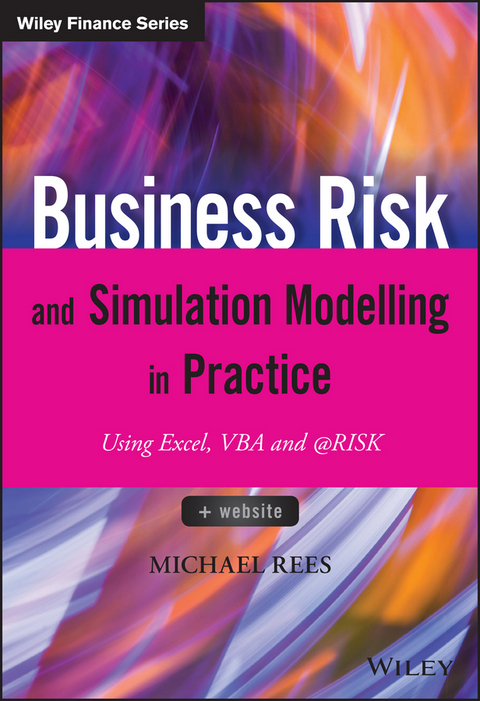
Business Risk and Simulation Modelling in Practice (eBook)
John Wiley & Sons (Verlag)
978-1-118-90404-6 (ISBN)

The complete guide to the principles and practice of risk quantification for business applications.
The assessment and quantification of risk provide an indispensable part of robust decision-making; to be effective, many professionals need a firm grasp of both the fundamental concepts and of the tools of the trade. Business Risk and Simulation Modelling in Practice is a comprehensive, in–depth, and practical guide that aims to help business risk managers, modelling analysts and general management to understand, conduct and use quantitative risk assessment and uncertainty modelling in their own situations. Key content areas include:
- Detailed descriptions of risk assessment processes, their objectives and uses, possible approaches to risk quantification, and their associated decision-benefits and organisational challenges.
- Principles and techniques in the design of risk models, including the similarities and differences with traditional financial models, and the enhancements that risk modelling can provide.
- In depth coverage of the principles and concepts in simulation methods, the statistical measurement of risk, the use and selection of probability distributions, the creation of dependency relationships, the alignment of risk modelling activities with general risk assessment processes, and a range of Excel modelling techniques.
- The implementation of simulation techniques using both Excel/VBA macros and the @RISK Excel add-in. Each platform may be appropriate depending on the context, whereas the core modelling concepts and risk assessment contexts are largely the same in each case. Some additional features and key benefits of using @RISK are also covered.
Business Risk and Simulation Modelling in Practice reflects the author′s many years in training and consultancy in these areas. It provides clear and complete guidance, enhanced with an expert perspective. It uses approximately one hundred practical and real-life models to demonstrate all key concepts and techniques; these are accessible on the companion website.
The complete guide to the principles and practice of risk quantification for business applications. The assessment and quantification of risk provide an indispensable part of robust decision-making; to be effective, many professionals need a firm grasp of both the fundamental concepts and of the tools of the trade. Business Risk and Simulation Modelling in Practice is a comprehensive, in depth, and practical guide that aims to help business risk managers, modelling analysts and general management to understand, conduct and use quantitative risk assessment and uncertainty modelling in their own situations. Key content areas include: Detailed descriptions of risk assessment processes, their objectives and uses, possible approaches to risk quantification, and their associated decision-benefits and organisational challenges. Principles and techniques in the design of risk models, including the similarities and differences with traditional financial models, and the enhancements that risk modelling can provide. In depth coverage of the principles and concepts in simulation methods, the statistical measurement of risk, the use and selection of probability distributions, the creation of dependency relationships, the alignment of risk modelling activities with general risk assessment processes, and a range of Excel modelling techniques. The implementation of simulation techniques using both Excel/VBA macros and the @RISK Excel add-in. Each platform may be appropriate depending on the context, whereas the core modelling concepts and risk assessment contexts are largely the same in each case. Some additional features and key benefits of using @RISK are also covered. Business Risk and Simulation Modelling in Practice reflects the author s many years in training and consultancy in these areas. It provides clear and complete guidance, enhanced with an expert perspective. It uses approximately one hundred practical and real-life models to demonstrate all key concepts and techniques; these are accessible on the companion website.
MICHAEL REES is an independent consultant and trainer for financial modelling. He works for a wide range of clients, including major corporations, private equity firms, fund managers, strategy consultants and risk management consultants.
Preface
This book aims to be a practical guide to help business risk managers, modelling analysts and general management to understand, conduct and use quantitative risk assessment and uncertainty modelling in their own situations. It is intended to provide a solid foundation in the most relevant aspects of quantitative modelling and the associated statistical concepts in a way that is accessible, intuitive, pragmatic and applicable to general business and corporate contexts. It also discusses the interfaces between quantitative risk modelling activities and the organisational context within which such activities take place. In particular, it covers links with general risk assessment processes and issues relating to organisational cultures, incentives and change management. Some knowledge of these issues is generally important in order to ensure the success of quantitative risk assessment approaches in practical organisational contexts.
The text is structured into three parts (containing 13 chapters in total):
- Part I provides an introduction to the topic of risk assessment in general terms.
- Part II covers the design and use of quantitative risk models.
- Part III provides an introduction to key ways to implement the repeated calculation steps that are required when conducting simulation, covering the use of VBA macros and that of the @RISK add-in.
The text has been written to be software independent as far as reasonably practical. Indeed (apart from an assumption that the reader wishes to use Excel to build any models), most of the text in Parts I and II would be identical whichever platform is used to actually perform the simulation process (i.e. whether it is VBA or @RISK). Thus, although some of the example files use Excel functionality only, and others use features of @RISK, essentially all could be readily built in either platform if necessary (there are a handful of exceptions): One would have to make a few simple formula changes in each case, with the tools presented in this text showing the reader how to do so. On the other hand, in the context of presenting data arising from probabilistic processes and simulation results, @RISK's graphical capabilities are generally more flexible (and quicker to implement) than those in Excel. Thus, for purposes of quality, consistency and convenience, many of the illustrations in the book use @RISK in order to show associated graphs, even where the model itself does not require @RISK per se. Thus, a reader is not required to have a copy of @RISK at that point in the text. Indeed, apart from when working with the examples in Chapter 13, there is no fundamental requirement for a reader to own a copy (or a trial version) of @RISK in order to gain value from the text. In fact, readers who wish to use other implementation platforms for the simulation itself may find many aspects of this text of relevance.
The choice to present both Excel/VBA and @RISK approaches serves a number of purposes:
- Whichever platform is used for the simulation, the core concepts, most of the modelling techniques and issues concerning process alignment and other organisational challenges are essentially the same. An integrated approach allows a reinforcement of some of the concepts from different perspectives, and provides a comparison between the possible implementation approaches whilst ensuring minimum repetition.
- Each platform has its own merits, so that in practice, some readers may need one approach whilst other readers would need another. In particular, not only is Excel essentially ubiquitous (and hence the implementation within Excel/VBA involves no additional cost), but also the range of possibilities to use Excel/VBA for risk modelling is larger than is often realised. For example, it is fairly straightforward to create random samples from over 20 probability distributions, and to correlate them. On the other hand, the use of @RISK can facilitate many aspects of the process associated with the building and communication of risk models and their results; in many organisation contexts, its use would be the most effective, flexible and transparent option, with the cost of the required licences generally being insignificant compared to the potential benefits and the investments being made (both in terms of participants' time and in terms of project investment budgets). The visual tools in @RISK also represent very powerful benefits from an organisational process perspective, where there is typically a large variety in the level of understanding of statistics and modelling within groups of participants.
The main content of each part and chapter is as follows:
- Part I introduces the need for risk assessment, its uses, the general process steps, possible approaches to risk quantification and the associated benefits and implementation challenges:
- In Chapter 1, we discuss the use of risk assessment in many day-to-day situations as an informal activity that most people conduct naturally, albeit implicitly and informally. We also present some prominent examples of where risk management has failed in business-related contexts. We then discuss some general challenges to the implementation of formalised risk assessment processes, before presenting key drivers of the need for more structured, explicit and formal approaches in some contexts, especially in many business situations. Finally, we present the main uses and objectives of general risk assessment processes.
- In Chapter 2, we cover general aspects of the risk assessment process, including tools to ensure that risk identification is appropriately thorough, the potential objectives and challenges in risk prioritisation, categories of risk mitigation actions, and some other selected process issues.
- In Chapter 3, we present a variety of possible qualitative and quantitative approaches to risk assessment, including their core aspects and relative benefits. We discuss the more demanding requirements of quantitative aggregation or full risk modelling approaches, especially in terms of risk identification and risk mapping. We note the associated challenges when qualitative or non-aggregate approaches are used as a basis for the subsequent development of quantitative models.
- In Chapter 4, we discuss the benefits of full risk modelling approaches, in relation both to risk register approaches to risk assessment and to traditional static (non-risk) modelling approaches to project evaluation and to general business analysis.
- In Chapter 5, we discuss many challenges in implementing quantitative risk modelling, especially those that relate to issues of an organisational, incentive, cultural, process and communications nature. An awareness of these can be of great importance both to modelling analysts and to senior management who wish to implement risk-based decision-making processes and to install a more risk-aware culture within their organisations.
- Part II provides a detailed discussion of the design and building of risk models:
- In Chapter 6, we present the key principles of simulation methods. We also cover the relationships between simulation and other numerical modelling techniques, such as sensitivity, scenario and optimisation analysis.
- In Chapter 7, we discuss core aspects in the design of risk models. We highlight some important similarities between risk modelling and traditional static modelling, as well as covering some of the key differences. We also discuss issues that need to be addressed in order to align the modelling activities with those of a general risk assessment process, as well as issues faced when integrating risk assessment into existing models.
- In Chapter 8, we cover statistical measures of risk and probability distributions, as well as the general topic of risk measurement using properties of distributions; this has general relevance for the use of distributions as inputs to risk models, and for the interpretation of simulation results.
- In Chapter 9, we describe over 20 distributions and their uses; these are usually sufficient for most practical activities in business risk modelling, and are available both in @RISK and in Excel/VBA. We also discuss the approximation of distributions with each other, and the processes and possible frameworks to select an appropriate distribution to use.
- In Chapter 10, we present methods to create random samples from the distributions discussed in Chapter 9; this is fundamental to readers wishing to use Excel/VBA approaches, whereas it is in-built as part of @RISK's distribution functions.
- In Chapter 11, we discuss the modelling of dependency relationships that are specific to risk models, including techniques such as the use of conditional probabilities, parameter dependencies, scenarios, correlated sampling, time-series modelling and others.
- Part III presents practical methods to implement the repeated calculations of a model that is the hallmark of simulation methods. The advantages of presenting this topic at the end of the text include that the core concepts apply to whichever platform is used for the simulation, and that it allows readers to achieve a strong basis in the concepts and understand the possibilities that quantitative risk modelling may offer, without needing to necessarily become involved in the technical aspects of implementation. We initially focus on the “mechanical” aspects of each platform, which are presented in a step-by-step fashion within the context of a simple model. We aim for the early part of the discussion to...
| Erscheint lt. Verlag | 5.8.2015 |
|---|---|
| Reihe/Serie | The Wiley Finance Series |
| Wiley Finance Series | Wiley Finance Series |
| Sprache | englisch |
| Themenwelt | Informatik ► Office Programme ► Outlook |
| Recht / Steuern ► Wirtschaftsrecht | |
| Wirtschaft ► Betriebswirtschaft / Management ► Finanzierung | |
| Schlagworte | business modeling • Business Risk and Simulation Modeling in Practice: Using Excel, VBA, and @RISK • dependency and correlation modeling • Excel modeling • Finance & Investments • financial modeling • Financial risk modeling • Finanz- u. Anlagewesen • Finanzwesen • Michael Rees • Modeling uncertainty • practical risk analysis • risk analysis • risk analysis statistical concepts • risk analysis technology • @RISK Excel add-in • Risk Modeling • risk modeling guide • risk modeling tools • Risk Quantification • Simulation Modeling • using VBA with Excel |
| ISBN-10 | 1-118-90404-4 / 1118904044 |
| ISBN-13 | 978-1-118-90404-6 / 9781118904046 |
| Informationen gemäß Produktsicherheitsverordnung (GPSR) | |
| Haben Sie eine Frage zum Produkt? |
 EPUB (Adobe DRM)
Kopierschutz: Adobe-DRM
Adobe-DRM ist ein Kopierschutz, der das eBook vor Mißbrauch schützen soll. Dabei wird das eBook bereits beim Download auf Ihre persönliche Adobe-ID autorisiert. Lesen können Sie das eBook dann nur auf den Geräten, welche ebenfalls auf Ihre Adobe-ID registriert sind.
Details zum Adobe-DRM
Dateiformat: EPUB (Electronic Publication)
EPUB ist ein offener Standard für eBooks und eignet sich besonders zur Darstellung von Belletristik und Sachbüchern. Der Fließtext wird dynamisch an die Display- und Schriftgröße angepasst. Auch für mobile Lesegeräte ist EPUB daher gut geeignet.
Systemvoraussetzungen:
PC/Mac: Mit einem PC oder Mac können Sie dieses eBook lesen. Sie benötigen eine
eReader: Dieses eBook kann mit (fast) allen eBook-Readern gelesen werden. Mit dem amazon-Kindle ist es aber nicht kompatibel.
Smartphone/Tablet: Egal ob Apple oder Android, dieses eBook können Sie lesen. Sie benötigen eine
Geräteliste und zusätzliche Hinweise
Buying eBooks from abroad
For tax law reasons we can sell eBooks just within Germany and Switzerland. Regrettably we cannot fulfill eBook-orders from other countries.
aus dem Bereich