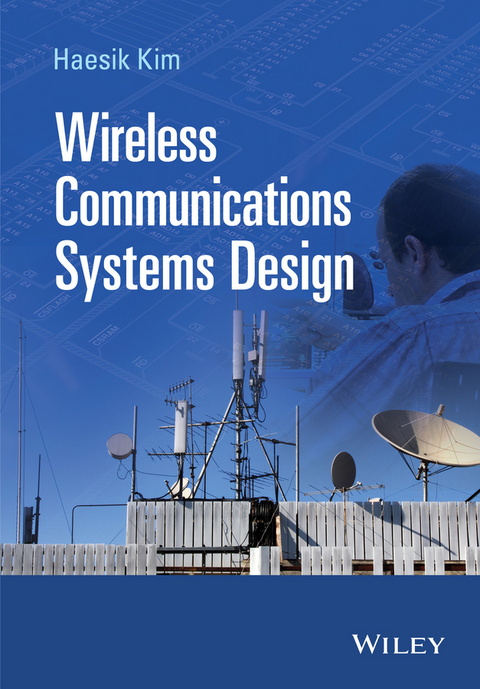
Wireless Communications Systems Design (eBook)
John Wiley & Sons (Verlag)
978-1-118-75944-8 (ISBN)
Wireless Communications Systems Design provides the basic knowledge and methodology for wireless communications design. The book mainly focuses on a broadband wireless communication system based on OFDM/OFDMA system because it is widely used in the modern wireless communication system. It is divided into three parts: wireless communication theory (part I), wireless communication block design (part II), and wireless communication block integration (part III). Written by an expert with various experience in system design (standards, research and development)
Wireless Communications Systems Design provides the basic knowledge and methodology for wireless communications design. The book mainly focuses on a broadband wireless communication system based on OFDM/OFDMA system because it is widely used in the modern wireless communication system. It is divided into three parts: wireless communication theory (part I), wireless communication block design (part II), and wireless communication block integration (part III). Written by an expert with various experience in system design (standards, research and development)
Dr Haesik Kim, VTT, Finland Dr Haesik Kim received the Ph.D. degree in Communication Systems from Lancaster University in UK. He is currently Sr. scientist in VTT Technical Research Centre of Finland and is involved in many research works such as energy efficient wireless communications, cognitive radio and network, etc. Previously, he was with NEC Laboratory UK where he carried out research on WiMAX physical layer design and standard. He has also worked at Samsung Advanced Institute of Technology (SAIT) where he focused on UWB and SDR physical layer design and served as system definition group member of WiMedia (MB-OFDM based UWB standard). Prior to that, he worked as ADSL modem developer in SME.
List of Abbreviations
- 2G
- The 2nd Generation
- 3G
- The 3rd Generation
- 3GPP
- The 3rd Generation Partnership Project
- ACS
- Add-Compare-Select
- ADC
- Analogue to Digital Converter
- AGC
- Automatic Gain Control
- AHB
- Advanced High-performance Bus
- AMBA
- Advanced Microcontroller Bus Architecture
- AMC
- Adaptive Modulation and Coding
- AMPS
- Advanced Mobile Phone System
- APB
- Advanced Peripheral Bus
- ARQ
- Automatic Repeat Request
- ASIC
- Application-Specific Integrated Circuit
- AVS
- Adaptive Voltage Scaling
- AWGN
- Additive White Gaussian Noise
- BCH
- Bose-Chaudhuri-Hocquenghem
- BCJR
- Bahl-Cocke-Jelinek-Raviv
- B-DMC
- Binary Discrete Memoryless Channels
- BEC
- Binary Erasure Channel
- BER
- Bit Error Rate
- BLAST
- Bell LAboratories layered Space Time
- BPF
- Band Pass Filter
- BPSK
- Binary Phase Shift Keying
- BS
- Base Station
- BSC
- Binary Symmetric Channel
- BTC
- Block Turbo Code
- CBIC
- Cell-based IC
- CC
- Convolutional Code
- CDF
- Cumulative Distribution Function
- CDMA
- Code Division Multiple Access
- CEPT
- European Conference of Postal and Telecommunications Administrations
- CID
- Connection Identifier
- CINR
- Carrier to Interference-plus-Noise Ratio
- CIR
- Channel Impulse Response
- CMOS
- Complementary Metal Oxide Semiconductor
- CORDIC
- COordinate Rotation DIgital Computer
- CP
- Cyclic Prefix
- CPS
- Common Part Sublayer
- CPU
- Central Processing Unit
- CQI
- Channel Quality Indicators
- CQICH
- Channel Quality Information Channel
- CRC
- Cyclic Redundancy Check
- CS
- Convergence Sublayer
- CSI
- Channel State Information
- CTC
- Convolutional Turbo Code
- DAC
- Digital to- analogue Converter
- DC
- Direct Current
- DDCE
- Decision-Directed Channel Estimation
- DFG
- Data Flow Graph
- DFT
- Discrete Fourier Transform
- DMA
- Direct Memory Access
- DNS
- Domain Name System
- DPSK
- Differential Phase Shift Keying
- DRS
- Demodulation Reference Signal
- DS
- Direct-Sequence
- DSL
- Digital Subscriber Line
- DSP
- Digital Signal Processor
- DVB-T
- Digital Video Broadcasting-Terrestrial
- DVFS
- Dynamic Voltage and Frequency Scaling
- DwPTS
- Downlink Pilot Time Slot
- EDA
- Electronic Design Automation
- EGC
- Equal Gain Combining
- EIRP
- Effective (or Equivalent) Isotropic Radiated Power
- eNB/eNodeB
- Evolved Node B
- ESD
- Energy Spectral Density
- ETSI
- European Telecommunications Standards Institute
- FCC
- Federal Communications Commission
- FCH
- Frame Control Head
- FDD
- Frequency Division Duplexing
- FDM
- Frequency Division Multiplexing
- FDMA
- Frequency Division Multiple Access
- FEC
- Forward Error Correction
- FEQ
- Frequency Domain eQualization
- FFT
- Fast Fourier Transform
- FIR
- Finite Impulse Response
- FPGA
- Field Programmable Gate Array
- FSD
- Fixed Sphere Decoding
- FSM
- Finite State Machine
- FTP
- File Transfer Protocol
- FUSC
- Fully Used Subchannels
- GF
- Galois Field
- GOS
- Grade of Service
- GP
- Guard Period
- GPIO
- General-Purpose Input/Output
- GSM
- Global System for Mobile Communications
- HDL
- Hardware Description Language
- HSPA
- High Speed Packet Access
- HTTP
- Hypertext Transfer Protocol
- HW
- Hardware
- IC
- Integrated Circuit
- ICI
- Inter-Carrier Interference
- ICMP
- Internet Control Message Protocol
- IDFT
- Inverse Discrete Fourier Transform
- IEEE
- Institute of Electrical and Electronics Engineers
- IFFT
- Inverse Fast Fourier Transform
- IGMP
- Internet Group Management Protocol
- IP
- Internet Protocol
- ISI
- Inter Symbol Interference
- ISO
- International Standard Organisation
- ITU
- International Telecommunication Union
- ITU-R
- International Telecommunication Union Radio communications sector
- JPEG
- Joint Photographic Experts Group
- LDPC
- Low Density Parity Check
- LFSR
- Linear Feedback Shift Register
- LLC
- Logical Link Control
- LLR
- Log Likelihood Ratio
- LMMSE
- Linear MMSE
- LNA
- Low Noise Amplifier
- LO
- Local Oscillator
- LPF
- Low Pass Filter
- LS
- Least Square
- LT
- Luby Transform
- LTE
- Long Term Evolution
- LTE-A
- Long Term Evolution-Advanced
- LUT
- Look-Up Table
- MAC
- Media Access Control
- MAP
- Maximum a Posteriori
- MAPL
- Maximum Allowable Path Loss
- MBSFN
- Multicast Broadcast Signal Frequency Network
- MIMO
- Multiple Input Multiple Output
- ML
- Maximum Likelihood
- MMSE
- Minimum Mean Squared Error
- MPEG
- Moving Picture Experts Group
- MPSK
- M-ary Phase Shift Keying
- MPSoC
- MultiProcessor System-on-Chip
- MRC
- Maximal Ratio Combining
- MS
- Mobile Station
- MSE
- Mean Squared Error
- NMT
- Nordic Mobile Telephone
- NP
- Nondeterministic Polynomial
- NTT
- Nippon Telegraph and Telephone
- Ofcom
- Office of Communications
- OFDM
- Orthogonal Frequency Division Multiplexing
- OFDMA
- Orthogonal Frequency Division Multiple Access
- OSI
- Open Systems Interconnection
- PA
- Power Amplifier
- PAPR
- Peak-to-Average Power Ratio
- PBCH
- Physical Broadcast Channel
- PCFICH
- Physical Control Format Indicator Channel
- PCI
- Protocol Control Information
- PDCCH
- Physical Downlink Control Channel
- Probability Density Function
- PDSCH
- Physical Downlink Shared Channel
- PDU
- Protocol Data Unit
- PED
- Partial Euclidean Distance
- PEP
- Pairwise Error Probability
- PHICH
- Physical Hybrid ARQ Indicator Channel
- PHY
- PHYsical Layer
- PLL
- Phase Locked Loop
- PMCH
- Physical Multicast Channel
- PN
- Pseudo-Noise
- PPP
- Point-to-Point Protocol
- PRACH
- Physical Random Access Channel
- PSD
- Power Spectral Density
- PSS
- Primary Synchronization Signal
- PUCCH
- Physical Uplink Control Channel
- PUSC
- Partially Used Subchannels
- PUSCH
- Physical Uplink Shared Channel
- QC
- Quasi Cyclic
- QoS
- Quality of Service
- QPSK
- Quadrature Phase Shift Keying
- R2MDC
- Radix-2 Multi-path Delay Commutator
- R2SDF
- Radix-2 Single-path Delay Feedback
- RACH
- Random Access Channel
- RB
- Resource Block
- RF
- Radio Frequency
- RM
- Reed-Muller
- rms
- Root Mean Square
- RS
- Reed-Solomon
- RSC
- Recursive Systematic Convolutional
- RSSI
- Received Signal Strength Indication
- RTG
- Receive Transition Gap
- RTL
- Register-Transfer Level
- SAP
- Service Access Points
- SC
- Selection Combining
- SD
- Sphere Decoding
- SDMA
- Space-Division Multiple Access
- SDR
- Software Defined Radio
- SDU
- Service Data Unit
- SFID
- Service Flow Identifier
- SIC
- Successive Interference Cancellation
- SINR
- Signal to Interference plus Noise Ratio
- SISO
- Soft Input Soft Output
- SMB
- Server Message Block
- SNR
- Signal to Noise Ratio
- SoC
- System-on-Chip
- SOVA
- Soft Output Viterbi Algorithm
- SPC
- Single Parity...
| Erscheint lt. Verlag | 6.8.2015 |
|---|---|
| Sprache | englisch |
| Themenwelt | Mathematik / Informatik ► Informatik ► Netzwerke |
| Technik ► Elektrotechnik / Energietechnik | |
| Technik ► Nachrichtentechnik | |
| Schlagworte | Communication Technology - Networks • Computer Science • Drahtlose Kommunikation • Electrical & Electronics Engineering • Elektrotechnik u. Elektronik • Informatik • Kommunikationsnetze • Mobile & Wireless Communications • Networking • Netzwerke • OFDM/OFDMA • Systems Design • telecommunications • wireless communications |
| ISBN-10 | 1-118-75944-3 / 1118759443 |
| ISBN-13 | 978-1-118-75944-8 / 9781118759448 |
| Informationen gemäß Produktsicherheitsverordnung (GPSR) | |
| Haben Sie eine Frage zum Produkt? |
 EPUB (Adobe DRM)
Kopierschutz: Adobe-DRM
Adobe-DRM ist ein Kopierschutz, der das eBook vor Mißbrauch schützen soll. Dabei wird das eBook bereits beim Download auf Ihre persönliche Adobe-ID autorisiert. Lesen können Sie das eBook dann nur auf den Geräten, welche ebenfalls auf Ihre Adobe-ID registriert sind.
Details zum Adobe-DRM
Dateiformat: EPUB (Electronic Publication)
EPUB ist ein offener Standard für eBooks und eignet sich besonders zur Darstellung von Belletristik und Sachbüchern. Der Fließtext wird dynamisch an die Display- und Schriftgröße angepasst. Auch für mobile Lesegeräte ist EPUB daher gut geeignet.
Systemvoraussetzungen:
PC/Mac: Mit einem PC oder Mac können Sie dieses eBook lesen. Sie benötigen eine
eReader: Dieses eBook kann mit (fast) allen eBook-Readern gelesen werden. Mit dem amazon-Kindle ist es aber nicht kompatibel.
Smartphone/Tablet: Egal ob Apple oder Android, dieses eBook können Sie lesen. Sie benötigen eine
Geräteliste und zusätzliche Hinweise
Buying eBooks from abroad
For tax law reasons we can sell eBooks just within Germany and Switzerland. Regrettably we cannot fulfill eBook-orders from other countries.
aus dem Bereich