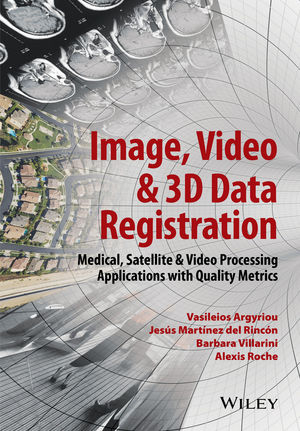
Image, Video and 3D Data Registration (eBook)
Data registration refers to a series of techniques for matching or bringing similar objects or datasets together into alignment. These techniques enjoy widespread use in a diverse variety of applications, such as video coding, tracking, object and face detection and recognition, surveillance and satellite imaging, medical image analysis and structure from motion. Registration methods are as numerous as their manifold uses, from pixel level and block or feature based methods to Fourier domain methods.
This book is focused on providing algorithms and image and video techniques for registration and quality performance metrics. The authors provide various assessment metrics for measuring registration quality alongside analyses of registration techniques, introducing and explaining both familiar and state-of-the-art registration methodologies used in a variety of targeted applications.
Key features:
- Provides a state-of-the-art review of image and video registration techniques, allowing readers to develop an understanding of how well the techniques perform by using specific quality assessment criteria
- Addresses a range of applications from familiar image and video processing domains to satellite and medical imaging among others, enabling readers to discover novel methodologies with utility in their own research
- Discusses quality evaluation metrics for each application domain with an interdisciplinary approach from different research perspectives
Data registration refers to a series of techniques for matching or bringing similar objects or datasets together into alignment. These techniques enjoy widespread use in a diverse variety of applications, such as video coding, tracking, object and face detection and recognition, surveillance and satellite imaging, medical image analysis and structure from motion. Registration methods are as numerous as their manifold uses, from pixel level and block or feature based methods to Fourier domain methods. This book is focused on providing algorithms and image and video techniques for registration and quality performance metrics. The authors provide various assessment metrics for measuring registration quality alongside analyses of registration techniques, introducing and explaining both familiar and state-of-the-art registration methodologies used in a variety of targeted applications.Key features: Provides a state-of-the-art review of image and video registration techniques, allowing readers to develop an understanding of how well the techniques perform by using specific quality assessment criteria Addresses a range of applications from familiar image and video processing domains to satellite and medical imaging among others, enabling readers to discover novel methodologies with utility in their own research Discusses quality evaluation metrics for each application domain with an interdisciplinary approach from different research perspectives
Vasileios Argyriou, School of Computing and Information Systems, Faculty of Science, Engineering and Computing University of Kingston, UK Dr. Argyriou is a Senior Lecturer of Computing Information Systems and Mathematics at Kingston University. His research focuses on computer vision and computer games. Dr. Argyriou is a committee member of BSI British Standards working on the new global standard for biometric IDs and 3D face information. Dr. Argyriou conceived, ?organised and chaired the first, second and third international workshops on Computer Vision for Computer Games (CVCG) part of the CVPR 2010-2012 conferences to bring together game industry and researchers on video processing, action recognition, real time systems and 3D scene reconstruction. Georgios Tzimiropoulos, School of Computer Science, University of Lincoln, UK Dr. Tzimiropoulos is a Senior Lecturer in the School of Computer Science at the University of Lincoln, U.K. He is currently an Associate Editor of the Image and Vision Computing Journal. He also serves as an Area Chair for the tenth IEEE Conference on Automatic Face and Gesture Recognition. His research interests include face and object recognition, alignment and tracking, and facial expression analysis. He is a member of the IEEE. Barbara Villarini, Advanced Research Technology ART Group, Italy Dr. Villarini is a researcher and developer at Advanced Research Technology ART group s.r.l working on innovative technologies to manage and optimize digital cinema from small cinema to multiplexing. She has participated in a number of EU and national projects, including the European Project EDCine in IST FP6, working on the improvement and achievement of the interoperability of Digital Cinema based on JPEG 2000 coding.
Preface
Acknowledgments
Chapter 1 Introduction
Vasileios Argyriou
Chapter 2 Registration for video coding
Vasileios Argyriou
Chapter 3 Registration for motion estimation and object tracking
Jesus Martinez del Rincon
Chapter 4 Face alignment and recognition using registration
Jesus Martinez del Rincon
Chapter 5 Remote sensing image registration in the frequency domain
Vasileios Argyriou
Chapter 6 Structure from motion
Vasileios Argyriou
Chapter 7 Medical image registration measures
Alexis Roche
Chapter 8 Video restoration using motion information
Vasileios Argyriou
Index
Chapter 1
Introduction
In the last few decades, the evolution in technology has provided a rapid development in image acquisition and processing, leading to a growing interest in related research topics and applications including image registration. Registration is defined as the estimation of a geometrical transformation that aligns points from one viewpoint of a scene with the corresponding points in the other viewpoint. Registration is essential in many applications such as video coding, tracking, detection and recognition of object and face, surveillance and satellite imaging, structure from motion, simultaneous localization and mapping, medical image analysis, activity recognition for entertainment, behaviour analysis and video restoration. It is considered one of the most complex and challenging problems in image analysis with no single registration algorithm to be suitable for all the related applications due to the extreme diversity and variety of scenes and scenarios. This book presents image, video and 3D data registration techniques for different applications discussing also the related quality performance metrics and datasets. State-of-the-art registration methods based on the targeted application are analysed, including an introduction to the problems and limitations of each method. Additionally, various assessment quality metrics for registration are presented indicating the differences among the related research areas. For example, the important features in a medical image (e.g. MRI data) may not be the same as in the picture of a human face, and therefore the quality metrics are adjusted accordingly. Therefore, state-of-the-art metrics for quality assessment are analysed explaining their advantages and disadvantages, and providing visual examples separately for each of the considered application areas.
1.1 The History of Image Registration
In image processing, one of the first times that the concept of registration appeared was in Roberts' work in 1963 [1]. He located and recognized predefined polyhedral objects in scenes by aligning their edge projections with image projections. The first registration applied to an image was in the remote sensing literature. Using sum of absolute differences as similarity measure, Barnea and Silverman [2] and Anuta [3, 4] proposed some automatic methods to register satellite images. In the same years, Leese [5] and Pratt [6] proposed a similar approach using the cross-correlation coefficient as similarity measure. In the early 1980s, image registration was used in biomedical image analysis using data acquired from different scanners measuring anatomy. In 1973, for the first time Fischler and Elschlager [7] used non-rigid registration to locate deformable objects in images. Also, non-rigid registration was used to align deformed images and to recognize handwritten letters. In medical imaging, registration was employed to aligned magnetic resonance (MR) and computer tomography (CT) brain images trying to build an atlas [8, 9].
Over the last few years due to the advent of powerful and low-cost hardware, real-time registration algorithms have been introduced, improving significantly their performance and accuracy. Consequently, novel quality metrics were introduced to allow unbiased comparative studies. This book will provide an analysis of the most important registration methodologies and quality metrics, covering the most important research areas and applications. Through this book, all the registration approaches in different applications will be presented allowing the reader to get ideas supporting knowledge transfer from one application area to another.
1.2 Definition of Registration
During the last decades, automatic image registration became essential in many image processing applications due to the significant amount of acquired data. With the term image registration, we define the process of overlaying two or more images of the same scene captured in different times and viewpoints or sensors. It represents a geometrical transformation that aligns points of an object observed from a viewpoint with the corresponding points of the same or different object captured from another viewpoint. Image registration is an important part of many image processing tasks that require information and data captured from different sources, such as image fusion, change detection and multichannel image restoration. Image registration techniques are used in different contexts and types of applications. Typically, it is widely used in computer vision (e.g. target localization, automatic quality control), in remote sensing (e.g. monitoring of the environment, change detection, multispectral classification, image mosaicing, geographic systems, super-resolution), in medicine (e.g. combining CT or ultrasound with MR data in order to get more information, monitor the growth of tumours, verify or improve the treatments) and in cartography updating maps. Image registration is also employed in video coding in order to exploit the temporal relationship between successive frames (i.e. motion estimation techniques are used to remove temporal redundancy improving video compression and transmission).
In general, registration techniques can be divided into four main groups based on how the data have been acquired [10]:
- Different viewpoints (multiview analysis): A scene is acquired from different viewpoints in order to obtain a larger/panoramic 2D view or a 3D representation of the observed scene.
- Different times (multitemporal analysis): A scene is acquired in different times, usually on a regular basis, under different conditions, in order to evaluate changes among consecutive acquisitions.
- Different sensors (multimodal analysis): A scene is acquired using different kinds of sensors. The aim is to integrate the information from different sources in order to reveal additional information and complex details of the scene.
- Scene to model registration: The image and the model of a scene are registered. The model can be a computer representation of the given scene, and the aim is to locate the acquired scene in the model or compare them.
It is not possible to define a universal method that can be applied to all registration tasks due to the diversity of the images and the different types of degradation and acquisition sources. Every method should take different aspects into account. However, in most of the cases, the registration methods consist of the following steps:
- Feature detection: Salient objects, such as close-boundary regions, edges, corners, lines and intersections, are manually or automatically detected. These features can be represented using points such as centre of gravity and line endings, which are called control points (CPs).
- Feature matching: The correspondence between the detected features and the reference features is estimated. In order to establish the matching, features, descriptors and similarity measures among spatial relationships are used.
- Transform model estimation: According to the matched features, parameters of mapping functions are computed. These parameters are used to align the sensed image with the reference image.
- Image resampling and transformation: The sensed image is transformed using the mapping functions. Appropriate interpolation techniques can be used in order to calculate image values in non-integer coordinates.
1.3 What is Motion Estimation
Video processing differs from image processing due to the fact that most of the observed objects in the scene are not static. Understanding how objects move helps to transmit, store and manipulate video in an efficient way. Motion estimation is the research area of imaging a video processing that deals with these problems, and it is also linked to feature matching stage of the registration algorithms. Motion estimation is the process by which the temporal relationship between two successive frames in a video sequence is determined. Motion estimation is a registration method used in video coding and other applications to exploit redundancy mainly in the temporal domain.
When an object in a 3D environment moves, the luminance of its projection in 2D is changing either due to non-uniform lighting or due to motion. Assuming uniform lighting, the changes can only be interpreted as movement. Under this assumption, the aim of motion estimation techniques is to accurately model the motion field. An efficient method can produce more accurate motion vectors, resulting in the removal of a higher degree of correlation.
Integer pixel registration may be adequate in many applications, but some problems require sub-pixel accuracy, either to improve the compression ratio or to provide a more precise representation of the actual scene motion. Despite the fact that sub-pixel motion estimation requires additional computational power and execution time, the obtained advantages settle its use that is essential for the most multimedia applications.
In a typical video sequence, there is no 3D information about the scene contents. The 2D projection approximating a 3D scene is known as ‘homography’, and the velocity of the 3D objects corresponds to the velocity of the luminance intensity on the 2D projection, known as ‘optical flow’. Another term is ‘motion field’, a 2D matrix of motion vectors, corresponding to how each pixel or block of pixels moves. General ‘motion field’ is a set of motion vectors, and this term is related to the ‘optical flow’ term, with the latter being...
| Erscheint lt. Verlag | 1.7.2015 |
|---|---|
| Sprache | englisch |
| Themenwelt | Informatik ► Grafik / Design ► Digitale Bildverarbeitung |
| Technik ► Elektrotechnik / Energietechnik | |
| Schlagworte | Bild- u. Videoverarbeitung • Bildverarbeitung • computer vision • Electrical & Electronics Engineering • Elektrotechnik u. Elektronik • Image and Video Processing • Maschinelles Sehen • Medical Imaging • Quality Metrics • registration • Satellite data alignment • Structure from Motion • Tracking and Activity analysis • video coding • Video restoration • Videoverarbeitung |
| ISBN-10 | 1-118-70243-3 / 1118702433 |
| ISBN-13 | 978-1-118-70243-7 / 9781118702437 |
| Informationen gemäß Produktsicherheitsverordnung (GPSR) | |
| Haben Sie eine Frage zum Produkt? |
 EPUB (Adobe DRM)
Kopierschutz: Adobe-DRM
Adobe-DRM ist ein Kopierschutz, der das eBook vor Mißbrauch schützen soll. Dabei wird das eBook bereits beim Download auf Ihre persönliche Adobe-ID autorisiert. Lesen können Sie das eBook dann nur auf den Geräten, welche ebenfalls auf Ihre Adobe-ID registriert sind.
Details zum Adobe-DRM
Dateiformat: EPUB (Electronic Publication)
EPUB ist ein offener Standard für eBooks und eignet sich besonders zur Darstellung von Belletristik und Sachbüchern. Der Fließtext wird dynamisch an die Display- und Schriftgröße angepasst. Auch für mobile Lesegeräte ist EPUB daher gut geeignet.
Systemvoraussetzungen:
PC/Mac: Mit einem PC oder Mac können Sie dieses eBook lesen. Sie benötigen eine
eReader: Dieses eBook kann mit (fast) allen eBook-Readern gelesen werden. Mit dem amazon-Kindle ist es aber nicht kompatibel.
Smartphone/Tablet: Egal ob Apple oder Android, dieses eBook können Sie lesen. Sie benötigen eine
Geräteliste und zusätzliche Hinweise
Buying eBooks from abroad
For tax law reasons we can sell eBooks just within Germany and Switzerland. Regrettably we cannot fulfill eBook-orders from other countries.
aus dem Bereich