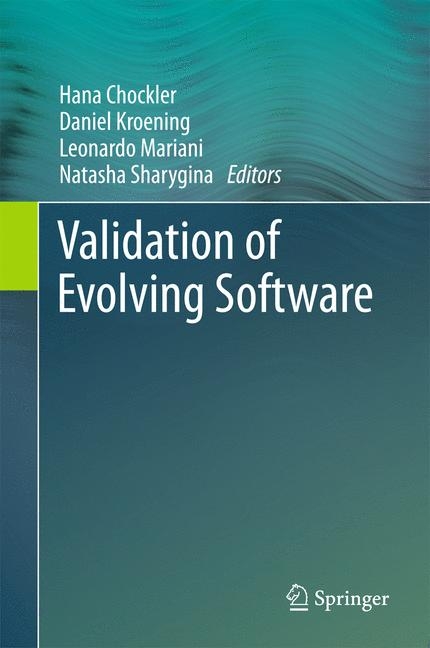
Validation of Evolving Software (eBook)
VIII, 220 Seiten
Springer International Publishing (Verlag)
9783319106236 (ISBN)
This book describes the methodology and accompanying technology for reducing the costs of validation of changes by introducing automatic techniques to analyze and test software increments. It builds a unified approach to efficient and reliable validation of changes and upgrades, and may be used as a research monograph and a reference book.
Dr. Hana Chockler received her Ph.D. in Computer Science from the Hebrew University of Jerusalem in 2003. She is a member of the Software Modelling and Applied Logic Group in King's College, London, UK; she previously worked in the formal methods group at IBM Haifa Research Labs. She has particular expertise in coverage metrics and their extension to quality metrics; her broader research interests include formal verification, model-checking of hardware and software; coverage and vacuity in formal verification; causality, responsibility and its relation to formal methods; explanation of counterexamples and the cross-entropy method for testing.
Prof. Daniel Kroening received his Ph.D. in Computer Science from Saarland University in 2001. He was an assistant professor at ETH Zurich in 2004-2007, he is now a professor in the Dept. of Computer Science at the University of Oxford. His areas of interest include model checking, decision procedures and software analysis. A feature of his work is frequent interaction with industrial partners, such as Microsoft Research, Intel Research, Toyota Motors, Ford, and Airbus UK.
Dr. Leonardo Mariani received his Ph.D. in Computer Science at the University of Milano Bicocca in 2005, where he is currently a researcher, collaborating with the Laboratory of Test and Analysis. His research interests include the test and analysis of component-based systems, inference of behavioural models, dynamic analysis, test and analysis of service-based applications, design of self-healing solutions and the design and development of autonomous and adaptive systems.
Prof. Natasha Sharygina received her Ph.D. from the University of Texas at Austin. She is the head of the Formal Verification lab at the University of Lugano (USI) and an adjunct professor at Carnegie Mellon University. She is an expert in the field of formal verification, static analysis and system design. Her lab creates both theoretical frameworks and practical tools to enable sound, scalable verification of industrial-size systems and they collaborate with industrial partners such as IBM Haifa, Cadence, Intel and ABB.
Dr. Hana Chockler received her Ph.D. in Computer Science from the Hebrew University of Jerusalem in 2003. She is a member of the Software Modelling and Applied Logic Group in King's College, London, UK; she previously worked in the formal methods group at IBM Haifa Research Labs. She has particular expertise in coverage metrics and their extension to quality metrics; her broader research interests include formal verification, model-checking of hardware and software; coverage and vacuity in formal verification; causality, responsibility and its relation to formal methods; explanation of counterexamples and the cross-entropy method for testing.Prof. Daniel Kroening received his Ph.D. in Computer Science from Saarland University in 2001. He was an assistant professor at ETH Zurich in 2004–2007, he is now a professor in the Dept. of Computer Science at the University of Oxford. His areas of interest include model checking, decision procedures and software analysis. A feature of his work is frequent interaction with industrial partners, such as Microsoft Research, Intel Research, Toyota Motors, Ford, and Airbus UK.Dr. Leonardo Mariani received his Ph.D. in Computer Science at the University of Milano Bicocca in 2005, where he is currently a researcher, collaborating with the Laboratory of Test and Analysis. His research interests include the test and analysis of component-based systems, inference of behavioural models, dynamic analysis, test and analysis of service-based applications, design of self-healing solutions and the design and development of autonomous and adaptive systems.Prof. Natasha Sharygina received her Ph.D. from the University of Texas at Austin. She is the head of the Formal Verification lab at the University of Lugano (USI) and an adjunct professor at Carnegie Mellon University. She is an expert in the field of formal verification, static analysis and system design. Her lab creates both theoretical frameworks and practical tools to enable sound, scalable verification of industrial-size systems and they collaborate with industrial partners such as IBM Haifa, Cadence, Intel and ABB.
Introduction.- Challenges of Existing Technology.- Static Analysis.- Dynamic Analysis.- Hybrid Analysis.- Quality of Validation.
| Erscheint lt. Verlag | 1.7.2015 |
|---|---|
| Zusatzinfo | VIII, 220 p. 60 illus., 28 illus. in color. |
| Verlagsort | Cham |
| Sprache | englisch |
| Themenwelt | Mathematik / Informatik ► Informatik |
| Schlagworte | Efficient Validation • evolving software • formal methods • Hybrid Techniques • Incremental Validation • Testing • Validation |
| ISBN-13 | 9783319106236 / 9783319106236 |
| Informationen gemäß Produktsicherheitsverordnung (GPSR) | |
| Haben Sie eine Frage zum Produkt? |
 PDF (Wasserzeichen)
DRM: Digitales Wasserzeichen
Dieses eBook enthält ein digitales Wasserzeichen und ist damit für Sie personalisiert. Bei einer missbräuchlichen Weitergabe des eBooks an Dritte ist eine Rückverfolgung an die Quelle möglich.
Dateiformat: PDF (Portable Document Format)
Mit einem festen Seitenlayout eignet sich die PDF besonders für Fachbücher mit Spalten, Tabellen und Abbildungen. Eine PDF kann auf fast allen Geräten angezeigt werden, ist aber für kleine Displays (Smartphone, eReader) nur eingeschränkt geeignet.
Systemvoraussetzungen:
PC/Mac: Mit einem PC oder Mac können Sie dieses eBook lesen. Sie benötigen dafür einen PDF-Viewer - z.B. den Adobe Reader oder Adobe Digital Editions.
eReader: Dieses eBook kann mit (fast) allen eBook-Readern gelesen werden. Mit dem amazon-Kindle ist es aber nicht kompatibel.
Smartphone/Tablet: Egal ob Apple oder Android, dieses eBook können Sie lesen. Sie benötigen dafür einen PDF-Viewer - z.B. die kostenlose Adobe Digital Editions-App.
Buying eBooks from abroad
For tax law reasons we can sell eBooks just within Germany and Switzerland. Regrettably we cannot fulfill eBook-orders from other countries.
aus dem Bereich