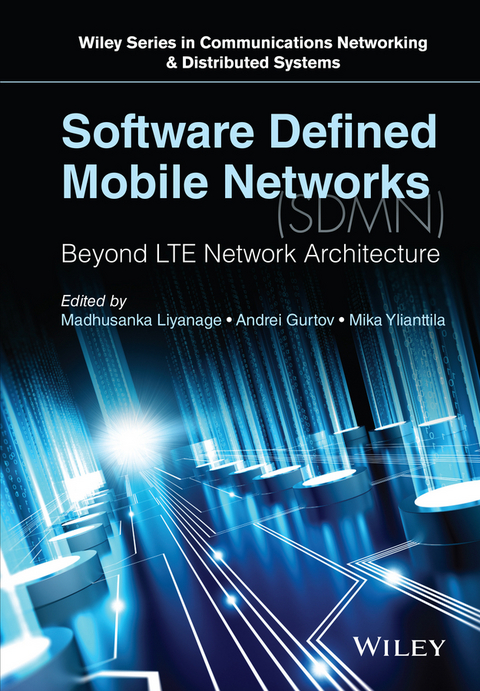
Software Defined Mobile Networks (SDMN) (eBook)
John Wiley & Sons (Verlag)
978-1-118-90026-0 (ISBN)
This book describes the concept of a Software Defined Mobile Network (SDMN), which will impact the network architecture of current LTE (3GPP) networks. SDN will also open up new opportunities for traffic, resource and mobility management, as well as impose new challenges on network security. Therefore, the book addresses the main affected areas such as traffic, resource and mobility management, virtualized traffics transportation, network management, network security and techno economic concepts. Moreover, a complete introduction to SDN and SDMN concepts. Furthermore, the reader will be introduced to cutting-edge knowledge in areas such as network virtualization, as well as SDN concepts relevant to next generation mobile networks. Finally, by the end of the book the reader will be familiar with the feasibility and opportunities of SDMN concepts, and will be able to evaluate the limits of performance and scalability of these new technologies while applying them to mobile broadband networks.
This book describes the concept of a Software Defined Mobile Network (SDMN), which will impact the network architecture of current LTE (3GPP) networks. SDN will also open up new opportunities for traffic, resource and mobility management, as well as impose new challenges on network security. Therefore, the book addresses the main affected areas such as traffic, resource and mobility management, virtualized traffics transportation, network management, network security and techno economic concepts. Moreover, a complete introduction to SDN and SDMN concepts. Furthermore, the reader will be introduced to cutting-edge knowledge in areas such as network virtualization, as well as SDN concepts relevant to next generation mobile networks. Finally, by the end of the book the reader will be familiar with the feasibility and opportunities of SDMN concepts, and will be able to evaluate the limits of performance and scalability of these new technologies while applying them to mobile broadb and networks.
Mr Madhusanka Liyanage, University of Oulu, Finland Madhusanka Liyanage received the B.Sc. degree in electronics and telecommunication engineering from the University of Moratuwa, Moratuwa, Sri Lanka, in 2009, the M.Eng. degree from the Asian Institute of Technology, Bangkok, Thailand, in 2011 and the M.Sc. degree from University of Nice Sophia Antipolis, Nice, France in 2011. Professor Andrei Gurtov, Aalto University, Finland Andrei Gurtov received his M.Sc (2000) and Ph.D. (2004) degrees in Computer Science from the University of Helsinki, Finland. He is presently a visiting scholar at the International Computer Science Institute (ICSI), Berkeley. He was a Professor at University of Oulu in the area of Wireless Internet in 2010-12. He is also a Principal Scientist leading the Networking Research group at the Helsinki Institute for Information Technology HIIT. Professor?Mika Ylianttila, University of Oulu, Finland Mika Ylianttila received his Doctoral Degree on Communications Engineering at the University of Oulu in 2005. He has worked as a researcher and professor at the Department of Electrical and Information Engineering. He is the director of the Center for Internet Excellence (CIE) research and innovation unit. He is also docent at the Department of Computer Science and Engineering.
Contributors
Ahmed Bux Abro (CCDE, CCIE Security, CISSP) is a technologist, strategist, and contributor for multiple technology fronts such as Digital Transformation, IoE, ITaaS, Cloud, SDDC, and SDN. Bringing change through the technology innovation and being distinguished in developing new technologies, architectures, frameworks, solutions, and services to solve complex and challenging business problems have remained his area of focus. He has introduced various new frameworks, architectures and standards around Cloud, Network Function Virtualization, and SDN. He is author of a book, multiple drafts, and papers with some patents on the waiting list. Playing an influential and mentor role for the professional community by leading a program that enables senior architects and experts, and help them in attaining necessary professional skillset and certifications. He has played technology leader role in Fortune 50 in diverse markets (North America, EMEA, Asia) and industry sectors. He is also a frequent public speaker in multiple industry events.
Ijaz Ahmad received his B.Sc. degree in computer systems engineering from University of Engineering and Technology (UET), Peshawar, Pakistan, in 2008. He completed his M.Sc. (Technology) degree of wireless communications engineering with major in telecommunications engineering from University of Oulu, Oulu, Finland, in 2012. Currently, he is a doctoral student with the Department of Communications Engineering, University of Oulu, Oulu, Finland, and a research scientist in Centre for Wireless Communications (CWC), Oulu, Finland. His research interest includes software defined mobile networks, network security, and network load balancing.
Fatih Alagöz is a professor in the Department of Computer Engineering, Bogazici University. He received the B.Sc. degree in electrical engineering from Middle East Technical University, Turkey, in 1992, and the M.Sc. and D.Sc. degrees in electrical engineering from the George Washington University, USA, in 1995 and 2000, respectively. His current research interests are in the areas of wireless/mobile/satellite networks. He has contributed/managed to ten research projects for the US Army of Intelligence Center, Naval Research Laboratory, UAE Research Fund, Turkish Scientific Research Council, State Planning Organization of Turkey, BAP, etc. He has published more than 150 scholarly papers in selected journals and conferences.
M. Bala Krishna received the B.E. degree in computer engineering from Delhi Institute of Technology (presently Netaji Subhash Institute of Technology), University of Delhi, Delhi, India, and the M.Tech. degree in information technology from University School of Information Technology (presently University School of Information and Communication Technology), GGS Indraprastha University, Delhi, India. He had received his Ph.D. in computer engineering from JMI Central University, New Delhi, India. He had earlier worked as Senior Research Associate and Project Associate at Indian Institute Technology, Delhi, India, in the areas of Digital Systems and Embedded Systems. He has worked as Faculty Member and handled projects related to Networking and Communication. He is presently working as Assistant Professor in University School of Information and Communications Technology (formerly University School of Information Technology), GGS Indraprastha University, New Delhi, India. His areas of interest include computer networks, wireless networking and communications, mobile and ubiquitous computing, and embedded system design. He has publications in International Journals, Conferences and book chapters. His teaching areas include wireless networks, mobile computing, data and computer communications, embedded systems, programming languages, etc. His current research work includes wireless ad hoc and sensor networks, green networking and communications, cognitive networks and smart grid communications. He is member of IEEE and ACM Technical Societies.
Kumar Balachandran received his B.E. in electronics and communications engineering with honors in 1986 from the Regional Engineering College, Tiruchirapalli, India, and his masters and doctorate in computer and systems engineering from Rensselaer Polytechnic Institute, Troy, NY, in 1988 and 1992, respectively. His postgraduate work was on convolutional codes and trellis-coded modulation. He started his career at PCSI where he helped specify and build Cellular Digital Packet Data (CDPD). Since 1995, he has worked at Ericsson Research on a broad range of topics in wireless communications. He is well published and frequently invited as speaker and panelist. He is named on 54 US patents. He is currently Principal Research Engineer at Ericsson Research at San Jose. His recent work is on spectrum issues and 5G Systems.
Pascal Berthou is an associate professor of computer science in the University of Toulouse, France, and Senior Research Scientist at LAAS-CNRS French research Labs, Toulouse, France. His current research focuses on network QoS-support for autonomic applications, wireless sensor networks, multinetwork communication architecture, software defined networking, network virtualization, multimedia applications over QoS-based broadband satellite systems, 5G broadband wireless networks, middleware-based communication, and network emulation.
Jun Bi received the B.S., M.S., and Ph.D. degrees in computer science from Tsinghua University, Beijing, China. He was a postdoctoral scholar at Bell Laboratories Research, and a research scientist at Bell Labs Research and Bell Labs Advanced Communication Technologies Center. Currently, he is a full professor and director of Network Architecture & IPv6 Research Division at Institute for Network Sciences and Cyberspace, Tsinghua University. His research interests include Internet architecture and protocols, future Internet (SDN and NDN), Internet routing, and source address validation and traceback. Please visit http://netarchlab.tsinghua.edu.cn/~junbi for more information. Jun Bi is the corresponding author of this chapter.
László Bokor graduated in 2004 with M.Sc. degree in computer engineering from the Budapest University of Technology and Economics (BME) at the Department of Telecommunications. In 2006, he received an M.Sc.+ degree in bank informatics from the same university’s Faculty of Economic and Social Sciences. He is a Ph.D. candidate at BME, member of the IEEE, Multimedia Networks Laboratory, and Mobile Innovation Centre of BME where he works on advanced mobility management related projects (i.e., FP6-IST PHOENIX and ANEMONE, EUREKA-Celtic BOSS, FP7-ICT OPTIMIX, EURESCOM P1857, EUREKA-Celtic MEVICO, EUREKA-Celtic SIGMONA, and FP7-ICT CONCERTO).
Peter Bosch currently addresses cellular and noncellular packet routing combined with in-line service routing for 5G mobile systems. Before Peter designed and implemented the MobileVPN routing system used to manage mobility between cellular and non-cellular access systems by way of IP VPN/MP-BGP, codesigned and implemented the world’s first UMTS HSDPA systems with MIMO technology, codesigned and implemented the UMTS base station router (BSR), designed and implemented LTE mobility solutions before these were standardized and worked on cloud operating systems and virtual radio access networks. Peter worked at Bell Labs, Alcatel-Lucent and Juniper before joining Cisco.
Brian Brown, CCIE #4805, is a solutions architect in the service provider group within the Cisco Advanced Services organization. In his 14 years at Cisco, he has supported large mobile and wireline networks around design and implementation of new technology. Brian earned his B.S. degree in computer engineering from Virginia Polytechnic and State University, and has worked in the networking industry for 20 years.
Claude Chaudet received his Ph.D. in 2004 from Insa de Lyon, France. He is now Associate Professor at Telecom ParisTech, where he conducts his research in the domains of wireless infrastructureless networks and embedded communicating devices. He published several articles on ad hoc, sensors and body area networks. Besides, he is also interested in large-scale networks where global properties can emerge from local behaviors and published papers related to intelligent transportation systems, smart grids and critical infrastructures protection.
Jose Costa-Requena is a research manager in the COMNET department. He has participated in several EU projects since 2002. Dr. Costa-Requena has been working both in AALTO and Nokia Ltd. for more than 10 years. He has been working as System Program Manager at Nokia with the development of mobile terminals, network infrastructures, and home appliances. He has managed large multisite projects with 10+ subcontractors and over 100 developers. He was in Nokia patenting board for 7+ years and holds 15+ granted patents and 40+ filed applications. He has several journal and conference publications. He is also a coauthor of IETF RFCs, and he has been delegate in 3GPP standardization forum working in architecture CN1, Security SA3 and Services SA2 working groups. Besides 10+ of experience in industry, he has large experience in managing EU projects such as MobileMan, DC2F, SCAMPI, MEVICO, SIGMONA, and PRECIOUS.
Alessandro Duminuco received a bachelor degree in 2003 and a master degree in 2006 in computer science engineering from Politecnico di Torino (Turin, Italy). In 2009, he received a Ph.D. in computer science from Telecom ParisTech at Eurecom (Sophia...
| Erscheint lt. Verlag | 17.6.2015 |
|---|---|
| Reihe/Serie | Wiley Series in Communications Technology |
| Wiley Series in Communications Technology | Wiley Series on Communications Networking & Distributed Systems |
| Sprache | englisch |
| Themenwelt | Mathematik / Informatik ► Informatik ► Netzwerke |
| Technik ► Elektrotechnik / Energietechnik | |
| Technik ► Nachrichtentechnik | |
| Schlagworte | Architecture • Beyond • Book • Communication Technology - Networks • Computer Science • Concepts • crucial • Drahtlose Kommunikation • Electrical & Electronics Engineering • Elektrotechnik u. Elektronik • expected • flexibility • GPP • growth • improvements • Informatik • Kommunikationsnetze • LTE • Mobile • Mobile & Wireless Communications • mobile networks • Network • Networking • networking sdn • Networks • Netzwerke • Performance • provide • required • Role • sdmn • sdmns • softwaredefined • Technologies |
| ISBN-10 | 1-118-90026-X / 111890026X |
| ISBN-13 | 978-1-118-90026-0 / 9781118900260 |
| Informationen gemäß Produktsicherheitsverordnung (GPSR) | |
| Haben Sie eine Frage zum Produkt? |
 EPUB (Adobe DRM)
Kopierschutz: Adobe-DRM
Adobe-DRM ist ein Kopierschutz, der das eBook vor Mißbrauch schützen soll. Dabei wird das eBook bereits beim Download auf Ihre persönliche Adobe-ID autorisiert. Lesen können Sie das eBook dann nur auf den Geräten, welche ebenfalls auf Ihre Adobe-ID registriert sind.
Details zum Adobe-DRM
Dateiformat: EPUB (Electronic Publication)
EPUB ist ein offener Standard für eBooks und eignet sich besonders zur Darstellung von Belletristik und Sachbüchern. Der Fließtext wird dynamisch an die Display- und Schriftgröße angepasst. Auch für mobile Lesegeräte ist EPUB daher gut geeignet.
Systemvoraussetzungen:
PC/Mac: Mit einem PC oder Mac können Sie dieses eBook lesen. Sie benötigen eine
eReader: Dieses eBook kann mit (fast) allen eBook-Readern gelesen werden. Mit dem amazon-Kindle ist es aber nicht kompatibel.
Smartphone/Tablet: Egal ob Apple oder Android, dieses eBook können Sie lesen. Sie benötigen eine
Geräteliste und zusätzliche Hinweise
Buying eBooks from abroad
For tax law reasons we can sell eBooks just within Germany and Switzerland. Regrettably we cannot fulfill eBook-orders from other countries.
aus dem Bereich