


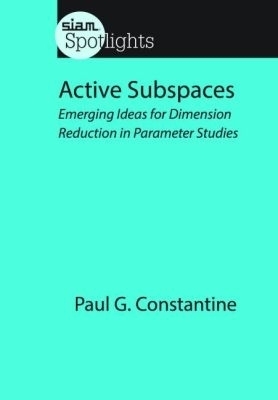
Active Subspaces
Emerging Ideas for Dimension Reduction in Parameter Studies
Seiten
2015
Society for Industrial & Applied Mathematics,U.S. (Verlag)
978-1-61197-385-3 (ISBN)
Society for Industrial & Applied Mathematics,U.S. (Verlag)
978-1-61197-385-3 (ISBN)
Describes techniques for discovering a model's active subspace and proposes methods for exploiting the reduced dimension to enable otherwise infeasible parameter studies. Readers will find new ideas for dimension reduction, easy-to-implement algorithms, and several examples of active subspaces in action.
Scientists and engineers use computer simulations to study relationships between a model's input parameters and its outputs. However, thorough parameter studies are challenging, if not impossible, when the simulation is expensive and the model has several inputs. To enable studies in these instances, the engineer may attempt to reduce the dimension of the model's input parameter space. Active subspaces are an emerging set of dimension reduction tools that identify important directions in the parameter space. This book describes techniques for discovering a model's active subspace and proposes methods for exploiting the reduced dimension to enable otherwise infeasible parameter studies.
Readers will find:
New ideas for dimension reduction.
Easy-to-implement algorithms.
Several examples of active subspaces in action.
Scientists and engineers use computer simulations to study relationships between a model's input parameters and its outputs. However, thorough parameter studies are challenging, if not impossible, when the simulation is expensive and the model has several inputs. To enable studies in these instances, the engineer may attempt to reduce the dimension of the model's input parameter space. Active subspaces are an emerging set of dimension reduction tools that identify important directions in the parameter space. This book describes techniques for discovering a model's active subspace and proposes methods for exploiting the reduced dimension to enable otherwise infeasible parameter studies.
Readers will find:
New ideas for dimension reduction.
Easy-to-implement algorithms.
Several examples of active subspaces in action.
Paul G. Constantine is the Ben L. Fryrear Assistant Professor of Applied Mathematics and Statistics at Colorado School of Mines. He received his PhD from Stanford's Institute for Computational and Mathematical Engineering and spent two years as the von Neumann Fellow at the Sandia National Laboratories' Computer Science Research Institute. His research interests include uncertainty quantification and dimension reduction for large-scale computer simulations.
Preface
Chapter 1: Quick Start
Chapter 2: Parameterized Models in Physics and Engineering
Chapter 3: Discover the Active Subspace
Chapter 4: Exploit the Active Subspace
Chapter 5: Active Subspaces in Action
Chapter 6: Summary and Future Directions
Bibliography
Index.
| Reihe/Serie | SIAM Spotlights |
|---|---|
| Verlagsort | New York |
| Sprache | englisch |
| Maße | 152 x 229 mm |
| Gewicht | 225 g |
| Themenwelt | Mathematik / Informatik ► Mathematik ► Analysis |
| Mathematik / Informatik ► Mathematik ► Angewandte Mathematik | |
| ISBN-10 | 1-61197-385-6 / 1611973856 |
| ISBN-13 | 978-1-61197-385-3 / 9781611973853 |
| Zustand | Neuware |
| Informationen gemäß Produktsicherheitsverordnung (GPSR) | |
| Haben Sie eine Frage zum Produkt? |
Mehr entdecken
aus dem Bereich

aus dem Bereich
Festigkeits- und Verformungslehre, Baudynamik, Wärmeübertragung, …
Buch | Hardcover (2025)
De Gruyter Oldenbourg (Verlag)
CHF 125,90


