Computer Science
Addison Wesley (Verlag)
978-0-13-407642-3 (ISBN)
- Titel ist leider vergriffen;
keine Neuauflage - Artikel merken
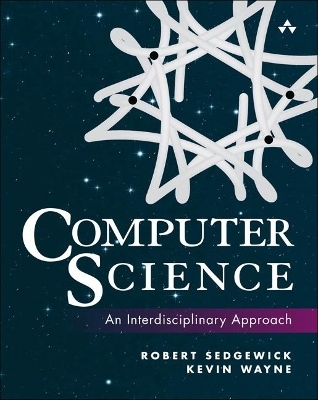
Robert Sedgewick and Kevin Wayne’s Computer Science: An Interdisciplinary Approach is the ideal modern introduction to computer science with Java programming for both students and professionals. Taking a broad, applications-based approach, Sedgewick and Wayne teach through important examples from science, mathematics, engineering, finance, and commercial computing.
The book demystifies computation, explains its intellectual underpinnings, and covers the essential elements of programming and computational problem solving in today’s environments. The authors begin by introducing basic programming elements such as variables, conditionals, loops, arrays, and I/O. Next, they turn to functions, introducing key modular programming concepts, including components and reuse. They present a modern introduction to object-oriented programming, covering current programming paradigms and approaches to data abstraction.
Building on this foundation, Sedgewick and Wayne widen their focus to the broader discipline of computer science. They introduce classical sorting and searching algorithms, fundamental data structures and their application, and scientific techniques for assessing an implementation’s performance. Using abstract models, readers learn to answer basic questions about computation, gaining insight for practical application. Finally, the authors show how machine architecture links the theory of computing to real computers, and to the field’s history and evolution.
For each concept, the authors present all the information readers need to build confidence, together with examples that solve intriguing problems. Each chapter contains question-and-answer sections, self-study drills, and challenging problems that demand creative solutions.
Companion web site (introcs.cs.princeton.edu/java) contains
Extensive supplementary information, including suggested approaches to programming assignments, checklists, and FAQs
Graphics and sound libraries
Links to program code and test data
Solutions to selected exercises
Chapter summaries
Detailed instructions for installing a Java programming environment
Detailed problem sets and projects
Companion 20-part series of video lectures is available at informit.com/title/9780134493831
Robert Sedgewick is the William O. Baker Professor of Computer Science at Princeton University, where he was founding chairman of the Department of Computer Science. He has held visiting research positions at Xerox PARC, Institute for Defense Analyses, and INRIA, and served on the board of directors at Adobe Systems. His research interests include analytic combinatorics, design and analysis of algorithms and data structures, and program visualization. He has written seventeen books. Kevin Wayne is the Phillip Y. Goldman Senior Lecturer in Computer Science at Princeton University, where he has taught since 1998, earning several teaching awards. He is an ACM Distinguished Educator and holds a Ph.D. in operations research and industrial engineering from Cornell University.
Preface xiii
Chapter 1: Elements of Programming 1
1.1 Your First Program 2
1.2 Built-in Types of Data 14
1.3 Conditionals and Loops 50
1.4 Arrays 90
1.5 Input and Output 126
1.6 Case Study: Random Web Surfer 170
Chapter 2: Functions and Modules 191
2.1 Defining Functions 192
2.2 Libraries and Clients 226
2.3 Recursion 262
2.4 Case Study: Percolation 300
Chapter 3: Object-Oriented Programming 329
3.1 Using Data Types 330
3.2 Creating Data Types 382
3.3 Designing Data Types 428
3.4 Case Study: N-Body Simulation 478
Chapter 4: Algorithms and Data Structures 493
4.1 Performance 494
4.2 Sorting and Searching 532
4.3 Stacks and Queues 566
4.4 Symbol Tables 624
4.5 Case Study: Small-World Phenomenon 670
Chapter 5: Theory of Computing 715
5.1 Formal Languages 718
5.2 Turing Machines 766
5.3 Universality 786
5.4 Computability 806
5.5 Intractability 822
Chapter 6: A Computing Machine 873
6.1 Representing Information 874
6.2 TOY Machine 906
6.3 Machine-Language Programming 930
6.4 TOY Virtual Machine 958
Chapter 7: Building a Computing Device 985
7.1 Boolean Logic 986
7.2 Basic Circuit Model 1002
7.3 Combinational Circuits 1012
7.4 Sequential Circuits 1048
7.5 Digital Devices 1070
Context 1093
Glossary 1097
Index 1107
APIs 1139
| Erscheint lt. Verlag | 23.6.2016 |
|---|---|
| Verlagsort | Boston |
| Sprache | englisch |
| Maße | 196 x 234 mm |
| Gewicht | 1644 g |
| Themenwelt | Schulbuch / Wörterbuch |
| Mathematik / Informatik ► Informatik ► Theorie / Studium | |
| ISBN-10 | 0-13-407642-7 / 0134076427 |
| ISBN-13 | 978-0-13-407642-3 / 9780134076423 |
| Zustand | Neuware |
| Informationen gemäß Produktsicherheitsverordnung (GPSR) | |
| Haben Sie eine Frage zum Produkt? |
aus dem Bereich