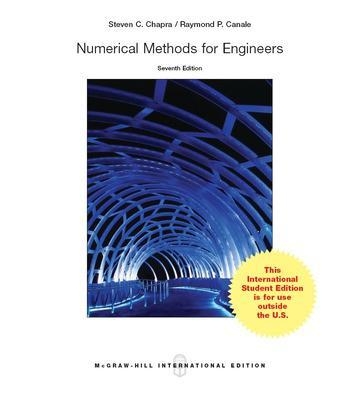
Numerical Methods for Engineers
McGraw-Hill Education (Asia) (Verlag)
978-981-4670-87-6 (ISBN)
- Titel ist leider vergriffen;
keine Neuauflage - Artikel merken
Numerical Methods for Engineers retains the instructional techniques that have made the text so successful. Chapra and Canale's unique approach opens each part of the text with sections called “Motivation,“ “Mathematical Background,” and “Orientation". Each part closes with an “Epilogue” containing “Trade-Offs,” “Important Relationships and Formulas,” and “Advanced Methods and Additional References”. Much more than a summary, the Epilogue deepens understanding of what has been learned and provides a peek into more advanced methods. Numerous new or revised problems are drawn from actual engineering practice. The expanded breadth of engineering disciplines covered is especially evident in these exercises, which now cover such areas as biotechnology and biomedical engineering. Excellent new examples and case studies span all areas of engineering giving students a broad exposure to various fields in engineering.
McGraw-Hill Education's Connect, is also available as an optional, add on item. Connect is the only integrated learning system that empowers students by continuously adapting to deliver precisely what they need, when they need it, how they need it, so that class time is more effective. Connect allows the professor to assign homework, quizzes, and tests easily and automatically grades and records the scores of the student's work. Problems are randomized to prevent sharing of answers an may also have a "multi-step solution" which helps move the students' learning along if they experience difficulty.
Steve Chapra is the Emeritus Professor and Emeritus Berger Chair in the Civil and Environmental Engineering Department at Tufts University. His other books include Surface Water-Quality Modeling, Numerical Methods for Engineers, and Applied Numerical Methods with Python. Dr. Chapra received engineering degrees from Manhattan College and the University of Michigan. Before joining Tufts, he worked for the U.S. Environmental Protection Agency and the National Oceanic and Atmospheric Administration, and taught at Texas A&M University, the University of Colorado, and Imperial College London. His general research interests focus on surface water-quality modeling and advanced computer applications in environmental engineering. He is a Fellow and Life Member of the American Society of Civil Engineering (ASCE) and has received many awards for his scholarly and academic contributions, including the Rudolph Hering Medal (ASCE) for his research, and the Meriam-Wiley Distinguished Author Award (American Society for Engineering Education). He has also been recognized as an outstanding teacher and advisor among the engineering faculties at Texas A&M University, the University of Colorado, and Tufts University. As a strong proponent of continuing education, he has also taught over 90 workshops for professionals on numerical methods, computer programming, and environmental modeling.Beyond his professional interests, he enjoys art, music (especially classical music, jazz, and bluegrass), and reading history. Despite unfounded rumors to the contrary, he never has, and never will, voluntarily bungee jump or sky dive.
Part 1 - Modeling, Computers, and Error Analysis
1) Mathematical Modeling and Engineering Problem Solving
2) Programming and Software
3) Approximations and Round-Off Errors
4) Truncation Errors and the Taylor Series
Part 2 - Roots of Equations
5) Bracketing Methods
6) Open Methods
7) Roots of Polynomials
8) Case Studies: Roots of Equations
Part 3 - Linear Algebraic Equations
9) Gauss Elimination
10) LU Decomposition and Matrix Inversion
11) Special Matrices and Gauss-Seidel
12) Case Studies: Linear Algebraic Equations
Part 4 - Optimization
13) One-Dimensional Unconstrained Optimization
14) Multidimensional Unconstrained Optimization
15) Constrained Optimization
16) Case Studies: Optimization
Part 5 - Curve Fitting
17) Least-Squares Regression
18) Interpolation
19) Fourier Approximation
20) Case Studies: Curve Fitting
Part 6 - Numerical Differentiation and Integration
21) Newton-Cotes Integration Formulas
22) Integration of Equations
23) Numerical Differentiation
24) Case Studies: Numerical Integration and Differentiation
Part 7 - Ordinary Differential Equations
25) Runge-Kutta Methods
26) Stiffness and Multistep Methods
27) Boundary-Value and Eigenvalue Problems
28) Case Studies: Ordinary Differential Equations
Part 8 - Partial Differential Equations
29) Finite Difference: Elliptic Equations
30) Finite Difference: Parabolic Equations
31) Finite-Element Method
32) Case Studies: Partial Differential Equations
Appendix A - The Fourier Series
Appendix B - Getting Started with Matlab
Appendix C - Getting Starte dwith Mathcad
Bibliography
Index
| Verlagsort | Singapore |
|---|---|
| Sprache | englisch |
| Maße | 213 x 235 mm |
| Gewicht | 1633 g |
| Themenwelt | Mathematik / Informatik ► Mathematik ► Analysis |
| Mathematik / Informatik ► Mathematik ► Angewandte Mathematik | |
| ISBN-10 | 981-4670-87-1 / 9814670871 |
| ISBN-13 | 978-981-4670-87-6 / 9789814670876 |
| Zustand | Neuware |
| Informationen gemäß Produktsicherheitsverordnung (GPSR) | |
| Haben Sie eine Frage zum Produkt? |
aus dem Bereich