Collaborative Internet of Things (C-IoT) (eBook)
John Wiley & Sons (Verlag)
978-1-118-91371-0 (ISBN)
Fawzi Behmann
President, TelNet Management Consulting Inc., Texas, USA
Kwok Wu
Head, Embedded Software Development, Freescale Semiconductor, Texas, USA
This book provides a simplified visionary approach about the future direction of IoT, addressing its wide-scale adoption in many markets, its interception with advanced technology, the explosive growth in data, and the emergence of data analytics. IoT business applications span multiple vertical markets. The objective is to inspire creative thinking and collaboration among startups and entrepreneurs which will breed innovation and deliver IoT solutions that will positively impact us by making business processes more efficient, and improving our quality of life. With increasing proliferation of smart-phones and social media, data generated by user wearable/mobile devices continue to be key sources of information about us and the markets around us. Better insights will be gained through cognitive computation coupled with business intelligence and visual analytics that are GIS-based.
Fawzi Behmann President, TelNet Management Consulting Inc., Texas, USA Kwok Wu Head, Embedded Software Development, Freescale Semiconductor, Texas, USA
Foreword xi
About the Authors xv
Preface xix
1 Introductions and Motivation 1
1.1 Introduction 1
1.2 The Book 1
1.2.1 Objectives 1
1.2.2 Benefits 2
1.2.3 Organization 3
1.2.4 Book Cover 4
1.2.5 Impact of C-IoT 6
1.2.6 Summary 8
1.3 C-IoT Terms of References 9
1.3.1 Introduction 10
1.3.2 Need for IoT Framework 12
1.3.3 C-IoT Domains and Business Applications Model 13
1.3.4 Roadmap of IoT 20
1.3.5 C-IoT Platform/Developer Community 22
1.3.6 C-IoT Opportunities for Applications, Solutions, and Systems 23
1.4 The Future 26
1.4.1 General Trends 26
1.4.2 Point Solutions 27
1.4.3 Collaborative Internet of Things 29
1.4.4 C-IoT and RFID 36
1.4.5 C-IoT and Nanotechnology 38
1.4.6 Cyber-Collaborative IoT (C2-IoT) 39
1.4.7 C2-IoT and Ebola Case 40
1.4.8 Summary 43
References 46
2 Application Requirements 47
2.1 C-IoT Landscape 47
2.1.1 C-IoT Model and Architecture Layers 47
2.1.2 C-IoT Model and Enabling Technologies 48
2.1.3 Definition of Key Elements 50
2.1.4 Requirement Considerations 64
2.1.5 C-IoT System Solution - Requirement Considerations 67
2.2 Application Requirements - Use Cases 75
2.3 Health and Fitness System for Individual/Industry/Infrastructure (Lead Example) 76
2.3.1 Landscape 76
2.3.2 Health & Fitness Sensing Requirements 79
2.3.3 Health & Fitness Gateway Requirements 80
2.3.4 Health & Fitness Service Requirements 80
2.3.5 Health & Fitness and Solution Considerations 83
2.3.6 Health & Fitness and System Considerations 84
2.3.7 Health & Fitness and Hospitals 84
2.4 Video Surveillance, Drone, and Machine Vision 84
2.4.1 Landscape 84
2.4.2 Video Surveillance - across Home, Industry, and Infrastructure 86
2.4.3 Video Surveillance Sensing Requirements 88
2.4.4 Video Surveillance Gateway Requirements 89
2.4.5 Video Surveillance Services 90
2.4.6 Example: Red-Light Camera - Photo Enforcement Camera 93
2.4.7 Conclusion 94
2.5 Smart Home and Building 95
2.5.1 Landscape 95
2.5.2 Requirements 97
2.5.3 Smart Home & Building Sensing Requirements 99
2.5.4 Smart Home & Building Gateway Requirements 99
2.5.5 Smart Home & Building Services 100
2.6 Smart Energy 101
2.6.1 Landscape 101
2.6.2 Requirements 102
2.6.3 Smart Energy and Sensing Requirements 103
2.6.4 Smart Energy and Gateway Requirements 103
2.6.5 Smart Energy - Services 103
2.6.6 The Smart Energy App 104
2.6.7 Smart Energy and Network Security 105
2.7 Track and Monitor 106
2.7.1 Landscape 106
2.7.2 Track and Monitor - Sensing Requirements 106
2.7.3 Track and Monitor - Services 107
2.7.4 Track and Monitor - Solution Considerations 108
2.7.5 Track and Monitor Examples 108
2.8 Smart Factory 109
2.8.1 Factory Automation - Robot 109
2.8.2 Industrial 110
2.8.3 Service Robot 112
2.9 Others (Smart Car, Smart Truck, Drone, Machine Vision, and Smart City) 113
2.9.1 Smart Car 113
2.9.2 Smart Roadside 119
2.9.3 Drone 121
2.9.4 Machine Vision 123
2.9.5 Smart City 124
References 128
3 C-IoT Applications and Services 131
3.1 Smart IoT Application Use Cases 132
3.1.1 Health Monitoring - Individual Level (Fitness/Health-Tracking Wearables) 134
3.1.2 Health Monitoring at Business Level (e.g., Clinic and Homes for the Elderly) 137
3.1.3 Home and Building Automation - Individual Level (Smart Home) 146
3.1.4 Smart Energy and Smart Grid 158
3.1.5 Smart Energy Gateways 172
3.1.6 Industrial and Factory Automation 182
3.1.7 Smart Transportation and Fleet Logistics (Connected Cars - V2X: V2V, V2I) 185
3.1.8 Smart City 189
3.2 Smart IoT Platform 190
3.2.1 Smart IoT Software Gateway Platform 191
3.2.2 Smart Sensor Fusion Software Platform 195
3.3 Secured C-IoT Software Platform 196
3.3.1 Overview 197
3.3.2 C-IoT Security - Example of Smart Energy 197
3.3.3 Securing NAN (Metrology-to-Concentrator) 199
3.3.4 Securing Home Area Network (HAN) 201
3.3.5 Securing WAN (Concentrator-to-Substation/Utility Servers) 203
3.3.6 Platform Solution for Concentrator 203
3.3.7 Platform Solution for Substation/Utility Servers 204
3.3.8 Network Topology and IP Addressing: WAN 204
3.3.9 Security on the Concentrator and Utility Servers 204
3.3.10 Summary on C-IoT Security 205
References 207
4 IoT Reference Design Kit 209
4.1 Hardware Equipment List for the Demonstration 210
4.2 Software Required for Demonstration 210
4.3 Safely Power Off the Reference Platform 214
4.4 ZigBee Home and Building Automation 215
4.4.1 Troubleshooting ZigBee Home and Building Automation 217
4.5 Network Video Recorder (NVR) for Video Surveillance 217
4.5.1 Troubleshooting NVR 219
4.6 Internet 3G Broadband Gateway 219
4.7 UPNP 220
4.8 Digital Living Network Alliance (DLNA) Media Server 221
4.8.1 Set Up Reference Platform as DLNA Server 221
4.8.2 Set Up DLNA Clients 222
References 223
5 C-IoT Cloud-Based Services and C-IoT User Device Diversity 225
5.1 C-IoT Cloud-Based Services 225
5.1.1 Introduction and Drivers to C-IoT Service Platform 225
5.1.2 Classes of C-IoT Cloud Computing 227
5.1.3 C-IoT Innovative and Collaborative Services 228
5.1.4 The Emerging Data Center LAN 229
5.2 C-IoT User Device Diversity 231
5.2.1 Introduction 231
5.2.2 C-IoT Developers/Platform 232
5.2.3 Wearable Devices - Individual 234
5.2.4 Harvesting (Self-Powered Nodes) - Infrastructure Applications 235
5.2.5 Embedded Devices and Servers 235
5.2.6 Performing Sentiment Analysis Using Big Data 236
5.2.7 IBM Watson for Cognitive Innovations 237
5.2.8 Far-Reaching Consequences 237
5.2.9 C-IoT (Collaborative IoT) 238
References 238
6 Impact of C-IoT and Tips 239
6.1 Impact on Business Process Productivity and Smart of Digital Life 239
6.1.1 Individual 239
6.1.2 Industry 240
6.1.3 Infrastructure 241
6.2 Considerations of Developing Differentiated C-IoT Solutions 242
6.2.1 Software Processes and Platform 242
6.2.2 Standardization 242
6.2.3 Sensors and C-IoT 243
6.2.4 Advertising Ecosystem Value Exchange 244
6.2.5 Opportunity with Industry Supply Chain for Material Handling 244
6.3 Practical Tips on Maintaining Digital Lifestyle 247
6.3.1 Mobile and Wearable Computing 247
6.3.2 Robotics and Automation 248
6.3.3 Sensors and C-IoT 249
6.3.4 Big Data and Predictive Analysis 250
6.3.5 The Changing Workforce 250
6.3.6 Sustainability 251
References 251
7 Conclusion 253
7.1 Simple C-IoT Domains and Model 253
7.2 Disruptive Business Applications of C-IoT 254
7.2.1 Individual 254
7.2.2 Industry 254
7.3 A New Digital Lifestyle 255
7.4 Development Platform 255
7.4.1 Influencers for Smart Connected Homes 256
7.4.2 Influencers for Industrial Internet 256
7.5 C-IoT Emerging Standards, Consortiums, and Other Initiatives 256
7.5.1 C-IoT Emerging Standards 257
7.5.2 C-IoT Emerging Consortiums 259
7.5.3 Forums, Workshops, and Other Initiatives 260
7.5.4 C-IoT and Radio Communications 260
7.5.5 C-IoT and Nanotechnology 261
7.5.6 C-IoT and Security 261
7.6 Final Note 262
References 262
Index 265
1
Introductions and Motivation
1.1 Introduction
This book will provide the reader with a quick overview of the Internet of Things (IoT) as the next technical revolution of the Internet and address its impact on digital life and business process empowered by emerging Cloud Services. The IOE – Internet of Everything is a DOT (Disruption of Things) and agent of change transforming from Internet of People to Internet of M2M (machine-to-machine) to IoT and IoE. Key benefits include improved business process efficiency, productivity, and quality of digital life. The market demand is moving from reactive on-demand remote monitoring and control (pull model) to more proactive services where the services will identify who you are and deliver what you want and when you want. Services will take on a new form empowered by insights driven from data collected in a given target applications.
This book is targeted to:
- Decision Makers, CEOs, CIOs, CTOs, and Senior Executives
- Communications and Networking System Architects
- Product and Marketing Managers
- Software and Hardware Engineers
- Consultants, Entrepreneurs, and Startups
- Service Providers of content, utility, security, entertainment, and other services
- Professors and Students
- Hobbyists.
1.2 The Book
1.2.1 Objectives
The objective of this book is to provide a simplified approach to comprehend the IoT innovative business model, value, and the impact it will have over our lives and businesses.
Hence, the objective will be analyzed from two aspects:
- Improving quality of our lives
- Improving business efficiencies.
Both (1) and (2) will contribute to having better insights that will lead to living in a smart environment and being part of a smart community/smart city.
This book will provide both a simplified and innovative business model for IoT and IoT domains and key applications. In addition, window of opportunities for IoT applications is rapidly growing and this book will address the need for a platform where diverse applications and solution can be developed. Finally, there is a need for system solution to collaborate for better insights and decision-making.
1.2.2 Benefits
It is the hope that this book will be a great reference and a tool for the reader and provide tangible benefits that include:
- Prepare the readers to embrace the revolution of Internet Technology with IOT that impact our lives, our business, and the environment we live in.
- Understand the evolution of IoT opportunities in terms of key applications that impact our lives, business, or the environment. Examples include Health & Fitness, Smart Building & Home, Video Surveillance, Track & Monitor, Smart Factor/Manufacturing, Smart Energy, and others.
- Comprehend the simplified approach to IoT Business Model consisted of Sensing, Gateway, and Services. Understand landscape of technologies and standards that enable creation of innovative time-to-market solutions and systems.
- Describe technologies and protocols that directly relate to IoT for IoT Architecture model (Physical, Virtual, and Cloud). Examples:
- Physical. Sensors, radio frequency identification (RFID), micro-electromechanical systems (MEMS), wireless sensor networks (WSN), global positioning system (GPS), ZigBee, near field communication (NFC), Wi-Fi, and 3G/4G
- Virtual. Software Defined anything (SDx), network functions virtualization (NFV), IPv4/IPv6, geographic information system (GIS), and body area network (BAN)/local area network (LAN)/wide area network (WAN) (body area network/local area network/wide area network)
- Cloud. Big Data/Analytics.
- Acquire deeper the understanding with series of requirements of key applications and how they are implemented.
- Leverage a smart IoT platform approach to facilitate the development of applications and enable communications among systems and solutions in a collaborative manner (C-IoT). Smart IoT as characterized by the 8A’s stand for Automated Remote Provisioning and Management, Augmented Reality, Awareness of Context and Location, Analyze, Take Action, Automate, Anticipate, Predict, Autonomous, and Attractive. The 7S’s stand for Simplicity, Security, Safety, Smart, Scalable, Sustainable, and Sleek Appeal.
- Acquire deeper understanding of Secured IoT products and systems. Provide examples and tips for do-it-yourself (DIY) IoT solution.
- Make the reader aware of future challenges facing IoT.
- Inspire the reader to think and innovate on unlimited IoT opportunities by sharing examples of future trends.
1.2.3 Organization
This chapter introduces a simple innovative model for Collaborative Internet of Things (C-IoT) and a new way of looking at the market via domains and applications. The book introduces simplified segmentation for C-IoT consisting of three domains: Individual, Industrial, and Infrastructure. Applications/Solutions/Systems can impact Individual, Industry, or Infrastructure or all. The C-IoT model in its simplest form consists of sensing, gateway, and services. Gaining insights from application/solution/system will result in driving better results in each domain. Spanning applications/solutions/systems to more than one domain create a higher value for a better strategic decision.
The core of this book will highlight a series of cases spanning from the requirements to the solution for present market and business opportunities and exploring future opportunities.
Chapter 2 describes the landscape of C-IoT and highlights relevant technologies and standards of the C-IoT model. In addition, it illustrates the application requirements by selecting some of the C-IoT applications spanning one or more of the three domains: Individual, Industry, and Infrastructure.
Chapter 3 describes the implementation of some C-IoT applications progressively from personal consumer to home to industrial (business) and smart city (infrastructure and communities) levels to deliver sustainable smart living and smart environment that help optimize business process efficiency and improve quality of life.
Chapter 4 describes the need for a unified smart C-IoT software platform that enables one to build and deploy smart C-IoT product, systems solutions, and services for different vertical markets in a quick time-to-market fashion. This will be described including the 4A’s and 4S’s that characterize smart C-IoT products. The 4A’s stand for Awareness of Context and Location, Analyze, and Take Action, Automate and Autonomous, and Anticipate. The 4S’s stand for Simplicity, Security, Smart, and Scalable. The chapter ends with covering the Secured IoT.
Chapter 5 provides examples of do it yourself (DIY) kits aimed on bringing the concept, approach to hands-on experience that will inspire innovative thinking in exploring untapped opportunities that will improve the quality of humanity, and business efficiency in general.
Chapter 6 addresses the emerging new wave of new devices and technologies such as wearable/mobile and cloud technology (local, public, and inter-cloud), analytics, and social media as key building blocks of C-IoT distributed intelligence. In addition, the chapter examines the C-IoT impact on our digital lives and businesses and some of the future challenges such as privacy and security.
Chapter 7 presents the readers with final remarks and tips to inspire them to innovate and deliver differentiated solution that contributes toward improving quality of lives and improves business processes.
1.2.4 Book Cover
1.2.4.1 Title of the Book
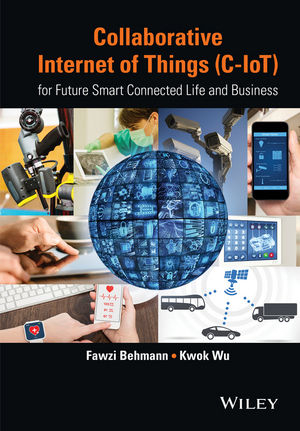
The title is carefully constructed that is depicted by the image on the front cover of this book as well as the brief text in the back cover.
The title reflects the direction of the book focusing on the Future and addressing the need for a C-IoT that represents intelligently interacting and collaborating with current IoT solutions and systems to gain improvement and greater benefits that will have a positive impact on the quality of our lives and our business in terms of process efficiency.
The title can be depicted by two diagrams, which consists of:
- C-IoT domains and applications represented by the three circles (Individual, Industry, and Infrastructure) and examples of apps represented by triangles that cross the circles (examples of apps: Health & Fitness, Video Surveillance, Track & Monitor, and Smart Energy).
- IoT Model represented by the triangle with three functions (Sensing, Gateway, and Services).
The C-IoT in the title reflects the impact C-IoT has in breaking silos exist today in vertical markets by enabling communications and collaborations of solutions and systems within each market and across IoT domains: Individual (Human), Industry (Business), and Infrastructure (Government/smart city).
C-IoT impacts Individual, Industry, and Infrastructure and contributes in improving quality of life and/or improves business operational efficiencies.
- On the Individual C-IoT, a consumer is interested in buying a Nest thermostat because it saves energy without the hassle of constantly tweaking the thermostat by hand. A consumer is interested in fitness trackers such as Fitbit or Jawbone UP because...
| Erscheint lt. Verlag | 23.4.2015 |
|---|---|
| Sprache | englisch |
| Themenwelt | Mathematik / Informatik ► Informatik ► Netzwerke |
| Mathematik / Informatik ► Informatik ► Web / Internet | |
| Technik ► Elektrotechnik / Energietechnik | |
| Schlagworte | Cloud • Communication Technology - Networks • Drahtlose Kommunikation • Electrical & Electronics Engineering • Elektrotechnik u. Elektronik • Internet of Things (IoT) • Kommunikationsnetze • Mobile & Wireless Communications • Signal Processing • Signalverarbeitung • Smart |
| ISBN-10 | 1-118-91371-X / 111891371X |
| ISBN-13 | 978-1-118-91371-0 / 9781118913710 |
| Informationen gemäß Produktsicherheitsverordnung (GPSR) | |
| Haben Sie eine Frage zum Produkt? |
 EPUB (Adobe DRM)
Kopierschutz: Adobe-DRM
Adobe-DRM ist ein Kopierschutz, der das eBook vor Mißbrauch schützen soll. Dabei wird das eBook bereits beim Download auf Ihre persönliche Adobe-ID autorisiert. Lesen können Sie das eBook dann nur auf den Geräten, welche ebenfalls auf Ihre Adobe-ID registriert sind.
Details zum Adobe-DRM
Dateiformat: EPUB (Electronic Publication)
EPUB ist ein offener Standard für eBooks und eignet sich besonders zur Darstellung von Belletristik und Sachbüchern. Der Fließtext wird dynamisch an die Display- und Schriftgröße angepasst. Auch für mobile Lesegeräte ist EPUB daher gut geeignet.
Systemvoraussetzungen:
PC/Mac: Mit einem PC oder Mac können Sie dieses eBook lesen. Sie benötigen eine
eReader: Dieses eBook kann mit (fast) allen eBook-Readern gelesen werden. Mit dem amazon-Kindle ist es aber nicht kompatibel.
Smartphone/Tablet: Egal ob Apple oder Android, dieses eBook können Sie lesen. Sie benötigen eine
Geräteliste und zusätzliche Hinweise
Buying eBooks from abroad
For tax law reasons we can sell eBooks just within Germany and Switzerland. Regrettably we cannot fulfill eBook-orders from other countries.
aus dem Bereich