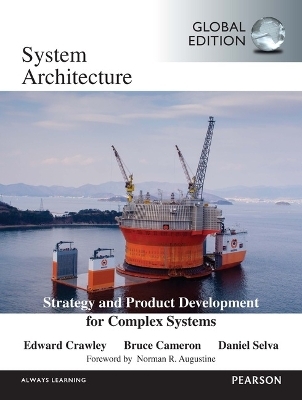
System Architecture, Global Edition
Pearson Education Limited (Verlag)
978-1-292-11084-4 (ISBN)
System architecture is the study of early decision making in complex systems. This text teaches how to capture experience and analysis about early system decisions, and how to choose architectures that meet stakeholder needs, integrate easily, and evolve flexibly. With case studies written by leading practitioners, from hybrid cars to communications networks to aircraft, this text showcases the science and art of system architecture.
Foreword
Preface
Acknowledgments
About the Authors
PART 1: SYSTEM THINKING
1. Introduction to System Architecture
Architecture of Complex Systems
The Advantages of Good Architecture
Learning Objectives
Organization of the Text
References
2. System Thinking
2.1 Introduction
2.2 Systems and Emergence
2.3 Task 1: Identify the System, Its Form, and Its Function
2.4 Task 2: Identify Entities of a System, Their Form, and Their Function
2.5 Task 3: Identify the Relationships among the Entities
2.6 Task 4: Emergence
2.7 Summary
References
3. Thinking about Complex Systems
3.1 Introduction
3.2 Complexity in Systems
3.3 Decomposition of Systems
3.4 Special Logical Relationships
3.5 Reasoning through Complex Systems
3.6 Architecture Representation Tools: SysML and OPM
3.7 Summary
References
PART 2: ANALYSIS OF SYSTEM ARCHITECTURE
4. Form
4.1 Introduction
4.2 Form in Architecture
4.3 Analysis of Form in Architecture
4.4 Analysis of Formal Relationships in Architecture
4.5 Formal Context
4.6 Form in Software Systems
4.7 Summary
References
5. Function
5.1 Introduction
5.2 Function in Architecture
5.3 Analysis of External Function and Value
5.4 Analysis of Internal Function
5.5 Analysis of Functional Interactions and Functional Architecture
5.6 Secondary Value-Related External and Internal Functions
5.7 Summary
References
6. System Architecture
6.1 Introduction
6.2 System Architecture: Form and Function
6.3 Non-idealities, Supporting Layers, and Interfaces in System Architecture
6.4 Operational Behavior
6.5 Reasoning about Architecture Using Representations
6.6 Summary
References
7. Solution-Neutral Function and Concepts
7.1 Introduction
7.2 Identifying the Solution-Neutral Function
7.3 Concept
7.4 Integrated Concepts
7.5 Concepts of Operations and Services
7.6 Summary
References
8. From Concept to Architecture
8.1 Introduction
8.2 Developing the Level 1 Architecture
8.3 Developing the Level 2 Architecture
8.4 Home Data Network Architecture at Level
8.5 Modularizing the System at Level
8.6 Summary
References
PART 3: CREATING SYSTEM ARCHITECTURE
9. The Role of the Architect
9.1 Introduction
9.2 Ambiguity and the Role of the Architect
9.3 The Product Development Process
9.4 Summary
References
10. Upstream and Downstream Influences on System Architecture
10.1 Introduction
10.2 Upstream Influence: Corporate Strategy
10.3 Upstream Influence: Marketing
10.4 U pstream Influence: Regulation and Pseudo-Regulatory Influences
10.5 Upstream Influence: Technology Infusion
10.6 Downstream Influence: Implementation—Coding, Manufacturing, and Supply Chain Management
10.7 Downstream Influence: Operations
10.8 Downstream Influence: Design for X
10.9 Downstream Influence: Product and System Evolution, and Product Families
10.10 The Product Case: Architecture Business Case Decision (ABCD)
10.11 Summary
References
11. Translating Needs into Goals
11.1 Introduction
11.2 Identifying Beneficiaries and Stakeholders
11.3 Characterizing Needs
11.4 Interpreting Needs as Goals
11.5
| Verlagsort | Harlow |
|---|---|
| Sprache | englisch |
| Maße | 179 x 235 mm |
| Gewicht | 728 g |
| Themenwelt | Mathematik / Informatik ► Informatik ► Theorie / Studium |
| Technik | |
| ISBN-10 | 1-292-11084-8 / 1292110848 |
| ISBN-13 | 978-1-292-11084-4 / 9781292110844 |
| Zustand | Neuware |
| Informationen gemäß Produktsicherheitsverordnung (GPSR) | |
| Haben Sie eine Frage zum Produkt? |
aus dem Bereich