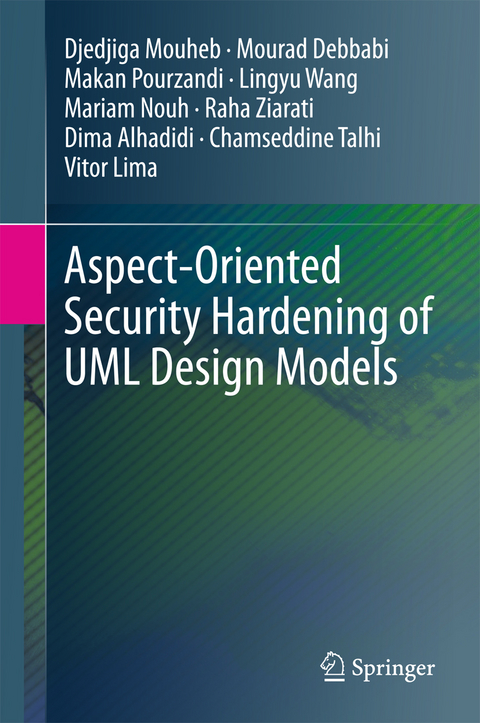
Aspect-Oriented Security Hardening of UML Design Models (eBook)
237 Seiten
Springer International Publishing (Verlag)
978-3-319-16106-8 (ISBN)
This book comprehensively presents a novel approach to the systematic security hardening of software design models expressed in the standard UML language. It combines model-driven engineering and the aspect-oriented paradigm to integrate security practices into the early phases of the software development process. To this end, a UML profile has been developed for the specification of security hardening aspects on UML diagrams. In addition, a weaving framework, with the underlying theoretical foundations, has been designed for the systematic injection of security aspects into UML models.
The work is organized as follows: chapter 1 presents an introduction to software security, model-driven engineering, UML and aspect-oriented technologies. Chapters 2 and 3 provide an overview of UML language and the main concepts of aspect-oriented modeling (AOM) respectively. Chapter 4 explores the area of model-driven architecture with a focus on model transformations. The main approaches that are adopted in the literature for security specification and hardening are presented in chapter 5. After these more general presentations, chapter 6 introduces the AOM profile for security aspects specification. Afterwards, chapter 7 details the design and the implementation of the security weaving framework, including several real-life case studies to illustrate its applicability. Chapter 8 elaborates an operational semantics for the matching/weaving processes in activity diagrams, while chapters 9 and 10 present a denotational semantics for aspect matching and weaving in executable models following a continuation-passing style. Finally, a summary and evaluation of the work presented are provided in chapter 11.
The book will benefit researchers in academia and industry as well as students interested in learning about recent research advances in the field of software security engineering.The authors of this book conducted several research initiatives in the area of computer security, privacy and cyber forensics. The content reported is the result of a 4-year research project on the aspect oriented security hardening of UML design models and is based on a fruitful collaboration between Concordia University and Ericsson under a research partnership program of the Canadian Natural Sciences and Engineering Research Council (NSERC).
The authors of this book conducted several research initiatives in the area of computer security, privacy and cyber forensics. The content reported is the result of a 4-year research project on the aspect oriented security hardening of UML design models and is based on a fruitful collaboration between Concordia University and Ericsson under a research partnership program of the Canadian Natural Sciences and Engineering Research Council (NSERC).
1 Introduction.- 2 Unified Modeling Language.- 3 Aspect-Oriented Paradigm.- 4 Model-Driven Architecture and Model Transformations.- 5 Model-Based Security.- 6 Security Aspect Specification.- 7 Security Aspect Weaving.- 8 Static Matching and Weaving Semantics in Activity Diagrams.- 9 Dynamic Matching and Weaving Semantics in k-Calculus.- 10 Dynamic Matching and Weaving Semantics in Executable UML.- 11 Conclusion.
| Erscheint lt. Verlag | 22.4.2015 |
|---|---|
| Zusatzinfo | XVIII, 237 p. 123 illus. |
| Verlagsort | Cham |
| Sprache | englisch |
| Themenwelt | Informatik ► Netzwerke ► Sicherheit / Firewall |
| Schlagworte | aspect-oriented modeling • aspect weaving • model-based security • Model-Driven Software Engineering • OCL • software security engineering • Systems Security • UML |
| ISBN-10 | 3-319-16106-7 / 3319161067 |
| ISBN-13 | 978-3-319-16106-8 / 9783319161068 |
| Informationen gemäß Produktsicherheitsverordnung (GPSR) | |
| Haben Sie eine Frage zum Produkt? |
 PDF (Wasserzeichen)
DRM: Digitales Wasserzeichen
Dieses eBook enthält ein digitales Wasserzeichen und ist damit für Sie personalisiert. Bei einer missbräuchlichen Weitergabe des eBooks an Dritte ist eine Rückverfolgung an die Quelle möglich.
Dateiformat: PDF (Portable Document Format)
Mit einem festen Seitenlayout eignet sich die PDF besonders für Fachbücher mit Spalten, Tabellen und Abbildungen. Eine PDF kann auf fast allen Geräten angezeigt werden, ist aber für kleine Displays (Smartphone, eReader) nur eingeschränkt geeignet.
Systemvoraussetzungen:
PC/Mac: Mit einem PC oder Mac können Sie dieses eBook lesen. Sie benötigen dafür einen PDF-Viewer - z.B. den Adobe Reader oder Adobe Digital Editions.
eReader: Dieses eBook kann mit (fast) allen eBook-Readern gelesen werden. Mit dem amazon-Kindle ist es aber nicht kompatibel.
Smartphone/Tablet: Egal ob Apple oder Android, dieses eBook können Sie lesen. Sie benötigen dafür einen PDF-Viewer - z.B. die kostenlose Adobe Digital Editions-App.
Buying eBooks from abroad
For tax law reasons we can sell eBooks just within Germany and Switzerland. Regrettably we cannot fulfill eBook-orders from other countries.
aus dem Bereich