


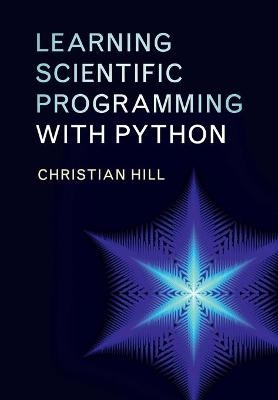
Learning Scientific Programming with Python
Seiten
2016
Cambridge University Press (Verlag)
978-1-107-42822-5 (ISBN)
Cambridge University Press (Verlag)
978-1-107-42822-5 (ISBN)
- Titel erscheint in neuer Auflage
- Artikel merken
Zu diesem Artikel existiert eine Nachauflage
Learn to master basic programming tasks from scratch with real-life scientific examples drawn from many different areas of science and engineering. This complete introduction to using Python teaches Numpy, SciPy and Matplotlib libraries and is supported by extensive online resources to provide a targeted package for students and researchers.
Learn to master basic programming tasks from scratch with real-life scientifically relevant examples and solutions drawn from both science and engineering. Students and researchers at all levels are increasingly turning to the powerful Python programming language as an alternative to commercial packages and this fast-paced introduction moves from the basics to advanced concepts in one complete volume, enabling readers to quickly gain proficiency. Beginning with general programming concepts such as loops and functions within the core Python 3 language, and moving onto the NumPy, SciPy and Matplotlib libraries for numerical programming and data visualisation, this textbook also discusses the use of IPython notebooks to build rich-media, shareable documents for scientific analysis. Including a final chapter introducing challenging topics such as floating-point precision and algorithm stability, and with extensive online resources to support advanced study, this textbook represents a targeted package for students requiring a solid foundation in Python programming.
Learn to master basic programming tasks from scratch with real-life scientifically relevant examples and solutions drawn from both science and engineering. Students and researchers at all levels are increasingly turning to the powerful Python programming language as an alternative to commercial packages and this fast-paced introduction moves from the basics to advanced concepts in one complete volume, enabling readers to quickly gain proficiency. Beginning with general programming concepts such as loops and functions within the core Python 3 language, and moving onto the NumPy, SciPy and Matplotlib libraries for numerical programming and data visualisation, this textbook also discusses the use of IPython notebooks to build rich-media, shareable documents for scientific analysis. Including a final chapter introducing challenging topics such as floating-point precision and algorithm stability, and with extensive online resources to support advanced study, this textbook represents a targeted package for students requiring a solid foundation in Python programming.
Christian Hill is a physicist and physical chemist at University College London and the University of Oxford. He has over twenty years' experience of programming in the physical sciences and has been programming in Python for ten years. His research uses Python to produce, analyse, process, curate and visualise large data sets for the prediction of the properties of planetary atmospheres.
1. Introduction; 2. The core Python language I; 3. Interlude: simple plotting with pylab; 4. The core Python language II; 5. IPython and IPython notebook; 6. NumPy; 7. Matplotlib; 8. SciPy; 9. General scientific programming; Appendix A. Solutions; Index.
| Erscheint lt. Verlag | 4.2.2016 |
|---|---|
| Zusatzinfo | Worked examples or Exercises; 52 Tables, black and white; 27 Halftones, black and white; 66 Line drawings, black and white |
| Verlagsort | Cambridge |
| Sprache | englisch |
| Maße | 174 x 247 mm |
| Gewicht | 900 g |
| Themenwelt | Mathematik / Informatik ► Informatik ► Programmiersprachen / -werkzeuge |
| Mathematik / Informatik ► Informatik ► Web / Internet | |
| Naturwissenschaften ► Physik / Astronomie | |
| ISBN-10 | 1-107-42822-X / 110742822X |
| ISBN-13 | 978-1-107-42822-5 / 9781107428225 |
| Zustand | Neuware |
| Informationen gemäß Produktsicherheitsverordnung (GPSR) | |
| Haben Sie eine Frage zum Produkt? |
Mehr entdecken
aus dem Bereich


aus dem Bereich
Grundlagen und praktische Anwendungen von Transpondern, kontaktlosen …
Buch (2023)
Hanser (Verlag)
CHF 125,95


