


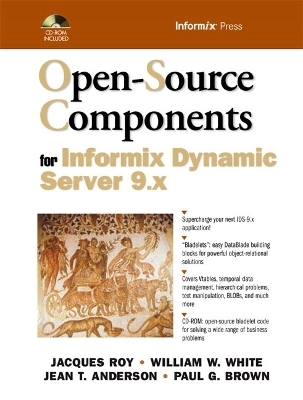
Open-Source Components for Informix Dynamic Server 9.x
Prentice Hall
978-0-13-042827-1 (ISBN)
- Titel ist leider vergriffen;
keine Neuauflage - Artikel merken
Object-relational databases offer immense power -- but many database professionals have failed to use it, because doing so required them to write their own DataBlade extensions. This book presents a breakthrough solution: bladelets. Created by a team of Informix' leading DataBlade experts, bladelets serve as building blocks, bringing Informix Dynamic Server 9.x ORDBMS power to bear on a wide range of business problems, while requiring far less original programming. The book covers ten bladelets in detail, with open source code for all of them provided on CD-ROM. These bladelets will help developers solve hierarchical problems; extend SQL to support temporal data management; access external files through SQL, use SQL as a data type, overcome database portability problems, work with vtables, streamline text manipulation, and address many other common challenges. Whether you use them "as is," or as the model for your own DataBlades, these bladelets can dramatically improve the performance, value, and time-to-market of your very next database application.
JACQUES ROY, one of Informix' leading evangelists on database extensibility, is author of Informix Dynamic Server.2000: Server-Side Programming in C (Prentice Hall PTR). WILLIAM W. WHITE, senior engineer at Informix, works with DataBlade Partners and internal engineers on projects related to database extensibility, and is a frequent contributor to the Informix Developers Network (IDN). JEAN ANDERSON is a Senior Engineer in Informix Datablade Partner Engineering specializing in helping developers implement server extensions. She has authored many technical notes and projects at IDN's DataBlade Corner. PAUL G. BROWN of Informix Labs is a prominent object-relational evangelist and author of Object-Relational Database Development, a Plumber's Guide (Prentice Hall PTR).
Preface.
Acknowledgments.
1. Taking Advantage of Database Extensibility.
Software Extensibility. How Do We Call It? IDS 9.x Object-Relational Features. Usage Examples. A New Approach to Problem Solving. What's Next?
2. Solving Hierarchical Problems with the Node Component.
Node and Hierarchies. Node versus Relational Implementation. Hierarchical Problems. Functions Overview. Indexing and SQL Statements. Client Access. Installation. Limitations and Improvements. Node Component Location. Acknowledgments.
3. Time Is on Our Side: Temporal Extensions to SQ.
Introduction to Temporal Data Management. Shortcomings of SQL-92 and Goals of the Period Bladelet. Overview of Period Bladelet. UDTs in Period Bladelet. UDFs for Temporal Operations. UDA. Statistics and Selectivity. Summary and Conclusions.
4. Accessing External Files through SQL.
RDBMS Characteristics. The VTI Interface. VTI Description. The Flat-File Interface. Creating an Access Method. Creating a Table. Using the Table. Supported Types. Installation. Registration. Removal. Limitations and Improvements. Flat-File Component Location. Acknowledgments. Reference.
5. SQL as a Data Type.
Overview of the Exec SQL Bladelet. Drawbacks and Limitations. Implementation Details for Exec SQL Bladelet. Application Example Using Exec SQL Bladelet. Summary and Conclusions.
6. Managing a World of Shapes.
The Problem That Shapes Solves. Shape Data Types. Functions Overview. Indexing and SQL Statements. Client Access. Installation. Limitations. Shapes Bladelet Location. Acknowledgments.
7. Whose SQL Is It?
How Do Nonstandard Features Come About? Why Not Stick to Standards? Solving the Portability Problem. Example 1: Oracle Compatibility. Example 2: IBM Compatibility. Conclusion. Obtaining SqlLib and Iutil. Acknowledgments.
8. Manipulating Text with Regular Expressions.
Regular Expressions. Regexp SQL Routines Overview. Built-in SQL Functions Overview. Regexp versus Built-In SQL Functions. Performance. Installation. Limitations and Improvements. Regexp Bladelet Location. Acknowledgments.
9. Removing the LVARCHAR Size Limit.
The Problem That mrLvarchar Solves. Candidate Data Types. Functions Overview. Inserting Data. Selecting and Searching Data. Extracting Substrings. Modifying Data. System Administration. Indexing and SQL Statement. Client Access. Installation. Limitations. mrLvarchar Bladelet Location. Acknowledgments.
10. Images Are Data, Too.
Using BLOBs in Image-Enabled Applications. The JPEG Image Format. The LLD Module. JPGImage Bladelet Features. Using the JPGImage Bladelet. Conclusion. JPGImage Bladelet Locatio. Acknowledgments.
11. Multiple Versions of Your Data.
Using VTable. Limitations and Future Enhancements. Where to Get the VTable Distribution. Acknowledgments.
Appendix A: Node Bladelet Functions Reference.
Appendix B: Period Bladelet Functions Reference.
Appendix C: Flat-File Interface Functions Reference.
Appendix D: Exec SQL Bladelet Functions Reference.
Appendix E: Shapes Bladelet Functions Reference.
Appendix F: SqlLib Bladelet Functions Reference.
Appendix G: IUtil Functions Reference.
Appendix H: Regexp Bladelet Functions Reference.
Appendix I: mrLvarchar Bladelet Functions Reference.
Appendix J: JPGImage Bladelet Functions Reference.
Appendix K: VTable Functions Reference.
Appendix L: Building and Deploying DataBlade Executable Objects.
Index.
| Erscheint lt. Verlag | 19.12.2001 |
|---|---|
| Verlagsort | Upper Saddle River |
| Sprache | englisch |
| Gewicht | 994 g |
| Themenwelt | Mathematik / Informatik ► Informatik ► Datenbanken |
| Mathematik / Informatik ► Informatik ► Netzwerke | |
| ISBN-10 | 0-13-042827-2 / 0130428272 |
| ISBN-13 | 978-0-13-042827-1 / 9780130428271 |
| Zustand | Neuware |
| Informationen gemäß Produktsicherheitsverordnung (GPSR) | |
| Haben Sie eine Frage zum Produkt? |


