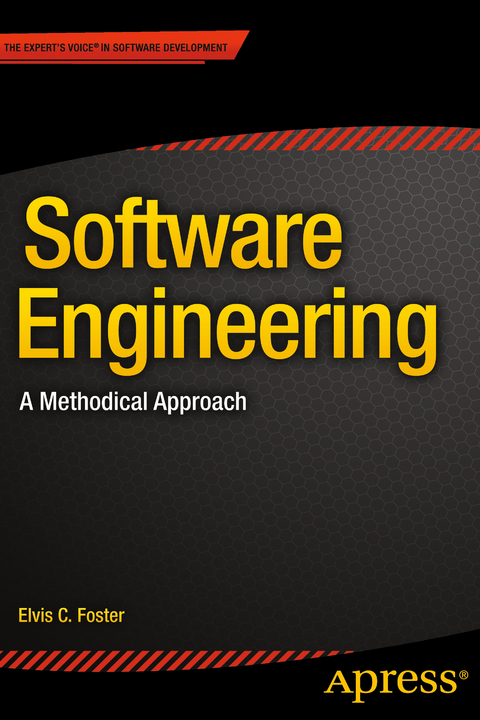
Software Engineering (eBook)
XXXII, 588 Seiten
Apress (Verlag)
978-1-4842-0847-2 (ISBN)
This text provides a comprehensive, but concise introduction to software engineering. It adopts a methodical approach to solving software engineering problems proven over several years of teaching, with outstanding results.
The book covers concepts, principles, design, construction, implementation, and management issues of software systems. Each chapter is organized systematically into brief, reader-friendly sections, with itemization of the important points to be remembered. Diagrams and illustrations also sum up the salient points to enhance learning. Additionally, the book includes a number of the author’s original methodologies that add clarity and creativity to the software engineering experience, while making a novel contribution to the discipline.
Upholding his aim for brevity, comprehensive coverage, and relevance, Foster’s practical and methodical discussion style gets straight to the salient issues, and avoids unnecessary topics and minimizes theoretical coverage.
Elvis C. Foster is Associate Professor of Computer Science at Keene State College, New Hampshire. He holds a Bachelor of Science (BS.) in Computer Science and Electronics, as well as a Doctor of Philosophy (PhD) in Computer Science (specializing in strategic information systems and database systems) from University of the West Indies, Mona Jamaica. Dr. Foster has over 22 years of combined experience as a software engineer, information technology executive and consultant, and computer science educator.
This text provides a comprehensive, but concise introduction to software engineering. It adopts a methodical approach to solving software engineering problems proven over several years of teaching, with outstanding results.The book covers concepts, principles, design, construction, implementation, and management issues of software systems. Each chapter is organized systematically into brief, reader-friendly sections, with itemization of the important points to be remembered. Diagrams and illustrations also sum up the salient points to enhance learning. Additionally, the book includes a number of the author’s original methodologies that add clarity and creativity to the software engineering experience, while making a novel contribution to the discipline.Upholding his aim for brevity, comprehensive coverage, and relevance, Foster’s practical and methodical discussion style gets straight to the salient issues, and avoids unnecessary topics and minimizes theoretical coverage.
Elvis C. Foster is Associate Professor of Computer Science at Keene State College, New Hampshire. He holds a Bachelor of Science (BS.) in Computer Science and Electronics, as well as a Doctor of Philosophy (PhD) in Computer Science (specializing in strategic information systems and database systems) from University of the West Indies, Mona Jamaica. Dr. Foster has over 22 years of combined experience as a software engineer, information technology executive and consultant, and computer science educator.
Software Engineering 532
Contents at a Glance 3
Contents 535
About the Author 555
Acknowledgments 556
Preface 557
Part A: Fundamentals 5
Chapter 1: Introduction to Software Engineering 6
1.1 Definitions and Concepts 6
1.1.1 System 7
1.1.2 Software 7
Software Engineering 7
Steps in the Analysis Process 8
1.2 The Organization as a System 8
1.2.1 Discussion 10
1.3 Information Levels in the Organization 10
1.3.1 Top Management 10
1.3.2 Middle Management 11
1.3.3 Junior Management and Operational Staff 11
1.3.4 Importance of Information Levels in Software Engineering 11
Discussion 12
1.3.5 Alternate Organizational Settings 12
1.4 Software Life Cycle 12
1.4.1 Waterfall Model 13
1.4.2 Phased Prototype Model 13
1.4.3 Iterative Development Model 14
1.4.4 Rapid Prototype Model 14
1.4.5 Formal Transformation Model 15
1.4.6 Components-Based Model 16
1.4.7 Agile Development Model 16
1.5 Categories of Software 17
1.6 Alternate Software Acquisition Approaches 18
1.6.1 Discussion 19
1.7 Software Engineering Paradigms 19
1.8 Desirable Features of Computer Software 19
1.9 Summary and Concluding Remarks 20
1.10 Review Questions 21
1.11 References and/or Recommended Readings 22
Chapter 2: The Role of the Software Engineer 24
2.1 Historical Role 24
2.2 Modern Role of the Software Engineer 25
2.3 Job Description of the Software Engineer 26
2.3.1 Core Functions of the Software Engineer 28
2.3.2 Desirable Qualities of the Software Engineer 28
2.4 Tools used by the Software Engineer 29
2.4.1 Coding Systems 29
Desirable Features of a Coding System 29
Types of Coding Systems 30
2.4.2 Forms Design 31
Guiding Principles of Forms Design 33
2.4.3 Data Analysis Charts 33
2.4.4 Technical Documents and Modeling Techniques 35
2.4.5 Software Planning and Development Tools 36
2.5 Management Issues with Which the Software Engineer must be Familiar 41
2.6 Summary and Concluding Remarks 41
2.7 Review Questions 42
2.8 References and/or Recommended Readings 43
Part B: Software Investigation and Analysis 44
Chapter 3: Project Selection and the Initial System Requirements 45
3.1 Project Selection 45
3.2 Problem Definition 46
3.2.1 Constraints of a System 47
3.2.2 Aid in Identifying System Problems 47
3.2.3 Identifying the System Void 48
3.3 The Proposed Solution 49
3.4 Scope and Objectives of the System 49
3.5 System Justification 50
3.6 Feasibility Analysis Report 50
3.6.1 Technical Feasibility 50
3.6.2 Economic Feasibility 51
3.6.3 Operational Feasibility 52
3.6.4 Evaluation of System Alternatives 52
Evaluation Based on Quality 52
Evaluation Based on Cost 53
3.6.5 Evaluation of System Alternatives (continued) 54
Putting the Pieces Together 55
3.7 Alternate Approach to the Feasibility Analysis 55
3.8 Summary of System Inputs and Outputs 56
3.9 Initial Project Schedule 57
3.10 Project Team 57
3.11 Summary and Concluding Remarks 59
3.12 Review Questions 60
3.13 References and/or Recommended Readings 61
Chapter 4: The Requirements Specification 62
4.1 Introduction 62
4.2 Contents of the Requirements Specification 63
4.3 Documenting the Requirements 65
4.4 Requirements Validation 65
4.5 How to Proceed 66
4.6 Presentation of the Requirements Specification 67
4.7 Summary and Concluding Remarks 68
4.8 Review Questions 68
4.9 References and/or Recommended Readings 69
Chapter 5: Information Gathering 70
5.1 Rationale for Information Gathering 70
5.2 Interviewing 72
5.3 Questionnaires and Surveys 73
5.4 Sampling and Experimenting 75
5.4.1 Probability Sampling Techniques 75
5.4.2 Non-probability Sampling Techniques 76
5.4.3 Sample Calculations 76
5.5 Observation and Document Review 78
5.6 Prototyping 78
5.7 Brainstorming and Mathematical Proof 80
5.8 Object Identification 80
5.8.1 The Descriptive Narrative Approach 81
5.8.2 The Rule-of-Thumb Approach 82
5.9 Summary and Concluding Remarks 83
5.10 Review Questions 84
5.11 References and/or Recommended Readings 86
Chapter 6: Communicating Via Diagrams 87
6.1 Introduction 88
6.2 Traditional System Flowcharts 89
6.2.1 Information-Oriented Flowchart 91
6.2.2 Process-Oriented Flowchart 92
6.2.3 Hierarchy- Input–Process-Output Chart 93
6.3 Procedure Analysis Chart 94
6.4 Innovation: Topology Charts 96
6.4.1 Information Topology Chart 96
6.4.2 User Interface Topology Chart 97
6.5 Data Flow Diagrams 100
6.6 Object Flow Diagram 106
6.7 Other Contemporary Diagramming Techniques 106
6.7.1 State Transition Diagram 107
6.7.2 Finite State Machine 108
6.8 Program Flowchart 109
6.9 Summary and Concluding Remarks 111
6.10 Review Questions 112
6.11 References and/or Recommended Readings 113
Chapter 7: Decision Models for System Logic 114
7.1 Structured Language 114
7.2 Decision Tables 115
7.2.1 Constructing the Decision Table 115
7.2.2 Analyzing and Refining the Decision Table 117
7.2.3 Extended Decision Table 118
7.3 Decision Trees 119
7.4 Which Technique to Use 121
7.5 Decision Techniques versus Flowcharts 121
7.6 System Rules 122
7.6.1 Rule Definition 125
7.6.2 Declarative versus Procedural Statements 125
7.6.3 Types of Rules 126
7.7 Summary and Concluding Remarks 127
7.8 Review Questions 129
7.9 References and/or Recommended Readings 129
Chapter 8: Project Management Aids 130
8.1 PERT and CPM 130
8.1.1 Step 1: Tabulate the Project Activities 131
8.1.2 Step 2: Draw the PERT Diagram 132
8.1.3 Step 3: Determine ES, EF, LS and LF for each Activity 133
8.1.4 Step 4: Determine the Critical Path 133
8.1.5 Step 5: Conduct a Sensitivity Analysis 133
8.2 The Gantt Chart 135
8.3 Project Management Software 137
8.4 Summary and Concluding Remarks 138
8.5 Review Questions 138
8.6 References and/or Recommended Readings 140
Part C: Software Design 141
Chapter 9: Overview of Software Design 142
9.1 The Software Design Process 142
9.2 Design Strategies 144
9.2.1 Function-Oriented Design 144
9.2.2 Object-Oriented Design 145
9.2.3 The Unified Modeling Language 148
9.2.4 Advantages of Object Oriented Design 148
9.2.5 Using Both FO and OO Strategies 149
9.3 Architectural Design 149
9.3.1. Approaches to Resource Sharing 150
9.3.2 System Controls 154
9.3.3 System Components 155
9.4 Interface Design 155
9.5 Software Design and Development Standards 155
9.5.1 Advantages of Software Standards 155
9.5.2 Issues That Software Standards Should Address 156
9.6 The Design Specification 159
9.6.1 Contents of the Design Specification 159
9.6.2 How to Proceed 159
9.7 Summary and Concluding Remarks 160
9.8 Review Questions 161
9.9 References and/or Recommended Readings 162
Chapter 10: Database Design 163
10.1 Introduction 163
10.2 Approaches to Database Design 165
10.2.1 Conventional Files 166
10.2.2 Database Approach 166
10.2.3 Identifying and Defining Entities or Object Types 167
10.2.4 Identifying Relationships 168
10.2.5 Developing the ERD or ORD 170
10.2.6 Preparing the Database Specification 175
10.3 Overview of File Organization 177
10.3.1 Sequential File Organization 177
10.3.2 Relative or Direct File Organization 178
10.3.3 Indexed Sequential File Organization 179
10.3.4 Multi-Access File Organization 179
10.4 Summary and Concluding Remarks 179
10.5 Review Questions 180
10.6 References and/or Recommended Readings 181
Chapter 11: User Interface Design 182
11.1 Introduction 182
11.1.1 User Needs 183
11.1.2 Human Factors 184
11.1.3 Design Considerations 184
11.1.4 User Interface Preparation 185
11.2 Types of User Interfaces 185
11.3 Steps in User Interface Design 187
11.3.1 Menu or Graphical User Interface 187
11.3.2 Command-Based User Interface 190
11.4 Overview of Output Design 190
11.5 Output Methods versus Content and Technology 191
11.5.1 Printed Output 191
11.5.2 Monitor Display 192
11.5.3 Audio Output 192
11.5.4 Microfilm/Microfiche 192
11.5.5 Magnetic and Optical Storage 192
11.5.6 Choosing the Appropriate Output Method 193
11.6 Guidelines for Designing Output 195
11.6.1 Guidelines for Designing Printed Output 195
11.6.2 Guidelines for Designing Screen Output 195
11.7 Overview of Input Design 197
11.8 Guidelines for Designing Input 198
11.9 Summary and Concluding Remarks 199
11.10 Review Questions 200
11.11 References and/or Recommended Reading 200
Chapter 12: Operations Design 201
12.1 Introduction 201
12.2 Categorization of Operations 202
12.3 Essentials of Operations Design 203
12.4 Informal Methods for Specifying Operation Requirements 203
12.4.1 Traditional Methods 203
12.4.2 Warnier Orr Diagram 205
Disadvantages of the Warnier-Orr Diagram Are 205
12.4.3 UML Notations for Object Behavior 206
12.4.4 Extended Operation Specification 209
12.5 Formal Specifications 217
12.6 Summary and Concluding Remarks 218
12.7 Review Questions 218
12.8 References and/or Recommended Reading 219
Chapter 13: Other Design Considerations 220
13.1 The System Catalog 220
13.1.1 Contents of the System Catalog 220
13.1.2 Building the System Catalog 221
13.1.3 Using the System Catalog 222
13.2 Product Documentation 223
13.2.1 The System Help Facility 223
Structure of the Help System 224
Content of the Help System 224
13.2.2 The User’s Guide and System Guide 225
13.3 User Message Management 226
13.3.1 Storage and Management of Messages 226
13.3.2 Message Retrieval 227
13.4 Design for Real-Time Systems 227
13.4.1 Real-Time System Modeling 227
13.4.2 Real-Time Programming 228
13.5 Design for Reuse 228
13.6 System Security 229
13.6.1 Access to the System 229
13.6.2 Access to System Resources 230
13.6.3 Access to System Data 231
13.7 Summary and Concluding Remarks 231
13.8 Review Questions 233
13.9 References and/or Recommended Readings 233
Part D: Software Development 234
Chapter 14: Sof?tware Development Issues 235
14.1 Introduction 235
14.2 Standards and Quality Assurance 236
14.2.1 The Relationship between Quality and Standards 237
14.2.2 Software Quality Factors 238
14.2.3 Quality Assurance Evaluation 238
14.3 Management of Targets and Financial Resources 239
14.3.1 Managing Budget and Expenditure 240
14.3.2 Managing Software Cost and Value 241
14.4 Leadership and Motivation 241
14.5 Planning of Implementation Strategy 243
14.6 Summary and Concluding Remarks 243
14.7 Review Questions 244
14.8 References and/or Recommended Readings 244
Chapter 15: Human Resource Management 245
15.1 Management Responsibilities 246
15.2 Management Styles 246
15.2.1 Autocratic Management 246
15.2.2 Egalitarian (Democratic) Management 247
15.2.3 Laissez Faire Management 247
15.2.4 Path-Goal Leadership 247
15.2.5 Transformational Leadership 248
15.2.6 The Super Leader Approach 249
15.2.7 Task-Oriented Leadership 249
15.2.8 Relation-Oriented Leadership 249
15.2.9 Contingency Leadership 250
15.3 Developing Job Descriptions 250
15.4 Hiring 251
15.5 Maintaining the Desired Environment 253
15.5.1 Effective Communication 254
15.5.2 Conflict Resolution 255
15.5.3 Treating Outstanding Achievements and Errant Actions 256
15.6 Preserving Accountability 256
15.6.1 Designing and Assigning Work 256
15.6.2 Evaluating Performance 257
15.7 Grooming and Succession Planning 259
15.8 Summary and Concluding Remarks 259
15.9 Review Questions 260
15.10 References and/or Recommended Readings 261
Chapter 16: Software Economics 262
16.1 Software Cost versus Software Price 262
16.1.1 Software Cost 262
16.1.2 Software Price 263
16.2 Software Value 264
16.3 Evaluating Software Productivity 265
16.3.1 Size-related Metrics 265
16.3.2 Function-related Metrics 266
16.3.3 Assessment Based on Value Added 268
16.4 Estimation Techniques for Engineering Cost 269
16.4.1 Algorithmic Cost Models 270
16.4.2 The COCOMO Model 271
16.4.3 The COCOMO II Model 271
16.5 Summary and Concluding Remarks 276
16.6 Review Questions 278
16.7 References and/or Recommended Reading 279
Part E: Software Implementation and Management 280
Chapter 17: Software Implementation Issues 281
17.1 Introduction 281
17.2 Operating Environment 282
17.2.1 Central System 282
17.2.2 Distributed System 283
17.2.3 Other Environmental Issues 284
17.3 Installation of the System 284
17.4 Code Conversion 284
17.5 Change Over 285
17.5.1 Direct Change Over 286
17.5.2 Parallel Conversion 286
17.5.3 Phased Conversion 286
17.5.4 Distributed Conversion 286
17.6 Training 287
17.7 Marketing of the Software 287
17.8 Summary and Concluding Remarks 288
17.9 Review Questions 289
17.10 Recommended Readings 290
Chapter 18: Software Management 291
18.1 Introduction 291
18.2 Software Maintenance 292
18.2.1 Software Modifications 292
18.2.2 Software Upgrades and Patches 294
18.2.3 Maintenance Cost 295
18.3 Legacy Systems 296
18.4 Software Integration 297
18.5 Software Re-engineering 297
18.6 Summary and Concluding Remarks 298
18.7 Review Questions 299
18.8 References and/or Recommended Readings 299
Chapter 19: Organizing for Effective Management 300
19.1 Introduction 301
19.2 Functional Organization 301
19.3 Parallel Organization 303
19.4 Hybrid (Matrix) Organization 305
19.5 Organization of Software Engineering Firms 306
19.6 Summary and Concluding Remarks 310
19.7 Review Questions 311
19.8 References and/or Recommended Readings 311
Part F: Final Preparations 312
Chapter 20: Sample Exercises and Examination Questions 313
20.1 Introduction 313
20.2 Assignment 1A 314
20.3 Assignment 2 315
20.4 Assignment 3A 318
20.5 Assignment 4A 320
20.6 Assignment 5A 321
20.7 Assignment 6A 323
20.8 Assignment 7A 324
20.9 Assignment 8A 325
20.10 Sample Interim Examination 1A 326
20.11 Sample Interim Examination 2B 328
20.12 Sample Final Examination A 330
20.13 Sample Final Examination B 334
Part G: Appendices 340
Appendix 1: Introduction to Object Oriented Methodologies 341
A1.1 Software Revolution and Rationale for Object-Oriented Techniques 341
A1.2 Information Engineering and the Object-Oriented Approach 342
A1.3 Integrating Hi-tech Technologies 344
A1.4 Characteristics of Object-Oriented Methodologies 345
A1.5 Benefits of Object-Oriented Methodologies 345
A1.6 Summary and Concluding Remarks 346
A1.7 Recommended Readings 346
Appendix 2: Basic Concepts of Object-Oriented Methodologies 347
A2.1 Objects and Object Types 347
A2.2 Operations 349
A2.3 Methods 349
A2.4 Encapsulation and Classes 350
A2.4.1 Encapsulation 350
A2.4.2 Class 351
A2.5 Inheritance and Amalgamation 351
A2.5.1 Inheritance 351
A2.5.2 Amalgamation 352
A2.6 Requests 352
A2.7 Polymorphism and Reusability 352
A2.8 Interfaces 353
A2.9 Late Binding 354
A2.10 Multithreading 354
A2.11 Perception versus Reality 354
A2.12 Overview of the Object-Oriented Software Engineering Process 355
A2.13 Summary and Concluding Remarks 356
A2.14 Recommended Readings 357
Appendix 3: Object-Oriented Information Engineering 358
A3.1 Introduction 358
A3.2 Engineering the Infrastructure 359
A3.3 Diagramming Techniques 360
A3.4 Enterprise Planning 361
A3.5 Business Area Analysis 365
A3.6 System Design 369
A3.7 System Construction 370
A3.8 Summary and Concluding Remarks 371
A3.9 References and/or Recommended Reading 372
Appendix 4: Basic Guidelines for Object-Oriented Methodologies 373
A4.1 Object Identification 373
A4.1.1 Using Things to be Modeled 374
A4.1.2 Using the Definitions of Objects, Categories and Interfaces 375
A4.1.3 Using Decomposition 375
A4.1.4 Using Generalizations and Subclasses 375
A4.1.5 Using OO Domain Analysis or Application Framework 376
A4.1.6 Reusing Hierarchies, Individual Objects and Classes 376
A4.1.7 Using Personal Experience 377
A4.1.8 Using the Descriptive Narrative Approach 377
A4.1.9 Using the Class-Responsibility-Collaboration Method 378
A4.1.10 Using the Rule-of-Thumb Method 379
A4.2 End User Involvement 380
A4.3 OO Diagramming 381
A4.4 Enterprise-wide Design 382
A4.5 Emphasis on OO-CASE Tools versus OO-Programming Language 383
A4.6 OO Modeling 383
A4.7 Summary and Concluding Remarks 385
A4.8 References and/or Recommended Reading 385
Appendix 5: Categorizing Objects 386
A5.1 Identifying Object Relationships 386
A5.2 Fern Diagram 387
A5.3 Information Topology Chart 389
A5.4 Object Relationship Diagrams 390
A5.5 Representing Details about Object Types 391
A5.5.1 Object Structure Diagram 391
A5.5.2 CRC Card 393
A5.6 Avoiding Multiple Inheritance Relationships 394
A5.6.1 Delegation Using Aggregation 395
A5.6.2 Delegation and Inheritance 396
A5.6.3 Nested generalization 396
A5.7 Top-Down versus Bottom-Up 397
A5.7.1 Top-Down Approach 397
A5.7.2 Bottom-Up Approach 398
A5.8 Summary and Concluding Remarks 398
A5.9 References and/or Recommended Reading 399
Appendix 6: Specifying Object Behavior 400
A6.1 Use-cases 400
A6.1.1 Symbols Used in Use-case 401
A6.1.2 Types of Use-cases 402
A6.1.3 Information Conveyed by a Use-case 403
A6.1.4 Bundling Use-cases and Putting Them to Use 404
A6.2 States and State Transition 405
A6.3 Finite State Machines 406
A6.4 Event Diagrams 407
A6.5 Triggers 410
A6.6 Activity Diagrams 411
A6.7 Sequence Diagrams and Collaboration Diagrams 414
A6.8 Object Flow Diagrams 414
A6.9 Summary and Concluding Remarks 416
A6.10 References and/or Recommended Reading 417
Appendix 7: Tools for Object-Oriented Methodologies 418
A7.1 Introduction 418
A7.2 Categories of CASE Tools 419
A7.3 Universal Database Management Systems 421
A7.4 Benefits of OO- CASE Tools and UDBMS Suites 422
A7.5 Object Oriented Programming Languages 422
A7.6 Modeling and Code Generation 423
A7.6.1 Instant CASE 424
A7.6.2 Repository 424
A7.7 Standards for OOM 425
A7.7.1 CORBA 425
A7.7.2 COM 426
A7.7.3 The .NET Boom 426
A7.8 Summary and Concluding Remarks 426
A7.9 References and/or Recommended Readings 427
Appendix 8: Project Proposal for a Generic Inventory Management System 428
A8.1 Problem Definition 429
A8.2 Proposed Solution 429
A8.3 Scope of the System 429
A8.4 System Objectives 430
A8.5 Expected Benefits 430
A8.6 Overview of Storage Requirements 431
A8.7 Anticipated Outputs 432
A8.8 Feasibility Analysis Report 432
A8.8.1 Feasibility of Alternative A 433
A8.8.2 Feasibility of Alternative B 433
A8.8.3 Feasibility of Alternative C 434
A8.8.4 Feasibility of Alternative D 435
A8.8.5 Evaluation of Alternatives 435
A8.9 Initial Project Schedule 437
Appendix 9: Requirements Specification for a Generic Inventory Management System 438
A9.1 System Overview 438
A9.1.1 Problem Definition 438
A9.1.2 Proposed Solution 438
A9.1.3 System Architecture 439
A9.2 Storage Requirements 440
A9.2.1 Acquisitions Management Subsystem 441
A9.2.2 Financial Management Subsystem 446
A9.3 Operational Requirements 450
A9.4 Business Rules 454
A9.4.1 Overview 454
A9.4.2 Derivation and Procedural Rules 454
A9.5 Summary and Concluding Remarks 456
Appendix 10: Design Specification for a Generic Inventory Management System 457
A10.1 System Overview 457
A10.1.1 Problem Definition 457
A10.1.2 Proposed Solution 457
A10.1.3 System Architecture 458
A10.2 Database Specification 460
A10.2.1 Introduction 460
A10.2.2 Acquisitions Management Subsystem 462
A10.2.3 Financial Management Subsystem 472
A10.2.4 Systems Control Subsystem 479
A10.3 Operations Specification 482
A10.3.1 Generic Pseudo-codes 482
A10.3.2 Acquisitions Management Subsystem 484
E1_A: Add Inventory Items 484
E1_M: Modify Inventory Items 485
E1_Z: Delete Inventory Items 485
E1_I / E1_R: Inquiry/Report on Inventory Items 486
A10.3.3 Financial Management Subsystem 487
E19_A: Add Accounts to Chart of Accounts 487
E19_M: Modify Accounts 488
E19_Z: Delete Accounts 488
E19_I / E19_R: Inquiry/Report on Chart of Accounts 489
A10.3.4 System Controls Subsystem 490
E29_A: Add to the Audit Table for Data Additions 490
E29_Z: Delete from the Audit Table for Data Additions 491
E29_I / E29_R: Inquiry/Report on the Audit Table for Data Additions 492
E30_A: Add to Audit Table for Data Modifications 493
E30_Z: Delete from Audit Table for Data Modifications 494
E30_I / E30_R: Inquiry/Report on Audit Table for Data Modifications 495
E31_A: Add to Audit Table for Data Deletions 496
E31_Z: Delete from Audit Table for Data Deletions 497
E31_I / E31_R: Inquiry/Report on Audit Table for Data Deletions 498
E34_A: Add Session Log Entry 499
E34_Z: Delete Sessions from Sessions Log 500
E34_I / E34_R: Inquiry/Report on Sessions 501
E35_X: System Initialization Operation: 502
E0_X: System Main Menu Operation 503
A10.4 User Interface Specification 504
A10.5 Message and Help Specifications 517
A10.5.1 Message Specification 517
A10.5.2 Help Specification 517
A10.6 Summary and Concluding Remarks 518
Index 519
| Erscheint lt. Verlag | 16.12.2014 |
|---|---|
| Zusatzinfo | XXXII, 588 p. 345 illus. |
| Verlagsort | Berkeley |
| Sprache | englisch |
| Themenwelt | Mathematik / Informatik ► Informatik ► Software Entwicklung |
| Mathematik / Informatik ► Informatik ► Theorie / Studium | |
| ISBN-10 | 1-4842-0847-1 / 1484208471 |
| ISBN-13 | 978-1-4842-0847-2 / 9781484208472 |
| Informationen gemäß Produktsicherheitsverordnung (GPSR) | |
| Haben Sie eine Frage zum Produkt? |
 PDF (Wasserzeichen)
DRM: Digitales Wasserzeichen
Dieses eBook enthält ein digitales Wasserzeichen und ist damit für Sie personalisiert. Bei einer missbräuchlichen Weitergabe des eBooks an Dritte ist eine Rückverfolgung an die Quelle möglich.
Dateiformat: PDF (Portable Document Format)
Mit einem festen Seitenlayout eignet sich die PDF besonders für Fachbücher mit Spalten, Tabellen und Abbildungen. Eine PDF kann auf fast allen Geräten angezeigt werden, ist aber für kleine Displays (Smartphone, eReader) nur eingeschränkt geeignet.
Systemvoraussetzungen:
PC/Mac: Mit einem PC oder Mac können Sie dieses eBook lesen. Sie benötigen dafür einen PDF-Viewer - z.B. den Adobe Reader oder Adobe Digital Editions.
eReader: Dieses eBook kann mit (fast) allen eBook-Readern gelesen werden. Mit dem amazon-Kindle ist es aber nicht kompatibel.
Smartphone/Tablet: Egal ob Apple oder Android, dieses eBook können Sie lesen. Sie benötigen dafür einen PDF-Viewer - z.B. die kostenlose Adobe Digital Editions-App.
Buying eBooks from abroad
For tax law reasons we can sell eBooks just within Germany and Switzerland. Regrettably we cannot fulfill eBook-orders from other countries.
aus dem Bereich