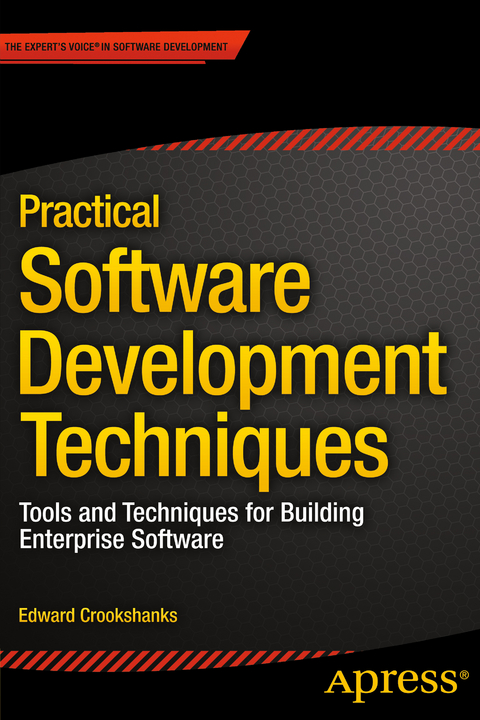
Practical Software Development Techniques (eBook)
XIV, 212 Seiten
Apress (Verlag)
978-1-4842-0728-4 (ISBN)
This book provides an overview of tools and techniques used in enterprise software development, many of which are not taught in academic programs or learned on the job. This is an ideal resource containing lots of practical information and code examples that you need to master as a member of an enterprise development team.
This book aggregates many of these 'on the job' tools and techniques into a concise format and presents them as both discussion topics and with code examples. The reader will not only get an overview of these tools and techniques, but also several discussions concerning operational aspects of enterprise software development and how it differs from smaller development efforts.
For example, in the chapter on Design Patterns and Architecture, the author describes the basics of design patterns but only highlights those that are more important in enterprise applications due to separation of duties, enterprise security, etc.The architecture discussion revolves has a similar emphasis – different teams may manage different aspects of the application’s components with little or no access to the developer.
This aspect of restricted access is also mentioned in the section on logging.
Theory of logging and discussions of what to log are briefly mentioned, the configuration of the logging tools is demonstrated along with a discussion of why it’s very important in an enterprise environment.
This book provides an overview of tools and techniques used in enterprise software development, many of which are not taught in academic programs or learned on the job. This is an ideal resource containing lots of practical information and code examples that you need to master as a member of an enterprise development team.This book aggregates many of these "e;on the job"e; tools and techniques into a concise format and presents them as both discussion topics and with code examples. The reader will not only get an overview of these tools and techniques, but also several discussions concerning operational aspects of enterprise software development and how it differs from smaller development efforts.For example, in the chapter on Design Patterns and Architecture, the author describes the basics of design patterns but only highlights those that are more important in enterprise applications due to separation of duties, enterprise security, etc.The architecture discussion revolves has a similar emphasis – different teams may manage different aspects of the application’s components with little or no access to the developer.This aspect of restricted access is also mentioned in the section on logging.Theory of logging and discussions of what to log are briefly mentioned, the configuration of the logging tools is demonstrated along with a discussion of why it’s very important in an enterprise environment.
1: Version Control2: Unit Testing and Test Driven Development3: Refactoring4: Build Tools and Continuous Integration5: Debugging6: Development Methodologies and SDLC7: Design Patterns and Architecture8: Software Requirements9: Just Enough SQLAppendix A: Enterprise Considerations and Other TopicsAppendix B: Discussion QuestionsAppendix C: Database detailsAppendix D: Bibliography
| Erscheint lt. Verlag | 12.11.2014 |
|---|---|
| Zusatzinfo | XIV, 212 p. 94 illus. |
| Verlagsort | Berkeley |
| Sprache | englisch |
| Themenwelt | Mathematik / Informatik ► Informatik ► Software Entwicklung |
| Mathematik / Informatik ► Informatik ► Theorie / Studium | |
| ISBN-10 | 1-4842-0728-9 / 1484207289 |
| ISBN-13 | 978-1-4842-0728-4 / 9781484207284 |
| Informationen gemäß Produktsicherheitsverordnung (GPSR) | |
| Haben Sie eine Frage zum Produkt? |
 PDF (Wasserzeichen)
DRM: Digitales Wasserzeichen
Dieses eBook enthält ein digitales Wasserzeichen und ist damit für Sie personalisiert. Bei einer missbräuchlichen Weitergabe des eBooks an Dritte ist eine Rückverfolgung an die Quelle möglich.
Dateiformat: PDF (Portable Document Format)
Mit einem festen Seitenlayout eignet sich die PDF besonders für Fachbücher mit Spalten, Tabellen und Abbildungen. Eine PDF kann auf fast allen Geräten angezeigt werden, ist aber für kleine Displays (Smartphone, eReader) nur eingeschränkt geeignet.
Systemvoraussetzungen:
PC/Mac: Mit einem PC oder Mac können Sie dieses eBook lesen. Sie benötigen dafür einen PDF-Viewer - z.B. den Adobe Reader oder Adobe Digital Editions.
eReader: Dieses eBook kann mit (fast) allen eBook-Readern gelesen werden. Mit dem amazon-Kindle ist es aber nicht kompatibel.
Smartphone/Tablet: Egal ob Apple oder Android, dieses eBook können Sie lesen. Sie benötigen dafür einen PDF-Viewer - z.B. die kostenlose Adobe Digital Editions-App.
Buying eBooks from abroad
For tax law reasons we can sell eBooks just within Germany and Switzerland. Regrettably we cannot fulfill eBook-orders from other countries.
PDF (Adobe DRM)Kopierschutz: Adobe-DRM
Adobe-DRM ist ein Kopierschutz, der das eBook vor Mißbrauch schützen soll. Dabei wird das eBook bereits beim Download auf Ihre persönliche Adobe-ID autorisiert. Lesen können Sie das eBook dann nur auf den Geräten, welche ebenfalls auf Ihre Adobe-ID registriert sind.
Details zum Adobe-DRM
Dateiformat: PDF (Portable Document Format)
Mit einem festen Seitenlayout eignet sich die PDF besonders für Fachbücher mit Spalten, Tabellen und Abbildungen. Eine PDF kann auf fast allen Geräten angezeigt werden, ist aber für kleine Displays (Smartphone, eReader) nur eingeschränkt geeignet.
Systemvoraussetzungen:
PC/Mac: Mit einem PC oder Mac können Sie dieses eBook lesen. Sie benötigen eine
eReader: Dieses eBook kann mit (fast) allen eBook-Readern gelesen werden. Mit dem amazon-Kindle ist es aber nicht kompatibel.
Smartphone/Tablet: Egal ob Apple oder Android, dieses eBook können Sie lesen. Sie benötigen eine
Geräteliste und zusätzliche Hinweise
Buying eBooks from abroad
For tax law reasons we can sell eBooks just within Germany and Switzerland. Regrettably we cannot fulfill eBook-orders from other countries.
aus dem Bereich