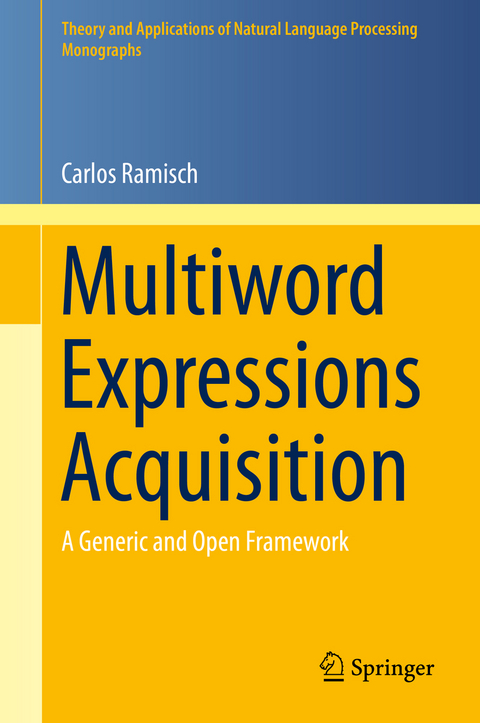
Multiword Expressions Acquisition (eBook)
XIV, 230 Seiten
Springer International Publishing (Verlag)
978-3-319-09207-2 (ISBN)
This book is an excellent introduction to multiword expressions. It provides a unique, comprehensive and up-to-date overview of this exciting topic in computational linguistics. The first part describes the diversity and richness of multiword expressions, including many examples in several languages. These constructions are not only complex and arbitrary, but also much more frequent than one would guess, making them a real nightmare for natural language processing applications.
The second part introduces a new generic framework for automatic acquisition of multiword expressions from texts. Furthermore, it describes the accompanying free software tool, the mwetoolkit, which comes in handy when looking for expressions in texts (regardless of the language). Evaluation is greatly emphasized, underlining the fact that results depend on parameters like corpus size, language, MWE type, etc. The last part contains solid experimental results and evaluates the mwetoolkit, demonstrating its usefulness for computer-assisted lexicography and machine translation.
This is the first book to cover the whole pipeline of multiword expression acquisition in a single volume. It is addresses the needs of students and researchers in computational and theoretical linguistics, cognitive sciences, artificial intelligence and computer science. Its good balance between computational and linguistic views make it the perfect starting point for anyone interested in multiword expressions, language and text processing in general.
Carlos Ramisch is a researcher and lecturer at the Aix-Marseille University (France). He holds a double PhD in computer science from Grenoble University (France) and UFRGS (Brazil). His research interests are multiword expressions, semantics and multilingualism. Carlos coordinated many events, including the MWE workshops (2010, 2011, 2013) and the ACM TSLP special issue. He is the creator and developer of the mwetoolkit.
Carlos Ramisch is a researcher and lecturer at the Aix-Marseille University (France). He holds a double PhD in computer science from Grenoble University (France) and UFRGS (Brazil). His research interests are multiword expressions, semantics and multilingualism. Carlos coordinated many events, including the MWE workshops (2010, 2011, 2013) and the ACM TSLP special issue. He is the creator and developer of the mwetoolkit.
1.Introduction.- Part I.Multiword Expressions: a Though Nut to Crack.- 2.Definitions and Characteristics.- 3 State of the Art in MWE Processing.- Part II.MWE Acquisition.- 4.Evaluation of MWE Acquisition.- 5.A New Framework for MWE Acquisition.- Part III Applications.- 6.Application 1: Lexicography.- 7.Application 2: Machine Translation.- 8.Conclusions.- Appendixes.- A.Extended List of Translation Examples.- B.Resources Used in the Experiments.- C.The mwetoolkit: Documentation.- D.Tagsets for POS and syntax.- E.Detailed Lexicon Descriptions.
| Erscheint lt. Verlag | 24.9.2014 |
|---|---|
| Reihe/Serie | Theory and Applications of Natural Language Processing | Theory and Applications of Natural Language Processing |
| Zusatzinfo | XIV, 230 p. 17 illus. |
| Verlagsort | Cham |
| Sprache | englisch |
| Themenwelt | Informatik ► Theorie / Studium ► Künstliche Intelligenz / Robotik |
| Schlagworte | collocation • Collocation extraction • Multiword expression • Multiword expression acquisition • MWE • Mwetoolkit |
| ISBN-10 | 3-319-09207-3 / 3319092073 |
| ISBN-13 | 978-3-319-09207-2 / 9783319092072 |
| Informationen gemäß Produktsicherheitsverordnung (GPSR) | |
| Haben Sie eine Frage zum Produkt? |
 PDF (Wasserzeichen)
DRM: Digitales Wasserzeichen
Dieses eBook enthält ein digitales Wasserzeichen und ist damit für Sie personalisiert. Bei einer missbräuchlichen Weitergabe des eBooks an Dritte ist eine Rückverfolgung an die Quelle möglich.
Dateiformat: PDF (Portable Document Format)
Mit einem festen Seitenlayout eignet sich die PDF besonders für Fachbücher mit Spalten, Tabellen und Abbildungen. Eine PDF kann auf fast allen Geräten angezeigt werden, ist aber für kleine Displays (Smartphone, eReader) nur eingeschränkt geeignet.
Systemvoraussetzungen:
PC/Mac: Mit einem PC oder Mac können Sie dieses eBook lesen. Sie benötigen dafür einen PDF-Viewer - z.B. den Adobe Reader oder Adobe Digital Editions.
eReader: Dieses eBook kann mit (fast) allen eBook-Readern gelesen werden. Mit dem amazon-Kindle ist es aber nicht kompatibel.
Smartphone/Tablet: Egal ob Apple oder Android, dieses eBook können Sie lesen. Sie benötigen dafür einen PDF-Viewer - z.B. die kostenlose Adobe Digital Editions-App.
Buying eBooks from abroad
For tax law reasons we can sell eBooks just within Germany and Switzerland. Regrettably we cannot fulfill eBook-orders from other countries.
aus dem Bereich