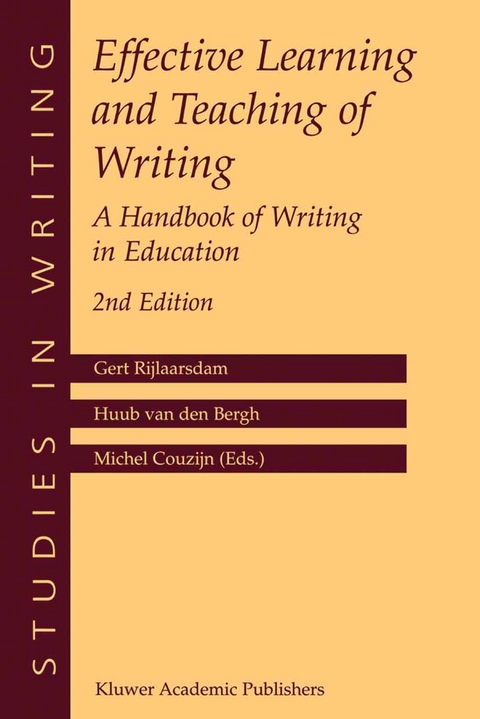
Effective Learning and Teaching of Writing (eBook)
X, 670 Seiten
Springer Netherland (Verlag)
978-1-4020-2739-0 (ISBN)
Effective Learning and Teaching of Writing is a handbook on research on the effective teaching and learning of writing. It is a reference for researchers and educators in the domain of written composition in education. Effective Learning and Teaching of Writing covers all age ranges and school settings and it deals with various aspects of writing and text types. Research methodology varies from experimental studies to reflective classroom practitioners' research.
This new volume in the series Studies in Writing brings together researchers from all kinds of disciplines involved in writing research and countries in their endeavour to improve the teaching of written composition. It is the result of co-operation of researchers all over the world and shows that in spite of the differences in educational regions over the world, research in writing shares similar problems, and tries to find answers, and generate new questions. The body of knowledge in this volume will inspire researchers and teachers to improve research and practice.
Effective Learning and Teaching of Writing is a handbook on research on the effective teaching and learning of writing. It is a reference for researchers and educators in the domain of written composition in education. Effective Learning and Teaching of Writing covers all age ranges and school settings and it deals with various aspects of writing and text types. Research methodology varies from experimental studies to reflective classroom practitioners' research. This new volume in the series Studies in Writing brings together researchers from all kinds of disciplines involved in writing research and countries in their endeavour to improve the teaching of written composition. It is the result of co-operation of researchers all over the world and shows that in spite of the differences in educational regions over the world, research in writing shares similar problems, and tries to find answers, and generate new questions. The body of knowledge in this volume will inspire researchers and teachers to improve research and practice.
Effective learning and teaching of writing: student involvement in the teaching of writing.- emergent writing in kindergarten and the emergence of the alphabetic principle.- looking at reading and writing through language.- rewriting to introduce punctuation in the second grade: a didactic approach.- contextual factors enhancing cognitive and metacognitive activity during the process of collaborative writing.- Metacognitive regulations, peer interactions and revision of narratives by sixth graders.- The directivity of teacher strategies in collaborative writing tasks.- Making digital annotations using the world wide web.- Popular culture: a resource for writing in secondary English classrooms.- The garden of thought - about writing poems in upper secondary school.- Using a structured writing workshop to help good readers who are poor writers.- Deaf ways of writing narratives: a bilingual approach.- Stylistic imitation as a tool in writing pedagogy.- Improving argumentative writing by fostering argumentative speech.- Monitoring local coherence through bridging integration.- Learning to write instructive texts by reader observation and written feedback.- Learning to read and write argumentative text by observation of peer learners.- The uptake of peer-based intervention in the writing classroom.- Teaching writing: using research to inform practice.- Impact of regular philosophical discussion on argumentative skills: reflection about education in primary schools.- Action research: a study on using an integrative-narrative method to teach l2 writing in a Hong Kong primary school.- Teaching how to write argumentative texts at primary school.- Teaching writing: teaching oral presentation.- Writing to learn: constructing the concept of genre in a writing.- Writing 'in your own words': children’s use of information sources in research projects.- Metacognition to learn how to write texts at school and to develop motivation to do it.- Fostering novices’ ability towrite informative texts.- Adapting to the classroom setting: new research on teachers moving between traditional and computer classrooms.- Assessment of argumentative writing.- Digital information literacy: teaching students to use the internet in source-based writing.- 'Down the plughole': the pitfalls of testing the writing of l2 pupils.- Composing a summary.- Enhancing thinking dispositions through informal writing:
Experiences in science classes.- Fostering reflective writing by structuring writing-to-learn tasks.- Reflective writing & reflective thinking: the implications of introducing reflective practice into a professional doctorate programme in pharmacy.- Writing to learn: conducting a process log.- Learning by writing hypertext: a research based design of university courses in writing hypertext.- The effect of student prior experience, attitudes, and approaches on performance in an undergraduate science writing program.- Children’s writing strategies: profiles of writers.- Writing-to-learn and graph-drawing as aids of the integration of text and graphs.- References.- Author index.- Subject index.- List of contributors.
| Erscheint lt. Verlag | 23.11.2007 |
|---|---|
| Reihe/Serie | Studies in Writing | Studies in Writing |
| Zusatzinfo | X, 670 p. |
| Verlagsort | Dordrecht |
| Sprache | englisch |
| Themenwelt | Schulbuch / Wörterbuch ► Lektüren / Interpretationen |
| Schulbuch / Wörterbuch ► Wörterbuch / Fremdsprachen | |
| Geisteswissenschaften ► Sprach- / Literaturwissenschaft ► Sprachwissenschaft | |
| Mathematik / Informatik ► Mathematik | |
| Sozialwissenschaften ► Pädagogik ► Schulpädagogik / Grundschule | |
| Schlagworte | Argument • Design • english classroom • Experiment • Information • Integration • Learning and Instruction • Motivation • Second Language |
| ISBN-10 | 1-4020-2739-7 / 1402027397 |
| ISBN-13 | 978-1-4020-2739-0 / 9781402027390 |
| Informationen gemäß Produktsicherheitsverordnung (GPSR) | |
| Haben Sie eine Frage zum Produkt? |
 PDF (Wasserzeichen)
DRM: Digitales Wasserzeichen
Dieses eBook enthält ein digitales Wasserzeichen und ist damit für Sie personalisiert. Bei einer missbräuchlichen Weitergabe des eBooks an Dritte ist eine Rückverfolgung an die Quelle möglich.
Dateiformat: PDF (Portable Document Format)
Mit einem festen Seitenlayout eignet sich die PDF besonders für Fachbücher mit Spalten, Tabellen und Abbildungen. Eine PDF kann auf fast allen Geräten angezeigt werden, ist aber für kleine Displays (Smartphone, eReader) nur eingeschränkt geeignet.
Systemvoraussetzungen:
PC/Mac: Mit einem PC oder Mac können Sie dieses eBook lesen. Sie benötigen dafür einen PDF-Viewer - z.B. den Adobe Reader oder Adobe Digital Editions.
eReader: Dieses eBook kann mit (fast) allen eBook-Readern gelesen werden. Mit dem amazon-Kindle ist es aber nicht kompatibel.
Smartphone/Tablet: Egal ob Apple oder Android, dieses eBook können Sie lesen. Sie benötigen dafür einen PDF-Viewer - z.B. die kostenlose Adobe Digital Editions-App.
Buying eBooks from abroad
For tax law reasons we can sell eBooks just within Germany and Switzerland. Regrettably we cannot fulfill eBook-orders from other countries.
aus dem Bereich