


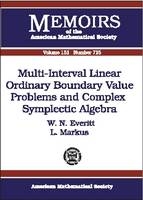
Multi-interval Linear Ordinary Boundary Value Problems and Complex Symplectic Algebra
Seiten
2001
American Mathematical Society (Verlag)
978-0-8218-2669-0 (ISBN)
American Mathematical Society (Verlag)
978-0-8218-2669-0 (ISBN)
- Keine Verlagsinformationen verfügbar
- Artikel merken
A multi-interval quasi-differential system $/{I_{r},M_{r},w_{r}:r/in/Omega/}$ consists of a collection of real intervals, $/{I_{r}/}$, as indexed by a finite, or possibly infinite index set $/Omega$ (where $/mathrm{card} (/Omega)/geq/aleph_{0}$ is permissible), on which are assigned ordinary or quasi-differential expressions $M_{r}$.
A multi-interval quasi-differential system $/{I_{r},M_{r},w_{r}:r/in/Omega/}$ consists of a collection of real intervals, $/{I_{r}/}$, as indexed by a finite, or possibly infinite index set $/Omega$ (where $/mathrm{card} (/Omega)/geq/aleph_{0}$ is permissible), on which are assigned ordinary or quasi-differential expressions $M_{r}$ generating unbounded operators in the Hilbert function spaces $L_{r}^{2}/equiv L^{2}(I_{r};w_{r})$, where $w_{r}$ are given, non-negative weight functions.For each fixed $r/in/Omega$ assume that $M_{r}$ is Lagrange symmetric (formally self-adjoint) on $I_{r}$ and hence specifies minimal and maximal closed operators $T_{0,r}$ and $T_{1,r}$, respectively, in $L_{r}^{2}$. However the theory does not require that the corresponding deficiency indices $d_{r}^{-}$ and $d_{r}^{+}$ of $T_{0,r}$ are equal (e. g. the symplectic excess $Ex_{r}=d_{r}^{+}-d_{r}^{-}/neq 0$), in which case there will not exist any self-adjoint extensions of $T_{0,r}$ in $L_{r}^{2}$. In this paper a system Hilbert space $/mathbf{H}:=/sum_{r/,/in/,/Omega}/oplus L_{r}^{2}$ is defined (even for non-countable $/Omega$) with corresponding minimal and maximal system operators $/mathbf{T}_{0}$ and $/mathbf{T}_{1}$ in $/mathbf{H}$.Then the system deficiency indices $/mathbf{d}^{/pm} =/sum_{r/,/in/, /Omega}d_{r}^{/pm}$ are equal (system symplectic excess $Ex=0$), if and only if there exist self-adjoint extensions $/mathbf{T}$ of $/mathbf{T}_{0}$ in $/mathbf{H}$. The existence is shown of a natural bijective correspondence between the set of all such self-adjoint extensions $/mathbf{T}$ of $/mathbf{T}_{0}$, and the set of all complete Lagrangian subspaces $/mathsf{L}$ of the system boundary complex symplectic space $/mathsf{S}=/mathbf{D(T}_{1})//mathbf{D(T}_{0})$. This result generalizes the earlier symplectic version of the celebrated GKN-Theorem for single interval systems to multi-interval systems. Examples of such complete Lagrangians, for both finite and infinite dimensional complex symplectic $/mathsf{S}$, illuminate new phenoma for the boundary value problems of multi-interval systems. These concepts have applications to many-particle systems of quantum mechanics, and to other physical problems.
A multi-interval quasi-differential system $/{I_{r},M_{r},w_{r}:r/in/Omega/}$ consists of a collection of real intervals, $/{I_{r}/}$, as indexed by a finite, or possibly infinite index set $/Omega$ (where $/mathrm{card} (/Omega)/geq/aleph_{0}$ is permissible), on which are assigned ordinary or quasi-differential expressions $M_{r}$ generating unbounded operators in the Hilbert function spaces $L_{r}^{2}/equiv L^{2}(I_{r};w_{r})$, where $w_{r}$ are given, non-negative weight functions.For each fixed $r/in/Omega$ assume that $M_{r}$ is Lagrange symmetric (formally self-adjoint) on $I_{r}$ and hence specifies minimal and maximal closed operators $T_{0,r}$ and $T_{1,r}$, respectively, in $L_{r}^{2}$. However the theory does not require that the corresponding deficiency indices $d_{r}^{-}$ and $d_{r}^{+}$ of $T_{0,r}$ are equal (e. g. the symplectic excess $Ex_{r}=d_{r}^{+}-d_{r}^{-}/neq 0$), in which case there will not exist any self-adjoint extensions of $T_{0,r}$ in $L_{r}^{2}$. In this paper a system Hilbert space $/mathbf{H}:=/sum_{r/,/in/,/Omega}/oplus L_{r}^{2}$ is defined (even for non-countable $/Omega$) with corresponding minimal and maximal system operators $/mathbf{T}_{0}$ and $/mathbf{T}_{1}$ in $/mathbf{H}$.Then the system deficiency indices $/mathbf{d}^{/pm} =/sum_{r/,/in/, /Omega}d_{r}^{/pm}$ are equal (system symplectic excess $Ex=0$), if and only if there exist self-adjoint extensions $/mathbf{T}$ of $/mathbf{T}_{0}$ in $/mathbf{H}$. The existence is shown of a natural bijective correspondence between the set of all such self-adjoint extensions $/mathbf{T}$ of $/mathbf{T}_{0}$, and the set of all complete Lagrangian subspaces $/mathsf{L}$ of the system boundary complex symplectic space $/mathsf{S}=/mathbf{D(T}_{1})//mathbf{D(T}_{0})$. This result generalizes the earlier symplectic version of the celebrated GKN-Theorem for single interval systems to multi-interval systems. Examples of such complete Lagrangians, for both finite and infinite dimensional complex symplectic $/mathsf{S}$, illuminate new phenoma for the boundary value problems of multi-interval systems. These concepts have applications to many-particle systems of quantum mechanics, and to other physical problems.
Introduction: Goals, organization Some definitions for multi-interval systems Complex symplectic spaces Single interval quasi-differential systems Multi-interval quasi-differential systems Boundary symplectic spaces for multi-interval systems Finite multi-interval systems Examples of complete Lagrangians Bibliography.
| Erscheint lt. Verlag | 1.5.2001 |
|---|---|
| Reihe/Serie | Memoirs of the American Mathematical Society |
| Verlagsort | Providence |
| Sprache | englisch |
| Gewicht | 170 g |
| Themenwelt | Mathematik / Informatik ► Mathematik ► Analysis |
| Mathematik / Informatik ► Mathematik ► Angewandte Mathematik | |
| Mathematik / Informatik ► Mathematik ► Geometrie / Topologie | |
| ISBN-10 | 0-8218-2669-7 / 0821826697 |
| ISBN-13 | 978-0-8218-2669-0 / 9780821826690 |
| Zustand | Neuware |
| Informationen gemäß Produktsicherheitsverordnung (GPSR) | |
| Haben Sie eine Frage zum Produkt? |
Mehr entdecken
aus dem Bereich

aus dem Bereich
Festigkeits- und Verformungslehre, Baudynamik, Wärmeübertragung, …
Buch | Hardcover (2025)
De Gruyter Oldenbourg (Verlag)
CHF 125,90


