Multivariate Analysis of Ecological Data using CANOCO
Cambridge University Press (Verlag)
978-0-521-89108-0 (ISBN)
- Titel erscheint in neuer Auflage
- Artikel merken
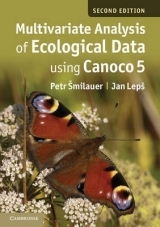
This book is primarily written for ecologists needing to analyse data resulting from field observations and experiments. It will be particularly useful for students and researchers dealing with complex ecological problems, such as the variation of biotic communities with environmental conditions or the response of biotic communities to experimental manipulation. Following a simple introduction to ordination methods, the text focuses on constrained ordination methods (RDA, CCA) and the use of permutation tests on statistical hypotheses of multivariate data. An overview of classification methods, or modern regression methods (GLM, GAM, loess), is provided and guidance on the correct interpretation of ordination diagrams is given. Seven case studies of varying difficulty help to illustrate the suggested analytical methods, using the Canoco for Windows software. The case studies utilise both the descriptive and manipulative approaches, and they are supported by data sets and project files available from the book website.
Dr Jan Leps is Professor of Ecology in the Department of Botany at the University of South Bohemia, Czech Republic. Dr Petr Smilauer is Lecturer in Multivariate Statistics at the University of South Bohemia, Czech Republic.
1. Introduction and data manipulation; 2. Experimental design; 3. Basics of gradient analysis; 4. Using Canoco; 5. Constrained ordination and permutation tests; 6. Similarity measures; 7. Classification methods; 8. Regression methods; 9. Advanced use of ordination; 10. Visualising multivariate data; 11. Case study 1: variation in forest bird assemblages; 12. Case study 2: search for community composition patterns and their environmental correlates: vegetation of spring meadows; 13. Case study 3: separating the effects of explanatory variables; 14. Case study 4: evaluation of experiments in randomised complete blocks; 15. Case study 5: analysis of repeated observations of species composition from factorial experiment; 16. Case study 6: hierarchical analysis of crayfish community variation; 17. Case study 7: differentiating two species and their hybrids with discriminant analysis.
| Erscheint lt. Verlag | 29.5.2003 |
|---|---|
| Zusatzinfo | 110 Line drawings, unspecified |
| Verlagsort | Cambridge |
| Sprache | englisch |
| Maße | 173 x 247 mm |
| Gewicht | 579 g |
| Themenwelt | Sachbuch/Ratgeber ► Natur / Technik ► Natur / Ökologie |
| Mathematik / Informatik ► Mathematik ► Angewandte Mathematik | |
| Naturwissenschaften ► Biologie ► Ökologie / Naturschutz | |
| Technik ► Umwelttechnik / Biotechnologie | |
| ISBN-10 | 0-521-89108-6 / 0521891086 |
| ISBN-13 | 978-0-521-89108-0 / 9780521891080 |
| Zustand | Neuware |
| Informationen gemäß Produktsicherheitsverordnung (GPSR) | |
| Haben Sie eine Frage zum Produkt? |
aus dem Bereich