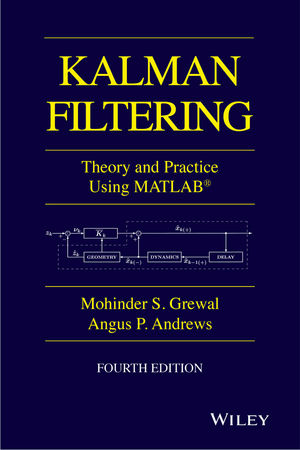
Kalman Filtering (eBook)
John Wiley & Sons (Verlag)
978-1-118-98491-8 (ISBN)
The definitive textbook and professional reference on Kalman Filtering - fully updated, revised, and expanded
This book contains the latest developments in the implementation and application of Kalman filtering. Authors Grewal and Andrews draw upon their decades of experience to offer an in-depth examination of the subtleties, common pitfalls, and limitations of estimation theory as it applies to real-world situations. They present many illustrative examples including adaptations for nonlinear filtering, global navigation satellite systems, the error modeling of gyros and accelerometers, inertial navigation systems, and freeway traffic control.
Kalman Filtering: Theory and Practice Using MATLAB, Fourth Edition is an ideal textbook in advanced undergraduate and beginning graduate courses in stochastic processes and Kalman filtering. It is also appropriate for self-instruction or review by practicing engineers and scientists who want to learn more about this important topic.
Mohinder S. Grewal, PhD, PE, is Professor of Electrical Engineering in the College of Engineering and Computer Science at California State University, Fullerton. He has more than forty years of experience in inertial navigation and control, and his mechanizations are currently used in commercial and military aircraft, surveillance satellites, missile and radar systems, freeway traffic control, and Global Navigation Satellite Systems.
Angus P. Andrews, PhD, is an MIT graduate with a PhD in mathematics from UCLA. His career in aerospace technology development spans more than 50 years, starting with navigation analysis for the Apollo moon missions, and including a dozen years in the analysis, design, development, and testing of inertial navigation systems. His discoveries included the orbital navigation method called unknown landmark tracking, alternative solutions for square root filters, and a model for bearing torques of electrostatic gyroscopes. Since retiring as a senior scientist from the Rockwell Science Center in 2000, he has continued consulting and instructing in sensor error modeling and analysis, and publishing articles and books on these subjects.
Mohinder S. Grewal, PhD, PE, is Professor of Electrical Engineering in the College of Engineering and Computer Science at California State University, Fullerton. He has more than forty years of experience in inertial navigation and control, and his mechanizations are currently used in commercial and military aircraft, surveillance satellites, missile and radar systems, freeway traffic control, and Global Navigation Satellite Systems. Angus P. Andrews, PhD, is an MIT graduate with a PhD in mathematics from UCLA. His career in aerospace technology development spans more than 50 years, starting with navigation analysis for the Apollo moon missions, and including a dozen years in the analysis, design, development, and testing of inertial navigation systems. His discoveries included the orbital navigation method called unknown landmark tracking, alternative solutions for square root filters, and a model for bearing torques of electrostatic gyroscopes. Since retiring as a senior scientist from the Rockwell Science Center in 2000, he has continued consulting and instructing in sensor error modeling and analysis, and publishing articles and books on these subjects.
"The book "Kalman Filtering: Theory and practice with MATLAB" is a well-written text with modern ideas which are expressed in a rigorous and clear manner. It is also a professional reference on Kalman filtering: fully updated, revised, and expanded." (Zentralblatt MATH 2016)
Chapter 1
Introduction
Once you get the physics right, the rest is mathematics.
—Rudolf E. Kalman
Kailath Lecture, Stanford University, May 11, 2009
1.1 Chapter Focus
This chapter presents a preview of where we are heading, some history of how others got there before us, an overview showing how all the material fits together, and a common notation and nomenclature to make it more apparent.
1.2 On Kalman Filtering
1.2.1 First of All: What Is a Kalman Filter?
Theoretically, it has been called the linear least mean squares estimator (LLSME) because it minimizes the mean-squared estimation error for a linear stochastic system using noisy linear sensors. It has also been called the linear quadratic estimator (LQE) because it minimizes a quadratic function of estimation error for a linear dynamic system with white measurement and disturbance noise. Even today, more than half a century after its discovery, it remains a unique accomplishment in the history of estimation theory. It is the only practical finite-dimensional solution to the real-time optimal estimation problem for stochastic systems, and it makes very few assumptions about the underlying probability distributions except that they have finite means and second central moments (covariances). Its mathematical model has been found to represent a phenomenal range of important applications involving noisy measurements for estimating the current conditions of dynamic systems with less-than-predictable disturbances. Although many approximation methods have been developed to extend its application to less-than-linear problems, and despite decades of dedicated research directed at generalizing it for nonlinear applications, no comparable general solution1 for nonlinear problems has been found.
Practically, the Kalman filter is one of the great discoveries of mathematical engineering, which uses mathematical modeling to solve engineering problems—in the much same way that mathematical physics is used to solve physics problems, or computational mathematics is used for solving efficiency and accuracy problems in computer implementations.
Its early users would come to consider the Kalman filter to be the greatest discovery in practical estimation theory in the twentieth century, and its reputation has continued to grow over time. As an indication of its ubiquity, a Google®; web search for “Kalman filter” or “Kalman filtering” produces more than a million hits. One reason for this is that the Kalman filter has enabled human kind to do many things that could not have been done without it, and it has become as indispensable as silicon in the makeup of many electronic systems. Its most immediate applications have been for the monitoring and control of complex dynamic systems such as continuous manufacturing processes, aircraft, ships, or spacecraft. To control a dynamic system, you must first know what it is doing. For these applications, it is not always possible or desirable to measure every variable that you want to control, and the Kalman filter provides the mathematical framework for inferring the unmeasured variables from indirect and noisy measurements. The Kalman filter is also used for predicting the likely future courses of dynamic systems that people are not likely to control, such as the flow of rivers during flood, the trajectories of celestial bodies, or the prices of traded commodities and securities. It has become a universal tool for integrating different sensor and/or data collection systems into an overall optimal solution.
As an added bonus, the Kalman filter model can be used as a tool for assessing the relative accuracy of alternative sensor system designs for likely scenarios of dynamic system trajectories. Without this capability, development of many complex sensor systems (including Global Navigation Satellite Systems) may not have been possible.
From a practical standpoint, the following are the perspectives that this book will present:
- It is only a tool. It does not solve any problem all by itself, although it can make it easier for you to do it. It is not a physical tool, but a mathematical one. Mathematical tools make mental work more efficient, just as mechanical tools make physical work more efficient. As with any tool, it is importantto understand its use and function before you can apply it effectively. The purpose of this book is to make you sufficiently familiar with and proficient in the use of the Kalman filter that you can apply it correctly and efficiently.
- It is a computer program. It has been called “ideally suited to digital computer implementation” [2], in part because it uses a finite representation of the estimation problem—by a finite number of variables. It does, however, assume that these variables are real numbers—with infinite precision. Some of the problems encountered in its use arise from the distinction between finite dimension and finite information and the distinction between “finite” and “manageable” problem sizes. These are all issues on the practical side of Kalman filtering that must be considered along with the theory.
- It is a consistent statistical characterization of an estimation problem. It is much more than an estimator, because it propagates the current state of knowledge of the dynamic system, including the mean-squared uncertainties arising from random dynamic perturbations and sensor noise. These properties are extremely useful for statistical analysis and the predictive design of sensor systems.
If these answers provide the level of understanding that you were seeking, then there is no need for you to read the rest of the book. If you need to understand Kalman filters well enough to use them effectively, then please read on!
1.2.2 How It Came to Be Called a Filter
It might seem strange that the term filter would apply to an estimator. More commonly, a filter is a physical device for removing unwanted fractions of mixtures. (The word felt comes from the same Medieval Latin stem and was used to denote the material that was used as a filter for liquids.) Originally, a filter solved the problem of separating unwanted components of liquid–solid mixtures. In the era of crystal radios and vacuum tubes, the term was applied to analog circuits that “filter” electronic signals. These signals are mixtures of different frequency components, and these physical devices preferentially attenuate unwanted frequencies.
This concept was extended in the 1930s and 1940s to the separation of “signals” from “noise,” both of which were characterized by their power spectral densities. Kolmogorov and Wiener used this statistical characterization of their probability distributions in forming an optimal estimate of the signal, given the sum of the signal and noise.
With Kalman filtering, the term assumed a meaning that is well beyond the original idea of separation of the components of a mixture. It has also come to include the solution of an inversion problem, in which one knows how to represent the measurable variables as functions of the variables of principal interest. In essence, it inverts this functional relationship and estimates the independent variables as inverted functions of the dependent (measurable) variables. These variables of interest are also allowed to be dynamic, with dynamics that are only partially predictable.
1.2.3 Its Mathematical Foundations
Figure 1.1 depicts the essential subjects forming the foundations for Kalman filtering theory. Although this shows Kalman filtering as the apex of a pyramid, it is itself but part of the foundations of another discipline, “modern” control theory, and a proper subset of statistical decision theory.
We will examine only the top three layers of the pyramid in this book, and a little of the underlying mathematics2 (matrix theory, in Appendix B on the Wiley web site).
Figure 1.1 Foundational concepts in Kalman filtering.
1.2.4 What It Is Used for
The applications of Kalman filtering encompass many fields, but its use as a tool is almost exclusively for two purposes: estimation and performance analysis of estimators.
- Estimating the State of Dynamic Systems. What is a dynamic system? Almost everything, if you are picky about it. Except for a few fundamental physical constants, there is hardly anything in the universe that is truly constant. The orbital parameters of the dwarf planet Ceres are not constant, and even the “fixed” stars and continents are moving. Nearly all physical systems are dynamic to some degree. If one wants very precise estimates of their characteristics over time, then one has to take their dynamics into consideration. The problem is that one does not always know their dynamics very precisely either. Given this state of partial ignorance, the best one can do is expressing our ignorance more precisely—using probabilities. The Kalman filter allows us to estimate the state of dynamic systems with certain types of random behavior by using such statistical information. A few examples of such systems are listed in the second column of Table 1.1.
- Performance Analysis of Estimation Systems. The third column of Table 1.1 lists some possible sensor types...
| Erscheint lt. Verlag | 29.12.2014 |
|---|---|
| Reihe/Serie | IEEE Press |
| Wiley - IEEE | Wiley - IEEE |
| Sprache | englisch |
| Themenwelt | Mathematik / Informatik ► Informatik ► Theorie / Studium |
| Naturwissenschaften ► Geowissenschaften ► Geografie / Kartografie | |
| Technik ► Elektrotechnik / Energietechnik | |
| Technik ► Nachrichtentechnik | |
| Schlagworte | Control Systems Technology • Electrical & Electronics Engineering • Elektrotechnik u. Elektronik • Fernerkundung • Global Navigation Satellite Systems • inertial navigation systems • Kalman Filter • linear dynamic systems • linear optimal filters • Matrix • Navigation • nonlinear extensions • optimal smoothers • Predictors • Probability Distribution • random processes • Regelungstechnik • Remote Sensing • Signal Processing • Signalverarbeitung |
| ISBN-10 | 1-118-98491-9 / 1118984919 |
| ISBN-13 | 978-1-118-98491-8 / 9781118984918 |
| Informationen gemäß Produktsicherheitsverordnung (GPSR) | |
| Haben Sie eine Frage zum Produkt? |
 EPUB (Adobe DRM)
Kopierschutz: Adobe-DRM
Adobe-DRM ist ein Kopierschutz, der das eBook vor Mißbrauch schützen soll. Dabei wird das eBook bereits beim Download auf Ihre persönliche Adobe-ID autorisiert. Lesen können Sie das eBook dann nur auf den Geräten, welche ebenfalls auf Ihre Adobe-ID registriert sind.
Details zum Adobe-DRM
Dateiformat: EPUB (Electronic Publication)
EPUB ist ein offener Standard für eBooks und eignet sich besonders zur Darstellung von Belletristik und Sachbüchern. Der Fließtext wird dynamisch an die Display- und Schriftgröße angepasst. Auch für mobile Lesegeräte ist EPUB daher gut geeignet.
Systemvoraussetzungen:
PC/Mac: Mit einem PC oder Mac können Sie dieses eBook lesen. Sie benötigen eine
eReader: Dieses eBook kann mit (fast) allen eBook-Readern gelesen werden. Mit dem amazon-Kindle ist es aber nicht kompatibel.
Smartphone/Tablet: Egal ob Apple oder Android, dieses eBook können Sie lesen. Sie benötigen eine
Geräteliste und zusätzliche Hinweise
Buying eBooks from abroad
For tax law reasons we can sell eBooks just within Germany and Switzerland. Regrettably we cannot fulfill eBook-orders from other countries.
aus dem Bereich