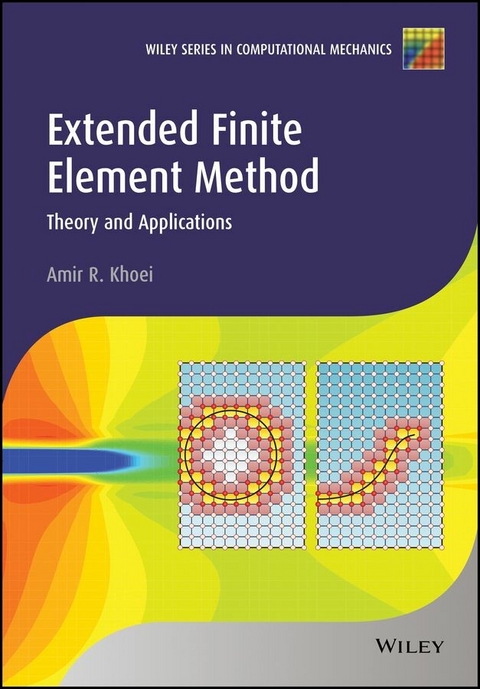
Extended Finite Element Method (eBook)
John Wiley & Sons (Verlag)
978-1-118-86968-0 (ISBN)
Introduces the theory and applications of the extended finite element method (XFEM) in the linear and nonlinear problems of continua, structures and geomechanics
Extended Finite Element Method: Theory and Applications introduces the theory and applications of the extended finite element method (XFEM) in the linear and nonlinear problems of continua, structures and geomechanics. The XFEM approach is based on an extension of standard finite element method based on the partition of unity method.
Extended Finite Element Method: Theory and Applications begins by introducing the concept of partition of unity, various enrichment functions, and fundamentals of XFEM formulation. It then covers the theory and application of XFEM in large deformations, plasticity and contact problems. The implementation of XFEM in fracture mechanics, including the linear, cohesive, and ductile crack propagation is also covered. The theory and applications of the XFEM in multiphase fluid flow, including the hydraulic fracturing in soil saturated media and crack propagation in thermo-hydro-mechanical porous media, is also discussed in detail.
- Introduces the theory and applications of the extended finite element method (XFEM) in the linear and nonlinear problems of continua, structures and geomechanics
- Explores the concept of partition of unity, various enrichment functions, and fundamentals of XFEM formulation.
- Covers numerous applications of XFEM including fracture mechanics, large deformation, plasticity, multiphase flow, hydraulic fracturing and contact problems
- Accompanied by a website hosting source code and examples
Introduces the theory and applications of the extended finite element method (XFEM) in the linear and nonlinear problems of continua, structures and geomechanics Explores the concept of partition of unity, various enrichment functions, and fundamentals of XFEM formulation. Covers numerous applications of XFEM including fracture mechanics, large deformation, plasticity, multiphase flow, hydraulic fracturing and contact problems Accompanied by a website hosting source code and examples
Amir R. Khoei, Sharif University of Technology, Iran
1
Introduction
1.1 Introduction
The finite element method (FEM) is one of the most common numerical tools for obtaining the approximate solutions of partial differential equations. It has been applied successfully in many areas of engineering sciences to study, model, and predict the behavior of structures. The area ranges across aeronautical and aerospace engineering, the automobile industry, mechanical engineering, civil engineering, biomechanics, geomechanics, material sciences, and many more. The FEM does not operate on differential equations; instead, continuous boundary and initial value problems are reformulated into equivalent variational forms. The FEM requires the domain to be subdivided into non-overlapping regions, called the elements. In the FEM, individual elements are connected together by a topological map, called a mesh, and local polynomial representation is used for the fields within the element. The solution obtained is a function of the quality of mesh and the fundamental requirement is that the mesh has to conform to the geometry. The main advantage of the FEM is that it can handle complex boundaries without much difficulty. Despite its popularity, the FEM suffers from certain drawbacks. There are number of instances where the FEM poses restrictions to an efficient application of the method. The FEM relies on the approximation properties of polynomials; hence, they often require smooth solutions in order to obtain optimal accuracy. However, if the solution contains a non-smooth behavior, like high gradients or singularities in the stress and strain fields, or strong discontinuities in the displacement field as in the case of cracked bodies, then the FEM becomes computationally expensive to get optimal convergence.
One of the most significant interests in solid mechanics problems is the simulation of fracture and damage phenomena (Figure 1.1). Engineering structures, when subjected to high loading, may result in stresses in the body exceeding the material strength and thus, in progressive failure. These material failure processes manifest themselves in various failure mechanisms such as the fracture process zone (FPZ) in rocks and concrete, the shear band localization in ductile metals, or the discrete crack discontinuity in brittle materials. The accurate modeling and evolution of smeared and discrete discontinuities have been a topic of growing interest over the past few decades, with quite a few notable developments in computational techniques over the past few years. Early numerical techniques for modeling discontinuities in finite elements can be seen in the work of Ortiz, Leroy, and Needleman (1987) and Belytschko, Fish, and Englemann (1988). They modeled the shear band localization as a “weak” (strain) discontinuity that could pass through the finite element mesh using a multi-field variational principle. Dvorkin, Cuitiño, and Gioia (1990) considered a “strong” (displacement) discontinuity by modifying the principle of virtual work statement. A unified framework for modeling the strong discontinuity by taking into account the softening constitutive law and the interface traction–displacement relation was proposed by Simo, Oliver, and Armero (1993). In the strong discontinuity approach, the displacement consists of regular and enhanced components, where the enhanced component yields a jump across the discontinuity surface. An assumed enhanced strain variational formulation is used, and the enriched degrees of freedom (DOF) are statically condensed on an element level to obtain the tangent stiffness matrix for the element. An alternative approach for modeling fracture phenomena was introduced by Xu and Needleman (1994) based on the cohesive surface formulation, which was used later by Camacho and Ortiz (1996) to model the damage in brittle materials. The cohesive surface formulation is a phenomenological framework in which the fracture characteristics of the material are embedded in a cohesive surface traction–displacement relation. Based on this approach, an inherent length scale is introduced into the model, and in addition, no fracture criterion is required so the crack growth and the crack path are outcomes of the analysis.
Figure 1.1 Building destroyed by a 8.8 magnitude earthquake on Saturday, February 27, 2010, with intense shaking lasting for about 3 minutes, which occurred off the coast of central Chile.
(Source: Vladimir Platonow (Agência Brasil) [CC-BY-3.0-br (http://creativecommons.org/licenses/by/3.0/br/deed.en)], via Wikimedia Commons; http://commons.wikimedia.org/wiki/File:Terremoto_no_Chile_2010.JPG)
In the FEM, the non-smooth displacement near the crack tip is basically captured by refining the mesh locally. The number of DOF may drastically increase, especially in three-dimensional applications. Moreover, the incremental computation of a crack growth needs frequent remeshings. Reprojecting the solution on the updated mesh is not only a costly operation but also it may have a troublesome impact on the quality of results. The classical FEM has achieved its limited ability for solving fracture mechanics problems. To avoid these computational difficulties, a new approach to the problem consists in taking into account the a priori knowledge of the exact solution. Applying the asymptotic crack tip displacement solution to the finite element basis seems to have been a somewhat early idea. A significant improvement in crack modeling was presented with the development of a partition of unity (PU) based enrichment method for discontinuous fields in the PhD dissertation by Dolbow (1999), which was referred to as the extended FEM (X-FEM). In the X-FEM, special functions are added to the finite element approximation using the framework of PU. For crack modeling, a discontinuous function such as the Heaviside step function and the two-dimensional linear elastic asymptotic crack tip displacement fields, are used to account for the crack. This enables the domain to be modeled by finite elements without explicitly meshing the crack surfaces. The location of the crack discontinuity can be arbitrary with respect to the underlying finite element mesh, and the crack propagation simulation can be performed without the need to remesh as the crack advances. A particularly appealing feature is that the finite element framework and its properties, such as the sparsity and symmetry, are retained and a single-field (displacement) variational principle is used to obtain the discrete equations. This technique provides an accurate and robust numerical method to model strong (displacement) discontinuities.
The original research articles on the X-FEM were presented by Belytschko and Black (1999) and Moës, Dolbow, and Belytschko (1999) for elastic fracture propagation on the topic of “A FEM for crack growth without remeshing”. They presented a minimal remeshing FEM for crack growth by including the discontinuous enrichment functions to the finite element approximation in order to account for the presence of the crack. The essential idea was based on adding enrichment functions to the approximation space that contains a discontinuous displacement field. Hence, the method allows the crack to be arbitrarily aligned within the mesh. The same span of functions was earlier developed by Fleming et al. (1997) for the enrichment of the element-free Galerkin method. The method exploits the PU property of finite elements that was noted by Melenk and Babuška (1996), namely that the sum of the shape functions must be unity. This property has long been known, since it corresponds to the ability of the shape functions to reproduce a constant that represents translation, which is crucial for convergence.
The X-FEM provides a powerful tool for enriching solution spaces with information from asymptotic solutions and other knowledge of the physics of the problem. This has proved very useful for cracks and dislocations where near-field solutions can be embedded by the PU method to tremendously increase the accuracy of relatively coarse meshes. The technique offers possibilities in treating phenomena such as surface effects in nano-mechanics, void growth, subscale models of interface behavior, and so on. Thus, the X-FEM method has greatly enhanced the power of the FEM for many of the problems of interest in mechanics of materials. The aim of this chapter is to provide an overview of the X-FEM with an emphasis on various applications of the technique to materials modeling problems, including linear elastic fracture mechanics ( LEFM); cohesive fracture mechanics; composite materials and material inhomogeneities; plasticity, damage and fatigue problems; shear band localization; fluid–structure interaction; fluid flow in fractured porous media; fluid flow and fluid mechanics problems; phase transition and solidification; thermal and thermo-mechanical problems; plates and shells; contact problems; topology optimization; piezoelectric and magneto-electroelastic problems; and multi-scale modeling.
1.2 An Enriched Finite Element Method
The FEM is widely used in industrial design applications, and many different software packages based on FEM techniques have been developed. It has undoubtedly become the most popular and powerful analytical tool for studying the behavior of a wide range of engineering and physical problems. Its applications have been developed from basic mechanical problems to fracture mechanics, fluid dynamics,...
| Erscheint lt. Verlag | 16.12.2014 |
|---|---|
| Reihe/Serie | Wiley Series in Computational Mechanics |
| Wiley Series in Computational Mechanics | Wiley Series in Computational Mechanics |
| Sprache | englisch |
| Themenwelt | Mathematik / Informatik ► Mathematik ► Angewandte Mathematik |
| Naturwissenschaften ► Physik / Astronomie ► Mechanik | |
| Technik ► Maschinenbau | |
| Schlagworte | application • Bauingenieur- u. Bauwesen • Baustatik u. Baumechanik • Civil Engineering & Construction • Code • Computational / Numerical Methods • contact • continua • Deformation • Example • extended finite element method • Festkörpermechanik • Festkörpermechanik • Finite-Element-Methode • Formulation • fracture mechanics • fracturing • Geomechanics • hydraulic • Linear • Maschinenbau • mechanical engineering • multiphase flow • Nonlinear • Plasticity • Rechnergestützte / Numerische Verfahren im Maschinenbau • Rechnergestützte / Numerische Verfahren im Maschinenbau • solid mechanics • source • Structural Theory & Structural Mechanics • structures • theory • website • XFEM |
| ISBN-10 | 1-118-86968-0 / 1118869680 |
| ISBN-13 | 978-1-118-86968-0 / 9781118869680 |
| Informationen gemäß Produktsicherheitsverordnung (GPSR) | |
| Haben Sie eine Frage zum Produkt? |
 EPUB (Adobe DRM)
Kopierschutz: Adobe-DRM
Adobe-DRM ist ein Kopierschutz, der das eBook vor Mißbrauch schützen soll. Dabei wird das eBook bereits beim Download auf Ihre persönliche Adobe-ID autorisiert. Lesen können Sie das eBook dann nur auf den Geräten, welche ebenfalls auf Ihre Adobe-ID registriert sind.
Details zum Adobe-DRM
Dateiformat: EPUB (Electronic Publication)
EPUB ist ein offener Standard für eBooks und eignet sich besonders zur Darstellung von Belletristik und Sachbüchern. Der Fließtext wird dynamisch an die Display- und Schriftgröße angepasst. Auch für mobile Lesegeräte ist EPUB daher gut geeignet.
Systemvoraussetzungen:
PC/Mac: Mit einem PC oder Mac können Sie dieses eBook lesen. Sie benötigen eine
eReader: Dieses eBook kann mit (fast) allen eBook-Readern gelesen werden. Mit dem amazon-Kindle ist es aber nicht kompatibel.
Smartphone/Tablet: Egal ob Apple oder Android, dieses eBook können Sie lesen. Sie benötigen eine
Geräteliste und zusätzliche Hinweise
Buying eBooks from abroad
For tax law reasons we can sell eBooks just within Germany and Switzerland. Regrettably we cannot fulfill eBook-orders from other countries.
aus dem Bereich