


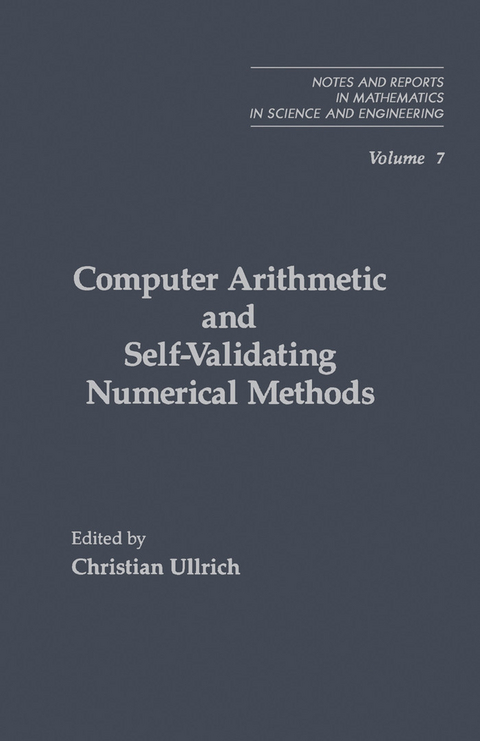
Computer Arithmetic and Self-Validating Numerical Methods (eBook)
316 Seiten
Elsevier Science (Verlag)
978-1-4832-6781-4 (ISBN)
Notes and Reports in Mathematics in Science and Engineering, Volume VII: Computer Arithmetic and Self-Validating Numerical Methods compiles papers presented at the first international conference on "e;Computer Arithmetic and Self-Validating Numerical Methods, held in Basel from October 2 to 6, 1989. This book begins by providing a tutorial introduction to computer arithmetic with operations of maximum accuracy, differentiation arithmetic and enclosure methods, and programming languages for self-validating numerical methods. The rest of the chapters discuss the determination of guaranteed bounds for eigenvalues by variational methods and guaranteed inclusion of solutions of differential equations. An appendix covering the IMACS-GAMM resolution on computer arithmetic is provided at the end of this publication. This volume is recommended for researchers and professionals working on computer arithmetic and self-validating numerical methods.
Front Cover 1
Computer Arithmetic and Self-Validating Numerical Methods 4
Copyright Page 5
Table of Contents 6
Contributors 8
Preface 10
Acknowledgments 12
Chapter 1. What Do We Need Beyond IEEE Arithmetic ? 14
1 Introduction 14
2 Scalar products and IEEE arithmetic 15
3 Algorithms for the scalar product 17
4 Problems and suggestions 21
5 Designs and implementations 28
6 Conclusions 39
References 40
Chapter 2. Chips for High Precision Arithmetic 46
1. Introduction 46
2. Exploration of the Design Space 47
3. Architecture of the ARITHMOS Processor 50
4. Architecture Evaluation 61
5. Conclusions 65
Acknowledgement 66
References 66
Chapter 3. Enclosure Methods 68
1. Introduction 68
2. Notation 69
3. Interval arithmetic evaluation 69
4. Outlook 84
References 84
Chapter 4. Differentiation Arithmetics 86
1. Evaluation Arithmetics 86
2. Code List Representation of Functions 87
3. Formal Power Series Arithmetic 88
4. Automatic Differentiation 90
5. Taylor Arithmetics 91
6. Rounded Taylor Arithmetic 92
7. Partial Derivatives 95
8. Gradient and Hessian Arithmetic 96
9. Serial Computation of Gradients and Hessians 97
10. Parallel Implementation of Differentiation Arithmetics 100
References 102
Chapter 5. Industrial Applications of Interval Techniques 104
1. Introduction 104
2. High Accuracy 105
3. When should interval techniques be considered? 113
4. An example - Least squares 114
5. An example - Nonlinear systems 116
6. What are some limitations of interval techniques? 118
7. What should you DO? 123
Acknowledgments 124
References 125
Chapter 6. Programming Languages for Enclosure Methods 128
1 Introduction 128
2 The Role of Arithmetic 130
3 New Developments 135
4 New Datatype Dotprecision 137
5 Scalar Product Expressions 139
6 Program Parts with Highly Accurate Evaluation of Expressions 142
7 Final Remarks 146
References 146
Chapter 7. The Determination of Guaranteed Bounds to Eigenvalues with the Use of Variational Methods
150
1. Introduction 150
2. Eigenvalue problems with bilinear forms 151
3. Determination of guaranteed bounds to eigenvalues by means of matrix eigenvalue problems 152
4. Inclusion theorems and variational methods 154
6. Further numerical tests 164
Chapter 8. The Determination of Guaranteed Bounds to Eigenvalues with the Use of Variational Methods
168
1 Introduction 168
2 Matrix eigenvalue problems 169
3 An eigenvalue problem with an ordinary differential equation 177
References 182
Chapter 9. Validated Solution of Initial Value Problems for
184
Introduction 184
1 The Method, Areas for Improvement 185
2 Accuracy Control 187
3 Minimizing the Effort 190
4 A priori Inclusion 193
5 Representation of Inclusion Sets 195
6 Stiff Systems 196
References 199
Chapter 10. Guaranteed Inclusions of Solutions of some Types of Boundary Value Problems 202
1. Introduction and operators of monotonie type 202
2. Choice of a suitable class of approximating functions 203
3. The algorithm 204
4. Interval-Analysis 204
5. Some remarks for the numerical computation 205
6. Some classes of operators of montonic type 205
7. Mixed boundary value problems (Kreiss-Lorenz [89]) 206
8. Discontinuous boundary values, Cavity flow 207
9. A nonlinear delay equation 209
10. Generalizations and Outlook 209
References 210
Chapter 11. Periodic Solutions: Enclosure, Verification, and Applications 212
1. Introduction 212
2. Periodic Solutions via Discretizations of ODEs and Discretization Errors 215
3. The Logistic Equation 219
4. The Lotka-Volterra Problem 220
5. The Lorenz Problem 221
6. The Restricted Three Body Problem of Celestial Mechanics 234
7. Periodic Solutions of Mathematical Models for Gear Drive Vibrations 244
9. Conclusions and Final Remarks 248
List of References 253
Chapter 12. Numerical Algorithms for Existence Proofs and Error Estimates for Two-Point Boundary Value Problems 260
1. Introduction 260
2. The construction of T 262
3. The choice of D 263
4. Constructing
264
5. On the procedures A and
265
6. Some results on differential inequalities 267
7. Veryfying (L) in some special cases 268
8. Transformation, general remarks 273
9. Transformation into an integral equation 275
10. Transformation by using breakpoints 278
References 280
Chapter 13. Aspects of Self-Validating Numerics in Banach Spaces 282
1. Introduction 283
2. One Autonomous Nonlinear PDE 286
3. Systems of First Order Autonomous Nonlinear PDEs 294
4. Generalized Hyperbolic Nonlinear Systems 300
5. Remarks on Boundary Conditions and Parallel Computations 302
6. A First Approach to the Problem 305
7. Some Algorithmic Aspects 307
8. Conclusions 310
References 311
Appendix: IMACS-GAMM Resolution on Computer Arithmetic 314
NOTES AND REPORTS IN MATHEMATIC SINCIENCE AND ENGINEERING 316
| Erscheint lt. Verlag | 10.5.2014 |
|---|---|
| Sprache | englisch |
| Themenwelt | Mathematik / Informatik ► Informatik ► Datenbanken |
| Mathematik / Informatik ► Informatik ► Theorie / Studium | |
| ISBN-10 | 1-4832-6781-4 / 1483267814 |
| ISBN-13 | 978-1-4832-6781-4 / 9781483267814 |
| Informationen gemäß Produktsicherheitsverordnung (GPSR) | |
| Haben Sie eine Frage zum Produkt? |
 PDF (Adobe DRM)
Kopierschutz: Adobe-DRM
Adobe-DRM ist ein Kopierschutz, der das eBook vor Mißbrauch schützen soll. Dabei wird das eBook bereits beim Download auf Ihre persönliche Adobe-ID autorisiert. Lesen können Sie das eBook dann nur auf den Geräten, welche ebenfalls auf Ihre Adobe-ID registriert sind.
Details zum Adobe-DRM
Dateiformat: PDF (Portable Document Format)
Mit einem festen Seitenlayout eignet sich die PDF besonders für Fachbücher mit Spalten, Tabellen und Abbildungen. Eine PDF kann auf fast allen Geräten angezeigt werden, ist aber für kleine Displays (Smartphone, eReader) nur eingeschränkt geeignet.
Systemvoraussetzungen:
PC/Mac: Mit einem PC oder Mac können Sie dieses eBook lesen. Sie benötigen eine
eReader: Dieses eBook kann mit (fast) allen eBook-Readern gelesen werden. Mit dem amazon-Kindle ist es aber nicht kompatibel.
Smartphone/Tablet: Egal ob Apple oder Android, dieses eBook können Sie lesen. Sie benötigen eine
Geräteliste und zusätzliche Hinweise
Buying eBooks from abroad
For tax law reasons we can sell eBooks just within Germany and Switzerland. Regrettably we cannot fulfill eBook-orders from other countries.
aus dem Bereich


