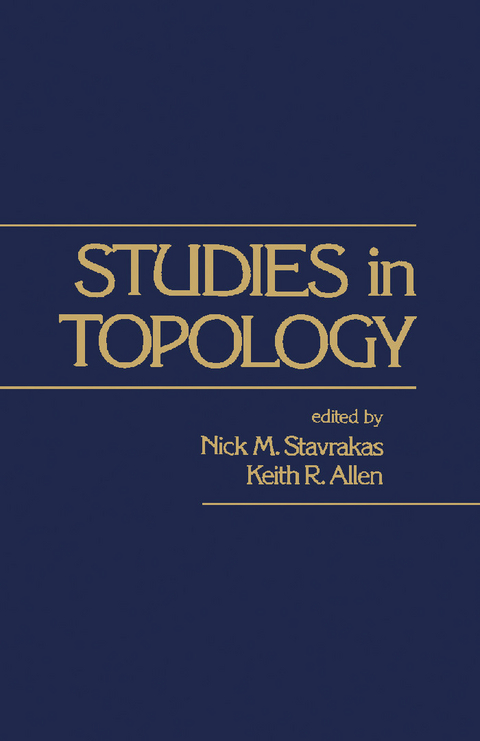
Studies in Topology (eBook)
672 Seiten
Elsevier Science (Verlag)
978-1-4832-5911-6 (ISBN)
Studies in Topology is a compendium of papers dealing with a broad portion of the topological spectrum, such as in shape theory and in infinite dimensional topology. One paper discusses an approach to proper shape theory modeled on the "e;ANR-systems"e; of Mardesic-Segal, on the "e;mutations"e; of Fox, or on the "e;shapings"e; of Mardesic. Some papers discuss homotopy and cohomology groups in shape theory, the structure of superspace, on o-semimetrizable spaces, as well as connected sets that have one or more disconnection properties. One paper examines "e;weak"e; compactness, considered as either a strengthening of absolute closure or a weakening of relative compactness (subject to entire topological spaces or to subspaces of larger spaces). To construct spaces that have only weak properties, the investigator can use the various productivity theorems of Scarborough and Stone, Saks and Stephenson, Frolik, Booth, and Hechler. Another paper analyzes the relationship between "e;normal Moore space conjecture"e; and productivity of normality in Moore spaces. The compendium is suitable for mathematicians, physicists, engineers, and other professionals involved in topology, set theory, linear spaces, or cartography.
Front Cover 1
Studies in Topology 4
Copyright Page 5
Table of Contents 8
Contributors 12
Preface 16
Acknowledgments 18
Birth of the Polish School of Mathematics 20
References 23
Chapter 1. Alternative Approaches to Proper Shape Theory 24
References 49
Chapter 2. On the Existence and Uniqueness Theorems of R. S. Pierce for Extensions of Zero-Dimensional Compact Metric Spaces 52
References 64
Chapter 3. Mapping Continua Onto the Cone Over the Cantor Set 66
References 67
Chapter 4. Nearness Spaces and Extensions of Topological Spaces 70
0. Preliminaries 70
1. Topological extensions 72
2. Functorial relationships between Near and Ex 74
3. Bunch determined nearness spaces 80
4. Remarks and questions 86
References 88
Chapter 5. On Several Problems of the Theory of Shape 90
1. To find a pure definition of e(X) 93
2. Is it true that Sh(X) = (Y) implies that e(X) = e(Y)? 93
References 101
Chapter 6. Some Results on (E,ßE)-Compactness 104
References 115
Chapter 7. Toroidal Decompositions of Manifolds Yield Factors of Manifolds 116
INTRODUCTION 116
2. TERMINOLOGY 117
3. PRELIMINARY RESULTS 118
4. MAIN LEMMA 121
References 132
Chapter 8. Homotopy and Cohomoiogy Groups in Shape Theory 134
References 142
Chapter 9. The Structure of Superspace 144
I. The Configuration Space of a Physical System 144
II. Cosmology 146
III. Superspaoe 148
References 156
Chapter 10. Some Notes on Multifunctions 158
References 160
Chapter 11. Connected Sets With a Finite Disconnection Property 162
1. INTRODUCTION 162
2. DEFINITIONS AND TERMINOLOGY 163
3. BASIC PROPERTIES OF .-SPACES 164
4. LOCALLY CONNECTED .-SPACES 170
5. COMPACT .-SPACES 183
6. DECOMPOSITION OF .-SPACES 191
References 195
Chapter 12. Applications of Collectionwise Hausdorff 198
References 199
Chapter 13. On o-semimetrizable Spaces 202
1) Introduction 202
2) Characterizations of o-semimetrizable spaces 203
References 210
Chapter 14. Characterizing Topological Properties 212
1. Introduction 212
2. Terminology 212
3. Main Results 213
References 219
Chapter 15. . Connectivity in the Plane 220
References 224
Chapter 16. On Continuous Extenders 226
References 234
Chapter 17. On a Notion of Weak Compactness in Non-Regular Spaces 238
1. Introduction 238
2. Characterizations and Properties 241
3. Examples 246
4. Compactification 248
5. Generalizations of Sequential Compactness 249
6. Motivation 257
7. Open Problems 258
References 259
Chapter 18. Actions of Locally Compact Groups With Zero on Manifolds 262
References 276
Chapter 19. Non-Continuous Retracts 278
References 283
Chapter 20. The Nielsen Numbers and Fiberings 286
0. Introduction 286
1. Principal Tk -bundle over lens spaces 288
2. The Nielsen and Lefschetz numbers 291
3. The fixed point property for a fiber preserving mapping 295
References 297
Chapter 21. Maps of ANR's Determined on Null Sequences of AR's 300
References 307
Chapter 22. Two Vietoris-type isomorphism theorems in Borsuk's theory of shape, concerning the Vietoris-Cech homology and Borsuk's fundamental groups 308
Introduction 308
0. Preliminaries 309
1. The isomorphism theorem for Borsuk's fundamental 310
2. The case of the pointed sequence generated by a map 317
3. A further application 320
4. The isomorphism theorem for Vietoris homology groups 322
References 336
Chapter 23. Uniformly Pathwise Connected Continua 338
INTRODUCTION 338
1. PRELIMINARIES 340
2. IMPROVING UNIFORM FAMILIES OF PATHS BY REPARAMETERIZATION 341
3. UNIFORMLY PATHWISE CONNECTED CONTINUA 344
References 347
Chapter 24. Several Problems of Continua Theory 348
1. CONFLUENCY AND RATIONAL CONTINUA 348
2. CONFLUENCY AND CLASS A 349
3. CONFLUENCY RELATIVE TO LOCALLY CONNECTED CONTINUA 350
References 351
Chapter 25. A Characterization of Local Connectivity in Dendroids 354
1. Introduction 354
2. Characterizations of dendrites 355
References 361
Chapter 26. A Survey of Embedding Theorems for Semigroups of Continuous Functions 362
1 . INTRODUCTION 362
2. THE CASE WHERE Y IS DISCRETE 362
3. THE CASE WHERE Y IS NOT DISCRETE 366
4. CONCLUSION 373
References 376
Chapter 27. THE HUREWICZ AND WHITEHEAD THEOREMS IN SHAPE THEORY 378
1. Pro-categories 379
2. Pro-groups 380
3. Pro-homotopy category of CW-complexes 381
4. The shape category 382
5. The Hurewicz theorem 383
6. The Whitehead theorem 384
7. Homology versions of the Whitehead theorem 386
References 387
Chapter 28. One-Dimensional Shape Properties and Three-Mamfolds 390
1. INTRODUCTION 390
2. IMAGES OF 1-MOVABLE CONTINUA 392
3. DESCRIBING COMPACTA IN THREE-MANIFOLDS 398
References 403
Chapter 29. Discontinuous Gd Graphs 406
Introduction 406
1. Sequences of open sets characterizing functions of Baire Class 1 408
2. Examples 413
References 415
Chapter 30. Some Basic Connectivity Properties of Whitney Map Inverses in C(X) 416
1. Introduction and basic definitions 416
2. A result of Krasinkiewiaz 420
3. Main results 421
4. Problems 430
References 432
Chapter 31. One-Point Compactifications of Q-manifold Factors and Infinite Mapping Cylinders 434
I. Introduction 434
II. Basic Results 436
References 448
Chapter 32. Some Surprising Base Properties in Topology 450
INTRODUCTION 450
1. Non-archimedean spaces 450
2. Productively non-archimedean and wµ -metrizable spaces 455
3. Proto-metrizdble spaces 458
4. Proto-uniformities and proto-metrics 462
5. Basically screenable spaces 465
6. Countable-dimensional spaces 467
7. Applications to dimension theory 469
References 471
Chapter 33. Some Topological Questions Related to Open Mapping and Closed Graph Theorems 474
References 478
Completeness in Aronszajn Spaces 480
1. INTRODUCTION 480
2. SETS OF INTERIOR CONDENSATION 483
3. ARONSZAJN SPACES AND MOORE SPACES 485
References 487
Chapter 34. Projectives in the Category of Ordered Spaces 490
1. INTRODUCTION 490
2. DEFINITIONS AND NOTATIONS 491
3. MAIN RESULTS 493
References 500
Chapter 35. On the Productivity of Normality in Moore Spaces 502
I. Review of product results 502
II. Recent metrization results 503
References 506
Chapter 36. A Metrization Theorem for Normal Moore Spaces 508
References 511
Chapter 37. Expansions of Topologies by Locally Finite Collections 512
1. Introduction 512
2. Preliminaries 513
3. Main Results 514
References 516
Chapter 38. Some Approximation Theorems for Inverse Limits 518
1. introduction 518
2. The approximation theorem 520
References 528
Chapter 39. The Metrizability of Normal Moore Spaces 530
References 537
Chapter 40. Toward a Product Theory for Orthocompactness 540
0. Notation and Terminology 540
1. Products with a compact factor 543
2. Products with a metric factor 545
3. Products of Ordinals 549
4. Examples 555
5. Addendum 558
References 559
Chapter 41. Movable Continua and Shape Retracts 562
References 566
Chapter 42. n-adic Decompositions and Retracts 568
1. Introduction and terminology 568
2. A survey 568
3. n-adic Antoine's necklaces and n-adic wreaths 569
References 573
Chapter 43. Embedding Characterizations for Collectionwise Normality and Expandability 576
Section 1. Introduction 576
Section 2. An Embedding Characterization for Collectionwise Normal Spaces 577
Section 3. Characterizations for Expandable Spaces 578
References 580
Chapter 44. Extending Maps from Products 582
References 587
Chapter 45. Dense Subsemigroups of Semigroups Of Continuous Selfmaps 588
INTRODUCTION 588
References 594
Chapter 46. Banach Spaces With Banach-Stone Property 596
Section 1. Basic Concepts 597
Section 2. Examples 597
References 603
Chapter 47. PRIMITIVE STRUCTURES IN GENERAL TOPOLOGY 604
I. INTRODUCTION 604
2. PRIMITIVE SEQUENCES 605
3. SOME KNOWN SPACES IN TERMS OF PRIMITIVE SEQUENCES 610
4. A GENERAL APPROACH TO DEFINING TOPOLOGICAL STRUCTURE VIA PRIMITIVE SEQUENCES 613
5. PRIMITIVE STRUCTURE OF (COUNTABLY) COMPACT TYPE RELATIONS TO OTHER SPACES
References 620
Chapter 48. Recent Developments in Dendritic Spaces and Related Topics 624
1. Introduction 624
2. A catalog of dendritic properties According to the definitions in the preceeding section 627
3. Comb spaces completion of the proof of Theorem 9
4. Further partial order characterizations 641
5. Locally connected spaces 644
7. Trees 662
8. Fixed point theorems for dendritic spaces 663
9. Concluding remarks 667
References 668
Index 672
| Erscheint lt. Verlag | 10.5.2014 |
|---|---|
| Sprache | englisch |
| Themenwelt | Mathematik / Informatik ► Mathematik ► Geometrie / Topologie |
| Technik | |
| ISBN-10 | 1-4832-5911-0 / 1483259110 |
| ISBN-13 | 978-1-4832-5911-6 / 9781483259116 |
| Informationen gemäß Produktsicherheitsverordnung (GPSR) | |
| Haben Sie eine Frage zum Produkt? |
 PDF (Adobe DRM)
Kopierschutz: Adobe-DRM
Adobe-DRM ist ein Kopierschutz, der das eBook vor Mißbrauch schützen soll. Dabei wird das eBook bereits beim Download auf Ihre persönliche Adobe-ID autorisiert. Lesen können Sie das eBook dann nur auf den Geräten, welche ebenfalls auf Ihre Adobe-ID registriert sind.
Details zum Adobe-DRM
Dateiformat: PDF (Portable Document Format)
Mit einem festen Seitenlayout eignet sich die PDF besonders für Fachbücher mit Spalten, Tabellen und Abbildungen. Eine PDF kann auf fast allen Geräten angezeigt werden, ist aber für kleine Displays (Smartphone, eReader) nur eingeschränkt geeignet.
Systemvoraussetzungen:
PC/Mac: Mit einem PC oder Mac können Sie dieses eBook lesen. Sie benötigen eine
eReader: Dieses eBook kann mit (fast) allen eBook-Readern gelesen werden. Mit dem amazon-Kindle ist es aber nicht kompatibel.
Smartphone/Tablet: Egal ob Apple oder Android, dieses eBook können Sie lesen. Sie benötigen eine
Geräteliste und zusätzliche Hinweise
Buying eBooks from abroad
For tax law reasons we can sell eBooks just within Germany and Switzerland. Regrettably we cannot fulfill eBook-orders from other countries.
aus dem Bereich