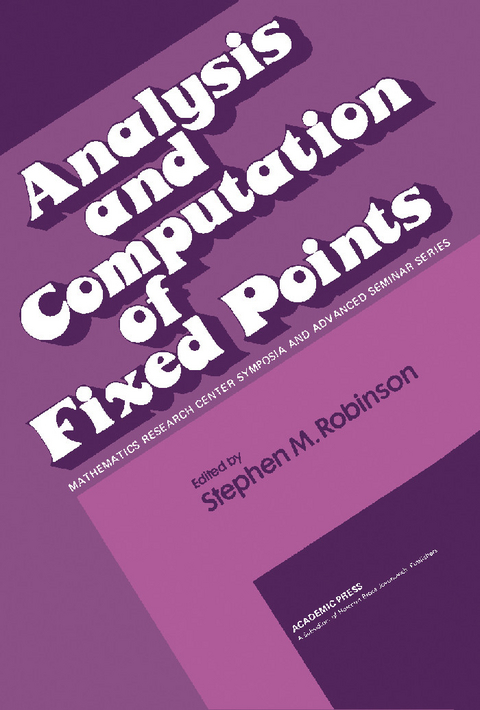
Analysis and Computation of Fixed Points (eBook)
424 Seiten
Elsevier Science (Verlag)
978-1-4832-6602-2 (ISBN)
Analysis and Computation of Fixed Points contains the proceedings of a Symposium on Analysis and Computation of Fixed Points, held at the University of Wisconsin-Madison on May 7-8, 1979. The papers focus on the analysis and computation of fixed points and cover topics ranging from paths generated by fixed point algorithms to strongly stable stationary solutions in nonlinear programs. A simple reliable numerical algorithm for following homotopy paths is also presented. Comprised of nine chapters, this book begins by describing the techniques of numerical linear algebra that possess attractive stability properties and exploit sparsity, and their application to the linear systems that arise in algorithms that solve equations by constructing piecewise-linear homotopies. The reader is then introduced to two triangulations for homotopy fixed point algorithms with an arbitrary grid refinement, followed by a discussion on some generic properties of paths generated by fixed point algorithms. Subsequent chapters deal with topological perturbations in the numerical study of nonlinear eigenvalue and bifurcation problems; general equilibrium analysis of taxation policy; and solving urban general equilibrium models by fixed point methods. The book concludes with an evaluation of economic equilibrium under deformation of the economy. This monograph should be of interest to students and specialists in the field of mathematics.
Front Cover 1
Analysis and Computation of Fixed Points 4
Copyright Page 5
Table of Contents 6
Contributors 8
Preface 10
Chapter 1. Numerical Stability and Sparsity in Piecewise-Linear Algorithms 12
1. Introduction 12
2. The QR and LU Factorizations 15
3. Using factorizations in the General PL Algorithm 18
4. The Separable Case 25
5. The Sparse Case 27
Acknowledgements 32
REFERENCES 33
Chapter 2. Two New Triangulations for Homotopy Fixed Point Algorithms with an Arbitrary Grid Refinement 36
1. Introduction 36
2. The Triangulation Sa 38
3. The Dynamic Shift Algorithm 46
4. Properties of the Algorithms 54
5. Computational Experience 57
REFERENCES 66
Chapter 3. Some Generic Properties of Paths Generated by Fixed Point Algorithms 68
§1. Introduction 68
§2. Generic Properties of Paths 71
§3. An Application 74
§4. On minimizing smooth real valued functions 76
§5. Appendix 79
REFERENCES 79
Chapter 4. A Simple Reliable Numerical Algorithm for Following Homotopy Paths 84
§1. Introduction 84
§2. Proceeding along the curve 88
§3. Angle checking 89
§4. Speed-up the step size 90
§5. Termination 91
§6. Remarks 92
§7. Numerical results 93
§8. Continuation versus Newton Methods 99
References 100
Chapter 5. Strongly Stable Stationary Solutions in Nonlinear Programs 104
1. INTRODUCTION 104
2. PRELIMINARIES 111
3. LOCAL NONSINGULARITY OF THE MAP F : ¦K*¦. Rn+m 115
4. NECESSARY AND SUFFICIENT CONDITIONS FOR THE S-STABILITY 122
5. STATIONARY INDEX 126
6. S-STABLE LOCAL MINIMUM SOLUTIONS 130
7. DEGENERATE S-STABLE STATIONARY SOLUTIONS 132
8. AN APPLICATION TO A PARAMETRIC NONLINEAR PROGRAM 142
9. AN APPLICATION TO A CLASS OF CONTINUOUS DEFORMATION METHODS 144
10. CONCLUDING REMARKS 146
REFERENCES 146
Chapter 6. Topological Perturbations in the Numerical Study of Nonlinear Eigenvalue and Bifurcation Problems 150
1. INTRODUCTION 150
2. TOPOLOGICAL PERTURBATIONS I 156
3. TOPOLOGICAL PERTURBATIONS II 173
4. NUMERICAL EXPERIENCE 179
REFERENCES 189
Chapter 7. General Equilibrium Analysis of Taxation Policy 194
MODEL STRUCTURE 195
MODEL ESTIMATION 199
STRUCTURE OF COMPUTER CODE 199
AN EXAMPLE OF MODEL FINDINGS 200
CONCLUDING REMARKS 200
REFERENCES 206
Chapter 8. Solving Urban General Equilibrium Models by Fixed Point Methods 208
1. INTRODUCTION 208
2. URBAN GENERAL EQUILIBRIUM MODELS 209
3. REALISTIC COMPLICATIONS 213
4. CONCLUSION 222
REFERENCES 222
Chapter 9. Economic Equilibrium under Deformation of the Economy 224
ABSTRACT 224
PREFACE 226
INTRODUCTION 229
THE FUNDAMENTAL ALGORITHM 249
THE ECONOMIC MODEL 259
COMPUTATIONAL REFINEMENTS 315
EXAMPLES OF ECONOMIC DEFORMATIONS 348
COMPUTATIONAL EXPERIENCE 374
APPENDIX A: TECHNICAL LEMMAS 416
REFERENCES 420
Index 422
| Erscheint lt. Verlag | 10.5.2014 |
|---|---|
| Sprache | englisch |
| Themenwelt | Mathematik / Informatik ► Mathematik ► Geometrie / Topologie |
| Technik | |
| ISBN-10 | 1-4832-6602-8 / 1483266028 |
| ISBN-13 | 978-1-4832-6602-2 / 9781483266022 |
| Informationen gemäß Produktsicherheitsverordnung (GPSR) | |
| Haben Sie eine Frage zum Produkt? |
 PDF (Adobe DRM)
Kopierschutz: Adobe-DRM
Adobe-DRM ist ein Kopierschutz, der das eBook vor Mißbrauch schützen soll. Dabei wird das eBook bereits beim Download auf Ihre persönliche Adobe-ID autorisiert. Lesen können Sie das eBook dann nur auf den Geräten, welche ebenfalls auf Ihre Adobe-ID registriert sind.
Details zum Adobe-DRM
Dateiformat: PDF (Portable Document Format)
Mit einem festen Seitenlayout eignet sich die PDF besonders für Fachbücher mit Spalten, Tabellen und Abbildungen. Eine PDF kann auf fast allen Geräten angezeigt werden, ist aber für kleine Displays (Smartphone, eReader) nur eingeschränkt geeignet.
Systemvoraussetzungen:
PC/Mac: Mit einem PC oder Mac können Sie dieses eBook lesen. Sie benötigen eine
eReader: Dieses eBook kann mit (fast) allen eBook-Readern gelesen werden. Mit dem amazon-Kindle ist es aber nicht kompatibel.
Smartphone/Tablet: Egal ob Apple oder Android, dieses eBook können Sie lesen. Sie benötigen eine
Geräteliste und zusätzliche Hinweise
Buying eBooks from abroad
For tax law reasons we can sell eBooks just within Germany and Switzerland. Regrettably we cannot fulfill eBook-orders from other countries.
aus dem Bereich