Mathematical Software (eBook)
398 Seiten
Elsevier Science (Verlag)
978-1-4832-6714-2 (ISBN)
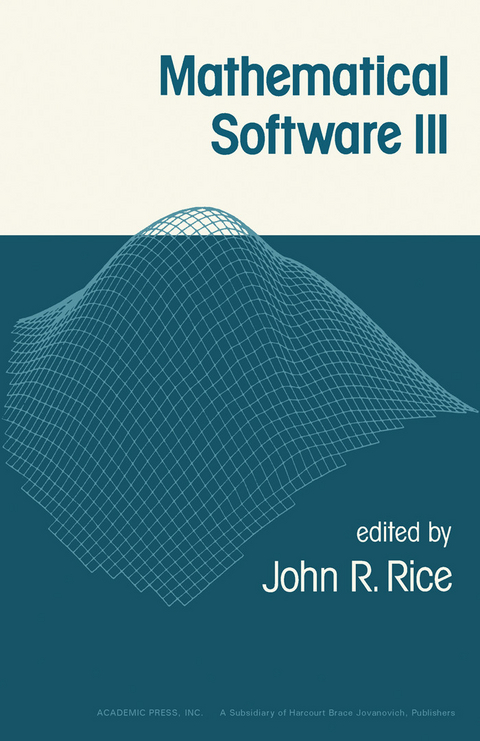
Mathematical Software III contains the proceedings of the Symposium on Mathematical Software held in Madison, Wisconsin, on March 28-30, 1977, under the auspices of the Mathematics Research Center at the University of Wisconsin-Madison. The papers focus on software designed for mathematical applications such as LINPACK for the solution of linear systems and least squares problems and ELLPACK for elliptic partial differential equations. Comprised of 14 chapters, this volume begins with an overview of LINPACK, a software package designed to solve linear systems and least squares problems. The reader is then introduced to an extension to the exchange algorithm for solving overdetermined linear equations; infallible calculation of polynomial zeros to specified precision; and representation and approximation of surfaces. Subsequent chapters discuss the ways in which mathematical software and exploratory data analysis should interact to satisfy their respective needs; production of mathematical software; computational aspects of the finite element method; and multi-level adaptive techniques for partial differential equations. The book also describes a realistic model of floating-point computation before concluding with an evaluation of the Block Lanczos method for computing a few of the least or greatest eigenvalues of a sparse symmetric matrix. This monograph should be of considerable interest to students and specialists in the fields of mathematics and computer science.
Front Cover 1
Mathematical Software III 4
Copyright Page 5
Table of Contents 6
Contributors 8
Preface 10
Chapter 1. Research, Development, and LINPACK 12
ABSTRACT 12
1. INTRODUCTION 12
2. ESTIMATION OF CONDITION NUMBERS 13
3. STABILITY OF LEAST SQUARES SOLUTIONS 16
4. SCALING AND COLUMN ELIMINATION 18
5. DOWNDATING 20
6. TIMING THE BLAS 22
REFERENCES 25
Chapter 2. A Technique that Gains Speed and Accuracy in the Minimax Solution of Overdetermined Linear Equations 26
ABSTRACT 26
1. INTRODUCTION 26
2. NUMERICAL INSTABILITY IN THE EXCHANGE ALGORITHM 29
3. THE NEW TECHNIQUE 31
4. THEORY 36
5. DISCUSSION 39
REFERENCES 43
Chapter 3. Infallible Calculation of Polynomial Zeros to Specified Precision 46
ABSTRACT 46
1. INTRODUCTION 47
2. PRELIMINARIES 50
3. STURM SEQUENCES FOR REAL ZEROS 56
4. STURM SEQUENCES FOR COMPLEX ZEROS 60
5. ROLLE'S THEOREM FOR REAL ZEROS 63
6. DESCARTES' THEOREM FOR REAL ZEROS 66
7. APPLICATION OF INTERVAL ARITHMETIC 70
8. COMPLEX ZEROS WITHOUT STURM SEQUENCES 74
REFERENCES 77
Chapter 4. Representation and Approximation of Surfaces 80
ABSTRACT 80
1. INTRODUCTION 81
2. INTERPOLATION METHODS DEFINED OVER RECTANGLES 83
3. INTERPOLATION SCHEMES DEFINED OVER TRIANGLES 93
4. INTERPOLATION METHODS FOR ARBITRARILY PLACED DATA 121
5. CONCLUSIONS 129
REFERENCES 129
ACKNOWLEDGEMENTS 131
Chapter 5. Simulation: Conflicts between Real-Time and Software 132
ABSTRACT 132
1. INTRODUCTION 133
2. SIMULATION 134
3. REAL-TIME OPERATION 136
4. NUMERICAL INTEGRATION IN REAL-TIME 137
5. ERRORS IN NUMERICAL INTEGRATION 140
6. METHODS FOR REDUCING DELAY AND IMPROVING STABILITY 142
7. CONCLUSIONS 148
REFERENCES 149
Chapter 6. Mathematical Software and Exploratory Data Analysis 150
ABSTRACT 150
1. INTRODUCTION 150
2. OVERVIEW OF EXPLORATORY DATA ANALYSIS 151
3. AN EXAMPLE: TIMING DATA 153
4. SOFTWARE NEEDS OF EXPLORATORY DATA ANALYSIS 165
5. SUMMARY 168
REFERENCES 168
Chapter 7.
172
1. INTRODUCTION 172
2. PROBLEM STATEMENT 173
3. EXPECTED APPLICATIONS 173
4. PUBLISHED WORK ON SURFACE INTERPOLATION TO IRREGULARLY LOCATED DATA 174
5. OUTLINE OF THE ALGORITHMIC APPROACH SELECTED 175
6. CONSTRUCTING A TRIANGULAR GRID 176
7. ESTIMATING PARTIAL DERIVATIVES AT THE GRID NODES 181
8. LOOKUP IN THE TRIANGULAR GRID 182
9. INTERPOLATION IN A TRIANGLE 182
10. EXAMPLES 183
11. THREE CRITERIA FOR TRIANGULATION OF A STRICTLY CONVEX QUADRILATERAL 187
12. GLOBAL CONSEQUENCES OF THE LOCAL OPTIMIZATION PROCEDURE 193
13. McLAIN'S TRIANGULATION METHOD 198
14. LIMITS ON GRID CHANGES WHEN ADDING A NEW POINT 199
15. CONCLUSIONS 201
REFERENCES 202
Chapter 8. Mathematical Software Production 206
ABSTRACT 206
I. Introduction 207
II. The Evolution of Mathematical Software Production 209
III. Intellectual Challenges 214
IV. Projects to Produce Mathematical Software 217
V. Trends in Mathematical Software Production 228
REFERENCES 231
Chapter 9. Computational Aspects of the Finite Element Method 236
1. INTRODUCTION 236
2. GOALS OF THE COMPUTATIONAL ANALYSIS 238
3. THE PRINCIPAL STAGES OF THE COMPUTATIONAL ANALYSIS 240
4. SOME SOFTWARE ASPECTS 256
5. SOME COMPUTATIONAL RESULTS 259
REFERENCES 264
Chapter 10. The Art of Writing a Runge-Kutta Code, Part I 268
1. INTRODUCTION 268
2. RUNGE-KUTTA METHODS 269
3. MEASURES OF QUALITY 273
4. SUMMARY 284
REFERENCES 284
Chapter 11. Multi-Level Adaptive Techniques (MLAT) for Partial Differential Equations: Ideas and Software 288
ABSTRACT 288
INTRODUCTION 288
1. SURVEY OF MULTI-GRID PROCESSES ON UNIFORM GRIDS 292
2. NON-UNIFORM GRIDS: ORGANIZATION AND MULTI-GRID PROCESSING 304
3. SURVEY OF ADAPTATION TECHNIQUES 313
4. DATA STRUCTURE AND SOFTWARE 318
REFERENCES 329
Chapter 12. ELLPACK: A Research Tool for Elliptic Partial Differential Equations Software 330
ABSTRACT 330
1. BACKGROUND 330
2. THE STRUCTURE OF ELLPACK 334
3. ELLPACK 77 USER INPUT 338
4. ELLPACK 77 ORGANIZATION AND INFORMATION 340
5. ELLPACK 78 346
6. ELLPACK IMPLEMENTATION AT PURDUE 349
REFERENCES 350
Chapter 13. A Realistic Model of Floating-Point Computation 354
Abstract 354
1. Introduction 354
2. Environment Parameters 355
3. Properties of Arithmetic 356
4. Machine Anomalies 359
5. Error Analysis 360
6. Arithmetic Comparisons 366
7. Overflow and Underflow (the Bêtes Noires of Portability) 368
8. Acknowledgments 371
References 371
Chapter 14. The Block Lanczos Method for Computing Eigenvalues 372
ABSTRACT 372
1. INTRODUCTION 372
2. A BLOCK LANCZOS ALGORITHM 373
3. IMPLEMENTATION 382
4. EXAMPLES 384
5. EXTENSIONS 386
REFERENCES 387
Index 390
| Erscheint lt. Verlag | 10.5.2014 |
|---|---|
| Sprache | englisch |
| Themenwelt | Mathematik / Informatik ► Informatik ► Theorie / Studium |
| Mathematik / Informatik ► Mathematik ► Angewandte Mathematik | |
| Technik | |
| ISBN-10 | 1-4832-6714-8 / 1483267148 |
| ISBN-13 | 978-1-4832-6714-2 / 9781483267142 |
| Informationen gemäß Produktsicherheitsverordnung (GPSR) | |
| Haben Sie eine Frage zum Produkt? |
 PDF (Adobe DRM)
Kopierschutz: Adobe-DRM
Adobe-DRM ist ein Kopierschutz, der das eBook vor Mißbrauch schützen soll. Dabei wird das eBook bereits beim Download auf Ihre persönliche Adobe-ID autorisiert. Lesen können Sie das eBook dann nur auf den Geräten, welche ebenfalls auf Ihre Adobe-ID registriert sind.
Details zum Adobe-DRM
Dateiformat: PDF (Portable Document Format)
Mit einem festen Seitenlayout eignet sich die PDF besonders für Fachbücher mit Spalten, Tabellen und Abbildungen. Eine PDF kann auf fast allen Geräten angezeigt werden, ist aber für kleine Displays (Smartphone, eReader) nur eingeschränkt geeignet.
Systemvoraussetzungen:
PC/Mac: Mit einem PC oder Mac können Sie dieses eBook lesen. Sie benötigen eine
eReader: Dieses eBook kann mit (fast) allen eBook-Readern gelesen werden. Mit dem amazon-Kindle ist es aber nicht kompatibel.
Smartphone/Tablet: Egal ob Apple oder Android, dieses eBook können Sie lesen. Sie benötigen eine
Geräteliste und zusätzliche Hinweise
Buying eBooks from abroad
For tax law reasons we can sell eBooks just within Germany and Switzerland. Regrettably we cannot fulfill eBook-orders from other countries.
aus dem Bereich