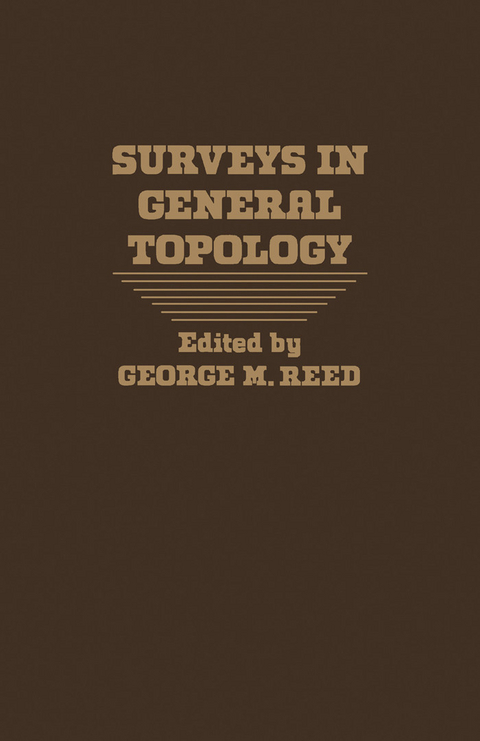
Surveys in General Topology (eBook)
572 Seiten
Elsevier Science (Verlag)
978-1-4832-6386-1 (ISBN)
Surveys in General Topology presents topics relating to general topology ranging from closed mappings and ultrafilters to covering and separation properties of box products. Ordered topological spaces and the use of combinatorial techniques in functional analysis are also considered, along with product spaces and weakly compact subsets of Banach spaces. Applications of stationary sets in topology are presented as well. Comprised of 15 chapters, this volume begins with an analysis of some of the techniques and results in the area of closed mappings, followed by a discussion on the theory of ultrafilters. The reader is then introduced to the question of when a box product of compact spaces is paracompact, and how badly a box product of compact or metrizable spaces can fail to be normal. Subsequent chapters focus on the transfinite dimension; the properties of metacompactness, submetacompactness, and subparacompactness; the dimension of ordered topological spaces; the use of combinatorial techniques for the treatment and solution of fundamental problems in functional analysis, particularly in the isomorphic theory of Banach spaces; and order-theoretic base axioms. This monograph will be of significant value both to researchers in general topology and to mathematicians outside the field who wish an overview of current topics and techniques.
Front Cover 1
Surveys in General Topology 4
Copyright Page 5
Table of Contents 8
Dedication 6
Contributors 10
Preface 12
Acknowledgments 14
Chapter 1. CLOSED MAPPINGS 16
1. Introduction 16
2. General Properties of closed mappings 18
3. Base axioms and perfect mappings 22
4. Lašnev spaces and decompositions 28
5. s-spaces, p-spaces, and related spaces 31
6. Covering properties 34
7. Odds and ends 37
References 41
Chapter 2. ULTRAFILTERS: AN INTERIM REPORT 48
1. Shelah's P-point Theorem 49
2. Incomparable ultrafilters 50
3. Other Special Points in . 53
4. Subspaaes of . 56
5. y-points in U (a) 61
6. Products reduced by an ultrafilter 62
7. Concluding remarks 64
References 65
Chapter 3. COVERING AND SEPARATION PROPERTIES OF BOX PRODUCTS 70
ABSTRACT 70
1. INTRODUCTION 70
2. CONVENTIONS 73
3. VARIOUS SORTS OF PRODUCTS, THE Gv -MODIFICATION 74
4. WORKING WITH V-PRODUCTS 75
5. SOME COVERING AND SEPARATION PROPERTIES 76
6. BASIC FACTS ABOUT .-PRODUCTS AND V-PRODUCTS 85
7. NEGATIVE RESULTS ON METRIZABLE FACTORS I: TOPOLOGICAL ARGUMENTS 89
8. NEGATIVE RESULTS ABOUT COMPACT FACTORS I: TOPOLOGICAL ARGUMENTS 93
9. COUNTABLE V-PRODUCTS OF COMPACT SPACES AND PARACOMPACTNESS 95
10. POSITIVE RESULTS, I: CONSISTENCY RESULTS 101
11. POSITIVE RESULTS II: HONEST RESULTS 113
12. NEGATIVE RESULTS ON METRIZABLE FACTORS II: COMBINATORIAL ARGUMENTS 118
13. NEGATIVE RESULTS ABOUT COMPACT FACTORS II: COMBINATORIAL ARGUMENT 122
14. WHEN THE QUOTIENT MAP IS NOT CLOSED 133
15. THE V-PRODUCT OF ARBITRARILY MANY FACTORS 137
REFERENCES 141
Chapter 4. TRANSFINITE DIMENSION 146
1. Definitions 146
2. Examples 149
3. Basic properties of transfinite dimensions 152
4. Relations between trind, trind and countable dimensionality 159
5. Status of main dimension theory theorems in the case of transfinite dimensions 166
References 174
Chapter 5. APPLICATIONS OF STATIONARY SETS IN TOPOLOGY 178
0. Notation and Conventions 179
1. Examples of a Stationary Set in Point Set Topology 180
2. The Combinatorics of Stationary Sets 185
3. Applications of disjoint stationary sets 190
4. Applications to combinatorial set theory 197
5. The Diamond Constellation 201
6. Historical and Bibliographic Notee 204
References 206
Chapter 6. THREE COVERING PROPERTIES 210
0. Preliminaries 212
1. Submetacompactness 216
2. Subparacompaetness 229
3. Metaoompaatness 242
4. Relations to paracompactness 250
ACKNOWLEDGEMENTS 253
References 254
Chapter 7. ORDERED TOPOLOGICAL SPACES 262
1. Introduction 262
2. Orderability 263
3. Normality 267
4. Paracompactness in GO spaces 278
5. Metrization and generalized metric classes 284
6. Some special ordered spaces 292
Appendix: Hahn-Mazurkiewioz theory 302
References 304
Chapter 8. DIMENSION OF GENERAL TOPOLOGICAL SPACES 312
1. The Tychonoff functor t 314
2. Normal covers 316
3. C*-embedding and z-embedding 318
4. Uniformly locally finite collections of subsets 320
5. Definition and basic properties of dimension 326
6. The Hopf extension theorem for general spaces and a aohomological characterization of dimension 333
7. Sum theorems 335
8. Product Theorems 339
9. Applications 343
References 348
Chapter 9. COMBINATORIAL TECHNIQUES IN FUNCTIONAL ANALYSIS 352
A. Dyadic Spaces and Generalizations 353
B. L8(µ)-spaces 360
C. A compact space as a function of its Souslin number 364
D. Pepazynski's conjecture 371
E. Rosenthal's criterion for the embedding of l1 375
References 377
Chapter 10. ORDER-THEORETIC BASE AXIOMS 382
Section 1: Lobs, blobs, and globs 383
Section 2: Non-archimedean spaces 389
Section 3: Large rank and rank 393
Section 4: Small rank and cardinal invariants 399
Section 5: Co-scattered spaces 402
Section 6: Products of metacompact spaces 408
References 411
Chapter 11. PRODUCT SPACES 414
1. Covering properties of product spaces 414
2. Extension of functions defined on product spaces 427
3. Dimension of product spaces 431
References 439
Chapter 12. S AND L SPACES 446
I. Formulating the problem 447
II. Related cardinal function problems 450
III. Other related problems 452
IV. Consistency examples of S and L spaces 453
V. Trying to kill S and L spaces 455
References 457
Chapter 13. LARGE CARDINALS FOR TOPOLOGISTS 460
0. Introduction 460
1. Inaccessible cardinals 463
2. Weakly compact cardinals, indescribable cardinals 468
3. Ramsey cardinals, ineffable cardinals 474
4. Measurable cardinals 476
5. Strongly compact cardinals, supercompact cardinals 481
6. Towards inconsistency 485
Appendix: Guide to the Literature 488
REFERENCES 488
Chapter 14. WEAKLY COMPACT SUBSETS OF BANACH SPACES 494
1. What is an EC? 495
2. Banaeh Spaces 498
3. Topological Properties 501
References 508
Chapter 15. THE DEVELOPMENT OF GENERALIZED BASE OF COUNTABLE ORDER THEORY 510
1. Introduction 510
2. Some of the main concepts and definitions introduced in the development of base of countable order theory 513
3. Some of the underlying point of view of base of countable order theory 521
4. Some of the main techniques of hase of countable order theory 522
5. Characterizations of developability 524
6. Open continuous mappings of spaces having bases of countable order 529
7. Closed continuous mappings of developable spaces and of spaces having bases of countable order 535
8. Some theorems on compactness 539
9. Some further remarks on completeness and topological uniformization 543
10. Inverse image approaches to topological uniformization 547
11. Extensions and generalizations of metrization theory in base of countable order theory 549
12. The finite intersection property in base of countable order theory 553
13. Some other characterizations of topological uniformizations of generalized base of countable order theory and related results 557
14. Generalized base of countable order theory and continua 559
15. Summary 562
References 562
| Erscheint lt. Verlag | 10.5.2014 |
|---|---|
| Sprache | englisch |
| Themenwelt | Mathematik / Informatik ► Mathematik ► Geometrie / Topologie |
| Technik | |
| ISBN-10 | 1-4832-6386-X / 148326386X |
| ISBN-13 | 978-1-4832-6386-1 / 9781483263861 |
| Informationen gemäß Produktsicherheitsverordnung (GPSR) | |
| Haben Sie eine Frage zum Produkt? |
 PDF (Adobe DRM)
Kopierschutz: Adobe-DRM
Adobe-DRM ist ein Kopierschutz, der das eBook vor Mißbrauch schützen soll. Dabei wird das eBook bereits beim Download auf Ihre persönliche Adobe-ID autorisiert. Lesen können Sie das eBook dann nur auf den Geräten, welche ebenfalls auf Ihre Adobe-ID registriert sind.
Details zum Adobe-DRM
Dateiformat: PDF (Portable Document Format)
Mit einem festen Seitenlayout eignet sich die PDF besonders für Fachbücher mit Spalten, Tabellen und Abbildungen. Eine PDF kann auf fast allen Geräten angezeigt werden, ist aber für kleine Displays (Smartphone, eReader) nur eingeschränkt geeignet.
Systemvoraussetzungen:
PC/Mac: Mit einem PC oder Mac können Sie dieses eBook lesen. Sie benötigen eine
eReader: Dieses eBook kann mit (fast) allen eBook-Readern gelesen werden. Mit dem amazon-Kindle ist es aber nicht kompatibel.
Smartphone/Tablet: Egal ob Apple oder Android, dieses eBook können Sie lesen. Sie benötigen eine
Geräteliste und zusätzliche Hinweise
Buying eBooks from abroad
For tax law reasons we can sell eBooks just within Germany and Switzerland. Regrettably we cannot fulfill eBook-orders from other countries.
aus dem Bereich