High Performance Computing Demystified (eBook)
278 Seiten
Elsevier Science (Verlag)
978-1-4832-6596-4 (ISBN)
David Loshin is President of Knowledge Integrity, Inc., a company specializing in data management consulting. The author of numerous books on performance computing and data management, including 'Master Data Management' (2008) and 'Business Intelligence - The Savvy Manager's Guide' (2003), and creator of courses and tutorials on all facets of data management best practices, David is often looked to for thought leadership in the information management industry.
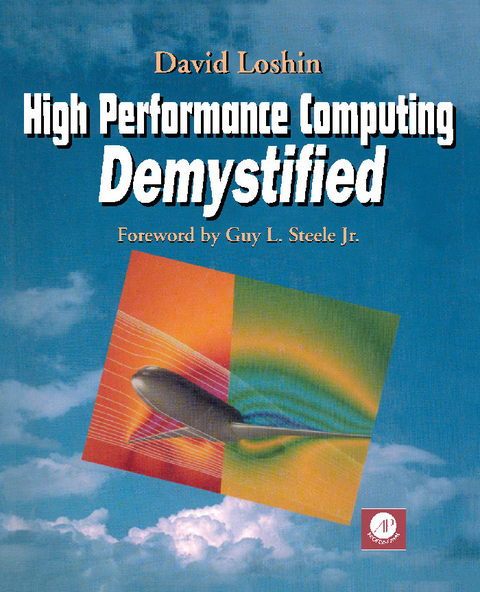
High Performance Computing Demystified provides an overview of high performance resources and their applications across many disciplines. This book is organized into five parts encompassing 16 chapters that cover the principles, mode of operation, and practical aspects of supercomputers. The first and second parts provide a brief history of high performance computing and describe the "e;basic parts needed to build high performance computers, including high performance microprocessors and network topologies. The third part examines the features of multiprocessor architectures of high performance, such as the large number crunchers, massively parallel processing machines, and networks of workstations. The fourth part deals with the software paradigms for high performance, while the fifth part looks into the high performance computing resources that are available to the public, with some guide to accessing those resources. This book is intended primarily for engineers and business managers who have a basic understanding of computers and would like to learn about high performance computing.
Front Cover 1
High Performance Computing Demystified 4
Copyright Page 5
Table of Contents 6
List of Figures 10
Foreword 12
Preface 16
Part I: Introduction and History 18
Chapter 1. Introduction 20
1.1 Introduction 20
1.2 What Is High Performance? 20
1.3 Who Uses High Performance Computers? 21
1.4 Analysis Metrics 24
1.5 Structure 26
Chapter 2. History 30
2.1 The History of High Performance 30
2.2 Classes of High Performance Machines 31
2.3 Vector Processing 32
2.4 Multiprocessor Supercomputers 34
2.5 Advances in Microprocessor Design 37
2.6 The Future: Putting It Together 37
Part II: Computer Architectures 40
Chapter 3. High Performance on a Chip 42
3.1 Killer Micros 42
3.2 What Makes a High Performance Chip? 42
3.3 How Processors Are Made Fast 44
3.4 RISC Machines 46
3.5 The Memory Bottleneck 50
3.6 Conclusion 60
Chapter 4. Topological Issues 62
4.1 Connectivity 63
4.2 Switches 63
4.3 Topologies and Routing 65
4.4 Network Functionality 72
4.5 New Trends in Communications 74
Part III: Multiple Processor Architectures 76
Chapter 5. Vector Processors 78
5.1 Pipelined Supercomputers 78
5.2 Vector Instructions 81
5.3 Early Pipelined Computers: Examples 81
5.4 Later Pipelined Computers 82
5.5 Attached Processors 83
5.6 New Directions 87
Chapter 6. Multiprocessor Machines 90
6.1 Parallelism 90
6.2 Coordination and Synchronization 92
6.3 Memory Models 92
6.4 Programming Models 99
6.5 Hardware Issues 101
Chapter 7. Collections of Workstations 108
7.1 The Cluster Model 108
7.2 Networks of Workstations 109
7.3 Future Goals 111
7.4 Example 111
Chapter 8. I/O 114
8.1 Introduction 114
8.2 RAID 114
8.3 Internal Parallel I/O Systems 115
8.4 External I/O Systems 116
8.5 Conclusion 120
Part IV: Software Issues 122
Chapter 9. Software 124
9.1 Languages 124
9.2 Compilers 134
9.3 Operating Systems 149
9·4 Message Passing Systems 151
9.5 Reliability in Distributed Systems 155
Part V: High Performance Applications 158
Chapter 10. Models of Physical Systems 160
10.1 Introduction 160
10.2 The Need for High Performance 161
10.3 Heat Conduction 162
10.4 Fluid Flow 162
10.5 Methods for Solving the Equations 165
10.6 Problem Decomposition 169
10.7 Other Applications 170
10.8 Conclusion 174
Chapter 11. Seismic Applications 176
11.1 Introduction 176
11.2 The Need for High Performance 176
11.3 Seismic Exploration 177
11.4 Seismic Processing 178
11.5 Analysis of Geophysical Data 178
11.6 Reservoir Modeling 184
11.7 Summary 185
Chapter 12. Biology and Artificial Life 186
12.1 Biology and High Performance Computing 186
12.2 Computational Biochemistry 186
12.3 Neural Networks 191
12.4 Memory-Based Reasoning 194
12.5 Artificial Life 196
12.6 Conclusion 198
Chapter 13. Business Applications 200
13.1 Introduction 200
13.2 Large Database Applications 201
13.3 Decision Support 201
13.4 Data Mining and Micromarketing 203
13.5 Intelligent Business Software 204
13.6 Example in Parallelization: Options Pricing 205
13.7 Conclusion 210
Chapter 14. Optimization 214
14.1 Introduction 214
14.2 The Need for High Performance 214
14.3 Formalization 215
14.4 The Simplex Method 219
14.5 Airline Crew Pairing 221
14.6 Portfolio Management 223
14.7 Summary 229
Chapter 15. Graphics and Visualization 230
15.1 Introduction 230
15.2 The Need for High Performance 230
15.3 A Graphics Technique: Ray Tracing 231
15.4 Parallel Graphics Processing 235
15.5 Specialized Hardware: SGI's RealityEngine 236
15.6 Visualization 237
15.7 Virtual Reality 238
Part VI: Availability 242
Chapter 16. Conclusion 244
16.1 Timely, Timeless, or What? 244
16.2 National Laboratories 244
16.3 Hard Copy Publications 249
16.4 Online Information 251
16.5 Manufacturers 252
Glossary 256
Bibliography 264
Index 270
| Erscheint lt. Verlag | 10.5.2014 |
|---|---|
| Sprache | englisch |
| Themenwelt | Mathematik / Informatik ► Mathematik |
| Technik | |
| ISBN-10 | 1-4832-6596-X / 148326596X |
| ISBN-13 | 978-1-4832-6596-4 / 9781483265964 |
| Informationen gemäß Produktsicherheitsverordnung (GPSR) | |
| Haben Sie eine Frage zum Produkt? |
 PDF (Adobe DRM)
Kopierschutz: Adobe-DRM
Adobe-DRM ist ein Kopierschutz, der das eBook vor Mißbrauch schützen soll. Dabei wird das eBook bereits beim Download auf Ihre persönliche Adobe-ID autorisiert. Lesen können Sie das eBook dann nur auf den Geräten, welche ebenfalls auf Ihre Adobe-ID registriert sind.
Details zum Adobe-DRM
Dateiformat: PDF (Portable Document Format)
Mit einem festen Seitenlayout eignet sich die PDF besonders für Fachbücher mit Spalten, Tabellen und Abbildungen. Eine PDF kann auf fast allen Geräten angezeigt werden, ist aber für kleine Displays (Smartphone, eReader) nur eingeschränkt geeignet.
Systemvoraussetzungen:
PC/Mac: Mit einem PC oder Mac können Sie dieses eBook lesen. Sie benötigen eine
eReader: Dieses eBook kann mit (fast) allen eBook-Readern gelesen werden. Mit dem amazon-Kindle ist es aber nicht kompatibel.
Smartphone/Tablet: Egal ob Apple oder Android, dieses eBook können Sie lesen. Sie benötigen eine
Geräteliste und zusätzliche Hinweise
Buying eBooks from abroad
For tax law reasons we can sell eBooks just within Germany and Switzerland. Regrettably we cannot fulfill eBook-orders from other countries.
aus dem Bereich