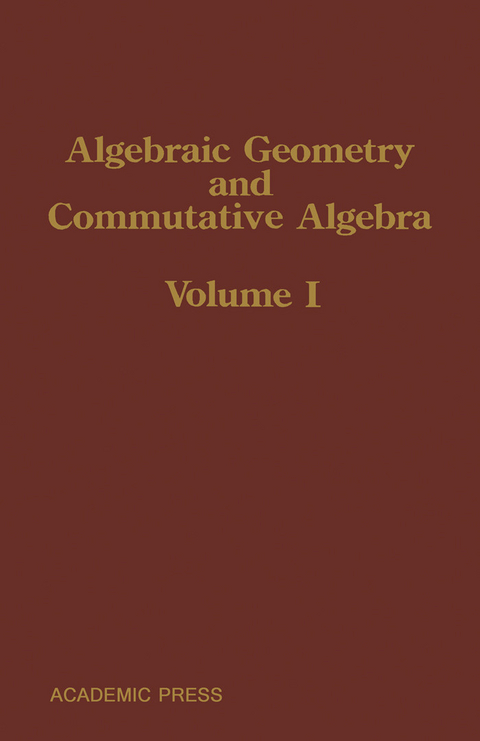
Algebraic Geometry and Commutative Algebra (eBook)
416 Seiten
Elsevier Science (Verlag)
978-1-4832-6518-6 (ISBN)
Algebraic Geometry and Commutative Algebra in Honor of Masayoshi Nagata presents a collection of papers on algebraic geometry and commutative algebra in honor of Masayoshi Nagata for his significant contributions to commutative algebra. Topics covered range from power series rings and rings of invariants of finite linear groups to the convolution algebra of distributions on totally disconnected locally compact groups. The discussion begins with a description of several formulas for enumerating certain types of objects, which may be tabular arrangements of integers called Young tableaux or some types of monomials. The next chapter explains how to establish these enumerative formulas, with emphasis on the role played by transformations of determinantal polynomials and recurrence relations satisfied by them. The book then turns to several applications of the enumerative formulas and universal identity, including including enumerative proofs of the straightening law of Doubilet-Rota-Stein and computations of Hilbert functions of polynomial ideals of certain determinantal loci. Invariant differentials and quaternion extensions are also examined, along with the moduli of Todorov surfaces and the classification problem of embedded lines in characteristic p. This monograph will be a useful resource for practitioners and researchers in algebra and geometry.
Front Cover 1
Algebraic Geometry and Commutative Algebra in Honor of Masayoshi NAGATA 4
Copyright Page 5
Foreword 8
Table of Contents of Volume II 13
Determinantal Loci and Enumerative Combinatorics of Young Tableaux 14
1. Introduction 14
First Chapter. YOUNG TABLEAUX AND DETERMINANTAL POLYNOMIALS IN BINOMIAL COEFFICIENTS 15
2. Tableaux and monomials 15
3. Determinantal polynomials of any width 18
4. Determinantal polynomials of width two 20
Second Chapter.
23
5. Counting tableaux of any width 23
6. Bitableaux 24
7. Counting bitableaux 24
8. Counting monomials 24
9. Bitableaux and monomials 25
Third Chapter.
26
10. Preamble 26
11. The mixed size case 26
12. The cardinality condition 28
13. The maximal size case 29
14. The basic case 29
15. Laplace development 29
16. The full depth case 29
17. Deduction of the full depth case 30
18. The straightening law 31
19. Problem 31
Fourth Chapter.
31
20. Determinantal loci 31
21. Vector spaces and homogeneous rings 35
22. Standard basis 36
23. Second fundamental theorem of invariant theory 37
24. Generalized second fundamental theorem of invariant theory 37
References 39
A Conjecture of Sharp —The Case of Local Rings with dim non CM = 1 or dim = 5 40
1. Introduction 40
2. Sharp's Conjecture 40
3. Proofs of Theorem 1.1 and Theorem 1.2 42
References 46
A Structure Theorem for Power Series Rings 48
1. We suppose that there is given a commutative diagram 50
2. We may replace B by C = R[X,Y]/(f1,...„fm) 50
3. 51
4. Proof of the Theorem 53
5. Corollary 55
References 56
On Rational Plane Sextics with Six Tritangents Wolf BARTH* and Ross MOORE 58
0. Introduction 58
1. Some Polynomials 59
2. The sextic space curve S 60
3. The projected curves Sx 63
4. The double plane X 64
5. The double plane Y 67
6. Moduli 68
7. Explanations 70
References 71
On Rings of Invariants of Finite Linear Groups 72
1. Fundamental groups 72
2. Proof of Theorem A 74
3. Additional results 75
References 77
Invariant Differentials 78
§1. Introduction 78
2. Use of the étale slice theorem 79
3. The ñnite group case 80
References 84
Classification of Polarized Manifoldsof Sectional Genus Two 86
Introduction 86
Notation, Convention and Terminology 87
1. Classification, first step 87
2. The case K ~ (3 – n)L 90
3. The case of a hyperquadric fíbration over a curve 96
4. Polarized surfaces of sectional genus two 104
Appendix 108
References 109
Affine Surfaces with . = 1 112
Introduction 112
1. Surfaces with K = –8 113
2. The case K{S) = 0 115
3. The case K{S) = 1 118
4. Examples K{S) = 2 133
References 137
On the Convolution Algebra of Distributionson Totally Disconnected Locally Compact Groups 138
0. Introduction 138
1. Finite w-distribution 139
2. Action of homeomorphisms and multiplication by functions 140
3. Generators of S(X, w V)
4. Action of . on vector valued functions 143
5. Tensor product of distributions 144
6. Convolution 145
7. Representation of G 146
8. Regular representation 146
9. Projection operator 147
10. D-modules and S.-modules 148
11. D-modules and e-modules 149
12. Proof of Theorem 1 151
13. Proof of Theorem 2 151
References 153
The Local Cohomology Groups of an Affine Semigroup Ring 154
Introduction 154
1. Affine semigroup rings and the associated cones 154
2. Complexes associated to an affine semigroup ring 158
3. The dualizing complex and the local cohomology groups 160
4. Serre's condition (S2) 163
References 165
Quaternion Extensions 168
Definitions, Notations and Some Necessary Facts 168
Introduction. 169
I. Quaternion extensions and quadratic forms 170
II. Fields that admit quaternion extensions 180
III. Automatic realizations 188
IV. Polynomials with Galois group Qs 192
Acknowledgement. 194
References 194
On the Discriminants of the Intersection Form on Néron-Severi Groups 196
0. Introduction 196
1. Preliminaries 197
2. Bilinear forms 199
3. The Discriminant of the intersection form 202
4. Examples 205
5. A K3 surface 208
References 213
On Complete Ideals in Regular Local Rings 216
Introduction 216
1. Point bases and completions of ideals in regular local rings 217
2. Simple complete ideals corresponding to infinitely near points 229
3. The length of a complete ideal (dimension 2) 235
4. Unique factorization for complete ideals (dimension 2) 240
References 242
On a Compactification of a Moduli Space of Stable Vector Bundles on a Rational Surface 246
Introduction. 246
1. Some remarks on semi-stable sheaves 248
2. Semi-stable sheaves on a rational surface 250
3. Semi-stability of the universal extension 253
4. Image of . ( G, C1 , C2) 258
5. Image of .(r,0,C2) 261
6. Good polarizations and the case of rank 2 270
References 272
On the Dimension of Formal Fibres of a Local Ring 274
Introduction. 274
1. Formal fibres 274
2. Some cases where a{A) is smaller than dim A – 1 276
References 279
On the Classification Problem of Embedded Lines in Characteristic . 280
1. Introduction 280
2. Expansions and Their Calculus 282
3. The Defining Equations 284
4. ai = 0 288
5. Other Coiijectiires 291
References 292
A Cancellation Theorem for Projective Modules over Finitely Generated Rings 294
1. Introduction 294
2. Cancellation 294
3. Projective stable ranges 297
References 299
Semi-ampleness of the Numerically Effective Part of Zariski Decomposition II 302
0. Introduction 302
1. Preliminary 302
2. Zariski decomposition 306
3. Canonical rings 319
References 323
On the Moduli of Todorov Surfaces 326
1. Equidistant binary linear codes 328
2. K3 surfaces with ordinary double points 332
3 . Double covers of surfaces with ordinary double points 338
4. Involutions on canonical surfaces 342
5. Todorov surfaces 344
6. Embeddings of Todorov lattices 349
7. The moduli of Todorov surfaces 357
8. Concluding remarks 363
Appendix 365
References 366
Curves, K3 Surfaces and Fano 3-folds of Genus = 10 370
1. Preliminary 373
2. Proof of Theorem 0.2 in the case g = 10 377
3. Generic K3 surfaces of genus 7,8, and 9 380
4. Generic K3 surface of genus 6 384
5. Fano 3-folds of genus 10 387
6. Curves of genus = 9 388
References 389
Threefolds Homeomorphic toa Hyperquadric in P4 392
0. Introduction 392
1. Hyperquadrics in P4 394
2. Lemmas 395
3. A complete intersection L = DnD 396
4. Proof of (3.2) 400
5. Proof of (3.3) 401
6. Proof of (3.4) 403
7. Proof of (3.5) 407
8. Proof of (3.6) 408
9. Proof of (0.1) 414
Appendix 415
References 417
| Erscheint lt. Verlag | 10.5.2014 |
|---|---|
| Sprache | englisch |
| Themenwelt | Mathematik / Informatik ► Mathematik ► Geometrie / Topologie |
| Technik | |
| ISBN-10 | 1-4832-6518-8 / 1483265188 |
| ISBN-13 | 978-1-4832-6518-6 / 9781483265186 |
| Informationen gemäß Produktsicherheitsverordnung (GPSR) | |
| Haben Sie eine Frage zum Produkt? |
 PDF (Adobe DRM)
Kopierschutz: Adobe-DRM
Adobe-DRM ist ein Kopierschutz, der das eBook vor Mißbrauch schützen soll. Dabei wird das eBook bereits beim Download auf Ihre persönliche Adobe-ID autorisiert. Lesen können Sie das eBook dann nur auf den Geräten, welche ebenfalls auf Ihre Adobe-ID registriert sind.
Details zum Adobe-DRM
Dateiformat: PDF (Portable Document Format)
Mit einem festen Seitenlayout eignet sich die PDF besonders für Fachbücher mit Spalten, Tabellen und Abbildungen. Eine PDF kann auf fast allen Geräten angezeigt werden, ist aber für kleine Displays (Smartphone, eReader) nur eingeschränkt geeignet.
Systemvoraussetzungen:
PC/Mac: Mit einem PC oder Mac können Sie dieses eBook lesen. Sie benötigen eine
eReader: Dieses eBook kann mit (fast) allen eBook-Readern gelesen werden. Mit dem amazon-Kindle ist es aber nicht kompatibel.
Smartphone/Tablet: Egal ob Apple oder Android, dieses eBook können Sie lesen. Sie benötigen eine
Geräteliste und zusätzliche Hinweise
Buying eBooks from abroad
For tax law reasons we can sell eBooks just within Germany and Switzerland. Regrettably we cannot fulfill eBook-orders from other countries.
aus dem Bereich