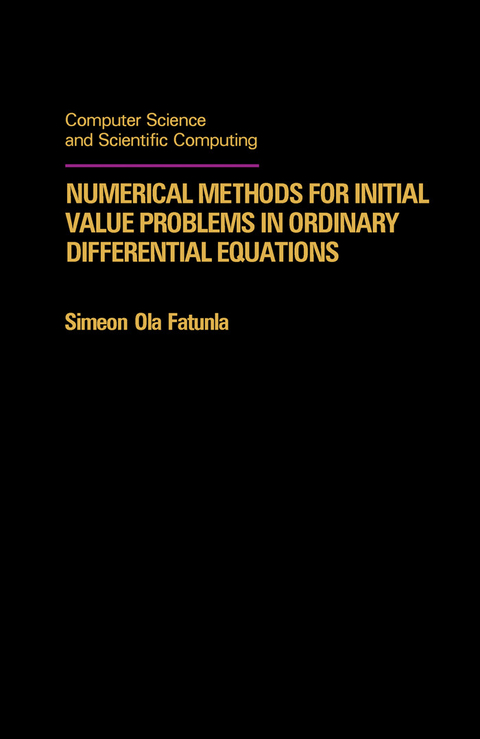
Numerical Methods for Initial Value Problems in Ordinary Differential Equations (eBook)
308 Seiten
Elsevier Science (Verlag)
9781483269269 (ISBN)
Numerical Method for Initial Value Problems in Ordinary Differential Equations deals with numerical treatment of special differential equations: stiff, stiff oscillatory, singular, and discontinuous initial value problems, characterized by large Lipschitz constants. The book reviews the difference operators, the theory of interpolation, first integral mean value theorem, and numerical integration algorithms. The text explains the theory of one-step methods, the Euler scheme, the inverse Euler scheme, and also Richardson's extrapolation. The book discusses the general theory of Runge-Kutta processes, including the error estimation, and stepsize selection of the R-K process. The text evaluates the different linear multistep methods such as the explicit linear multistep methods (Adams-Bashforth, 1883), the implicit linear multistep methods (Adams-Moulton scheme, 1926), and the general theory of linear multistep methods. The book also reviews the existing stiff codes based on the implicit/semi-implicit, singly/diagonally implicit Runge-Kutta schemes, the backward differentiation formulas, the second derivative formulas, as well as the related extrapolation processes. The text is intended for undergraduates in mathematics, computer science, or engineering courses, andfor postgraduate students or researchers in related disciplines.
Front Cover 1
Numerical Methods for Initial Value Problems in Ordinary Differential Equations 4
Copyright Page 5
Table of Contents 6
PREFACE 10
CHAPTER 1. PRELIMINARIES 14
1.1 The Difference Operators 14
1.2 Theory of Interpolation 16
1.3 Finite Difference Equations 23
1.4 Linear Systems with Constant Coefficients 26
1.5 Distribution of Roots of Polynomials 28
1.6 First Integral Mean Value Theorem 30
1.7 Common Norms in ODEs 31
CHAPTER 2. NUMERICAL INTEGRATION ALGORITHMS 33
2.1 Introduction 33
2.2 Existence of Solution, Numerical Approach 36
2.3 Special IVPs 39
2.4 Error Propagation, Stability and Convergence of Discretization Methods 41
CHAPTER 3. THEORY OF ONE-STEP METHODS 44
3.1 General Theory of One-Step Methods 44
3.2 The Euler Scheme, the Inverse Euler Scheme and Richardson's Extrapolation 48
3.3 The Convergence of Euler's Scheme 52
3.4 The Trapezoidal Scheme 55
CHAPTER 4. RUNGE-KUTTA PROCESSES 61
4.1 General Theory of Runge-Kutta Processes 61
4.2 The Explicit Two-Stage Process 69
4.3 Convergence and Stability of Two-Stage Explicit R-K Scheme 73
4.4 Matrix Representation of the R-K Processes 75
4.5 Error Estimation and Stepsize Selection in R-K Processes 85
4.6 Implicit and Semi-Implicit R-K Processes 88
4.7 Rosenbrock Methods 98
CHAPTER 5. LINEAR MULTISTEP METHODS 102
5.1 Starting Procedure 102
5.2 Explicit Linear Multistep Methods (Adams-Bashforth 1883,
104
5.3 Implicit Linear Multistep Methods (Adams-Moulton scheme, 1926 and
108
5.4 Implementation of the Predictor-Corrector Formulas 113
5.5 General Theory of Linear Multistep Methods 117
5.6 Automatic Implementation of the Adams Scheme 134
CHAPTER 6. NUMERICAL TREATMENT OF SINGULAR/ DISCONTINUOUS INITIAL VALUE PROBLEMS 138
6.1 Introduction 138
6.2 Non-Polynomial Methods 140
6.3 The Inverse Polynomial Methods 146
6.4 Local Error Estimates in Automatic Codes for Discontinuous Systems 149
CHAPTER 7. EXTRAPOLATION PROCESSES AND SINGULARITIES 153
7.1 Introduction 153
7.2 Generation of the Zero-th Column of Extrapolation Table 155
7.3 Polynomial and Rational Extrapolation 161
7.4 Convergence and Stability Properties of Extrapolation Processes 167
7.5 Practical Implementation of Extrapolation Processes 171
CHAPTER 8. STIFF INITIAL VALUE PROBLEMS 174
8.1 The Concept of Stiffness 174
8.2 Stiff and Nonstiff Algorithms 180
8.3 Solution of Nonlinear Equations and Estimation of Jacobians 181
8.4 Region of Absolute Stability 185
8.5 Stability Criteria for Stiff Methods 193
8.6 Stronger Stability Properties of IRK Processes 201
8.7 One-Leg Multistep Methods 208
CHAPTER 9. STIFF ALGORITHMS 211
9.1 What are Stiff Algorithms? 211
9.2 Efficient Implementation of Implicit Runge-Kutta Methods (IRK) 216
9.3 The Backward Differentiation Formula (BDF) 224
9.4 Second Derivative Formulas (SDFs) 228
9.5 Extrapolation Processes for Stiff Systems 230
9.6 Mono-Implicit R-K Formulas 236
CHAPTER 10. SECOND ORDER DIFFERENTIAL EQUATIONS 239
10.1 Introduction 239
10.2 Linear Multistep Methods and the Concept of P-Stability 241
10.3 Derivation of P-Stable Formulas 243
10.4 One-Leg Multistep Methods for Second Order IVPs 245
10.5 Multiderivative Methods for Second IVPs 249
CHAPTER 11. RECENT DEVELOPMENTS IN ODE SOLVERS 251
REFERENCES 266
INDEX 300
| Erscheint lt. Verlag | 10.5.2014 |
|---|---|
| Sprache | englisch |
| Themenwelt | Mathematik / Informatik ► Mathematik ► Analysis |
| Technik | |
| ISBN-13 | 9781483269269 / 9781483269269 |
| Informationen gemäß Produktsicherheitsverordnung (GPSR) | |
| Haben Sie eine Frage zum Produkt? |
 PDF (Adobe DRM)
Kopierschutz: Adobe-DRM
Adobe-DRM ist ein Kopierschutz, der das eBook vor Mißbrauch schützen soll. Dabei wird das eBook bereits beim Download auf Ihre persönliche Adobe-ID autorisiert. Lesen können Sie das eBook dann nur auf den Geräten, welche ebenfalls auf Ihre Adobe-ID registriert sind.
Details zum Adobe-DRM
Dateiformat: PDF (Portable Document Format)
Mit einem festen Seitenlayout eignet sich die PDF besonders für Fachbücher mit Spalten, Tabellen und Abbildungen. Eine PDF kann auf fast allen Geräten angezeigt werden, ist aber für kleine Displays (Smartphone, eReader) nur eingeschränkt geeignet.
Systemvoraussetzungen:
PC/Mac: Mit einem PC oder Mac können Sie dieses eBook lesen. Sie benötigen eine
eReader: Dieses eBook kann mit (fast) allen eBook-Readern gelesen werden. Mit dem amazon-Kindle ist es aber nicht kompatibel.
Smartphone/Tablet: Egal ob Apple oder Android, dieses eBook können Sie lesen. Sie benötigen eine
Geräteliste und zusätzliche Hinweise
Buying eBooks from abroad
For tax law reasons we can sell eBooks just within Germany and Switzerland. Regrettably we cannot fulfill eBook-orders from other countries.
aus dem Bereich