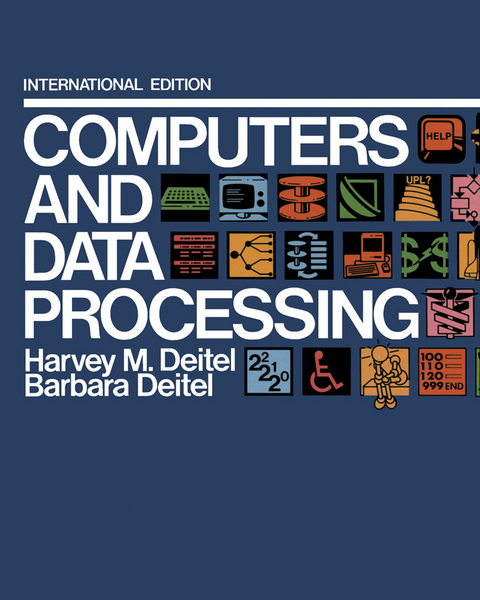
Computers and Data Processing (eBook)
662 Seiten
Elsevier Science (Verlag)
978-1-4832-6470-7 (ISBN)
Computers and Data Processing provides information pertinent to the advances in the computer field. This book covers a variety of topics, including the computer hardware, computer programs or software, and computer applications systems. Organized into five parts encompassing 19 chapters, this book begins with an overview of some of the fundamental computing concepts. This text then explores the evolution of modern computing systems from the earliest mechanical calculating devices to microchips. Other chapters consider how computers present their results and explain the storage and retrieval of massive amounts of computer-accessible information from secondary storage devices. This book discusses as well the development installation, evaluation, and control of computer systems. The final chapter discusses the use of computers in the transportation systems and the ways in which they make possible other innovations in transportation. This book is a valuable resource for computer scientists, systems analysts, computer programmers, mathematicians, and computer specialists.
Front Cover 1
Computers and Data Processing 3
Copyright Page 5
Table of Contents 7
Dedication 6
Preface 22
Part One: Introduction 28
Chapter 1. The Information Revolution 30
Introducing the Computer 31
The Benefits 33
The Dangers 33
Looking to the Future 34
A Tour of the Text 35
Chapter 2. The Evolution of Computers 48
Early Computing Devices 49
The Dawn of the Modern Computer Age 57
Generations of Computers 62
Part Two: Hardware 72
Chapter 3. The Processor 74
The Basic Computer Processing Cycle 75
The Central Processing Unit 76
The Binary Number System 85
Data Organization 85
Machine Language Instructions 89
The Josephson Junction: The "Computer on Ice" 94
Chapter 4. Input: Gateway to the Computer 100
Punched Cards 102
Key-to-Tape and Key-to-Disk Systems 105
Terminal-Oriented Systems 105
Touch Sensing 106
Other Input Devices 109
Source Data Automation 111
Optical Character Recognition 113
Optical Mark Recognition 117
Universal Product Code 121
Chapter 5. Output: Getting Results from Computers 128
Printed Reports 129
Types of Printers 129
Terminal-Oriented Systems 138
Cathode Ray Tube Terminals 139
Portable Terminals 143
Other Types of Computer Output 151
Applications for the Future 156
Chapter 6. Secondary Storage 160
Magnetic Tape Storage 161
Disk Storage 166
Mass Storage Devices 172
Bubble Memory 174
Optical Disks 175
File Organization Methods 177
Applications for the Future 178
Chapter 7. Data Communications 182
History 183
How Data Communications Systems Work 184
Asynchronous and Synchronous Transmission 185
Data Transmission Codes 187
Simplex, Half-Duplex, and Full-Duplex Transmission 187
Line Speed 187
Transmission Media 188
Line Configuration 193
Data Communications Networks 196
Multiplexors 201
Concentrators 203
Common Carriers 204
Expectations for the Future 205
Part Three: Software 210
Chapter 8. Structured Programming 212
What Is a Computer Program? 213
The Program Development Process 214
Structured Programming 217
Programming Psychology 222
Case Studies in Structured Program Development 224
Chapter 9. Programming Languages 246
Programming Languages 247
High-Level Languages 251
A Survey of High-Level Languages 253
Query Languages 265
A Universal Programming Language 265
Software Packages 265
Trends 266
A Brief Introduction to LOGO 266
Chapter 10. Structured Systems Analysis and Design Systems Acquisition
Why Develop or Modify Systems? 274
The Systems Life Cycle 274
The Systems Design Phase 276
The Implementation Phase 279
The Operation Phase 282
Systems Acquisition 284
Case Study: Structured Systems Analysis and Design 286
Chapter 11. Database Management Systems, Management Information Systems, Decision Support Systems 300
Data as a Business Resource 301
Database Management Systems 302
Management Information Systems 308
Decision Support Systems 321
Chapter 12. Operating Systems 334
Systems Programs 335
Applications Programs 335
Operating Systems 335
Operating Systems Functions 336
Batch Processing 336
Multiuser Operating Systems 337
Multiprogramming 337
Channels and Interrupts 337
Double Buffering 337
Storage Protection 338
Relocatable Programs 338
Reentrant Programs 339
Deadlock 339
Timesharing 340
Real-Time Systems 340
Scheduling 340
Print Spooling 341
Virtual Storage 341
Multiprocessing 343
Security 343
User-Friendliness 345
Firmware 346
Conclusion 353
Part Four: Computers in Business 358
Chapter 13. Personal Computing 360
What Is a Personal Computer? 361
A Brief History of Personal Computing 361
Portable Computers 376
Choosing a Personal Computer 376
Personal Computer Data Communications 378
Applications 378
Personal Computing Software 380
Education 380
The Information Providers 384
Social Impact 391
Chapter 14. Office Automation 396
Goals of Office Automation Systems 398
Characteristics of Offices and OA Systems 398
Word Processing 399
Electronic Mail 411
Electronic Calendar 414
Teleconferencing 414
Electronic Blackboard 415
OA Communications: The Computerized Branch Exchange 415
Computerized Typesetting 416
Archival Storage 417
Obstacles to the Growth of Office Automation 417
Trends in Office Automation 417
Chapter 15. Electronic Funds
424
Direct Deposit 425
On-Line Teller Terminals 426
Automated Teller Machines 426
Credit Authorization Terminals 428
The Debit Card and The Credit Card 429
Point-of-Sale Terminals and Transactions 429
Privacy and Social Issues in EFT 430
EFT Legislation and Regulation 431
The Future of EFT 432
Computer Crime Techniques 433
Computer Criminals 437
Computers and Law Enforcement 437
Security 438
Disaster Recovery 440
Encryption 440
Software Protection 441
Privacy 441
Conclusion 443
Part Five: Computers in Society 448
Chapter 16. Robotics and Artificial Intelligence 450
Robotics 451
The Mechanical Human 453
A Brief History of Robotics 454
Productivity Concerns 455
Industrial Robots: "Steel Collar" Workers 455
How Robots Work 456
Robot Vision 457
An Artificial Sense of Touch 459
Household Robots 460
Organized Labor and Robotics 460
Social Issues 461
Philosophical Issues 463
The Turing Test of Intelligence 465
Expert Systems 465
Natural Language Processing 466
Heuristics 467
The Game of Chess 468
Lisp: The Programming Language of Artificial Intelligence 468
Serial Versus Parallel Computers 469
Chapter 17. Computers and Medicine 476
Computer-Based Scanning Systems 479
The CAT Scan 479
The PET Scan 481
Heart Research 483
Cancer 484
Organ Matching 485
Anesthesiology 485
Surgery 486
Intensive Care 486
Obtaining Medical Histories 486
Drug Conflict Warnings 487
Searching Medical Libraries 487
Artificial Organs and Body Parts 487
Chapter 18. Computers and the Handicapped 492
Rehabilitation Engineering 493
Information Amplification 494
Computers and Blind People 494
Computers and Deaf People 498
Computers and Deaf-Blind People 501
Computers and Nonvocal Disabled People 501
Computers and the Paralyzed 503
The Handicapped at Work 505
Computers and Special Education 506
Biomedicai Engineering 507
Chapter 19. Computers and Transportation 516
Computers and Automobiles 517
Computers and Air Travel 520
Computers and Trains 525
Computers and Ships 528
Conclusion 531
Appendix A: BASIC Programming 536
Appendix B: Number Systems 596
Appendix C: The Computing Profession 610
Glossary 632
Trademarks 649
Illustration Credits 650
Index 656
| Erscheint lt. Verlag | 10.5.2014 |
|---|---|
| Sprache | englisch |
| Themenwelt | Mathematik / Informatik ► Informatik ► Theorie / Studium |
| ISBN-10 | 1-4832-6470-X / 148326470X |
| ISBN-13 | 978-1-4832-6470-7 / 9781483264707 |
| Informationen gemäß Produktsicherheitsverordnung (GPSR) | |
| Haben Sie eine Frage zum Produkt? |
 PDF (Adobe DRM)
Kopierschutz: Adobe-DRM
Adobe-DRM ist ein Kopierschutz, der das eBook vor Mißbrauch schützen soll. Dabei wird das eBook bereits beim Download auf Ihre persönliche Adobe-ID autorisiert. Lesen können Sie das eBook dann nur auf den Geräten, welche ebenfalls auf Ihre Adobe-ID registriert sind.
Details zum Adobe-DRM
Dateiformat: PDF (Portable Document Format)
Mit einem festen Seitenlayout eignet sich die PDF besonders für Fachbücher mit Spalten, Tabellen und Abbildungen. Eine PDF kann auf fast allen Geräten angezeigt werden, ist aber für kleine Displays (Smartphone, eReader) nur eingeschränkt geeignet.
Systemvoraussetzungen:
PC/Mac: Mit einem PC oder Mac können Sie dieses eBook lesen. Sie benötigen eine
eReader: Dieses eBook kann mit (fast) allen eBook-Readern gelesen werden. Mit dem amazon-Kindle ist es aber nicht kompatibel.
Smartphone/Tablet: Egal ob Apple oder Android, dieses eBook können Sie lesen. Sie benötigen eine
Geräteliste und zusätzliche Hinweise
Buying eBooks from abroad
For tax law reasons we can sell eBooks just within Germany and Switzerland. Regrettably we cannot fulfill eBook-orders from other countries.
aus dem Bereich