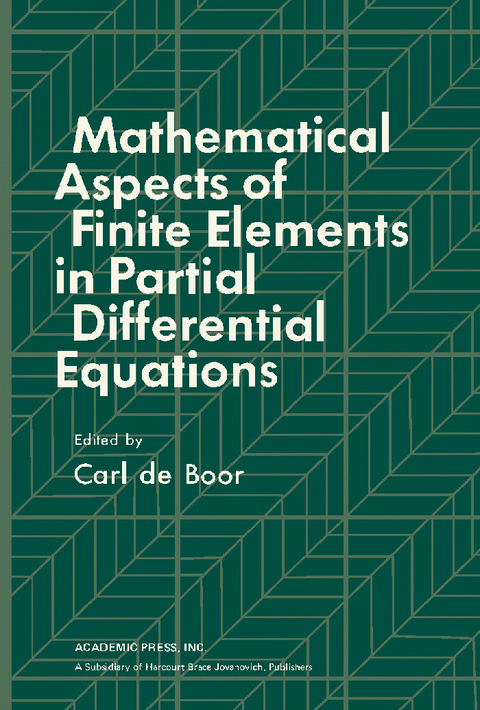
Mathematical Aspects of Finite Elements in Partial Differential Equations (eBook)
430 Seiten
Elsevier Science (Verlag)
978-1-4832-6807-1 (ISBN)
Mathematical Aspects of Finite Elements in Partial Differential Equations addresses the mathematical questions raised by the use of finite elements in the numerical solution of partial differential equations. This book covers a variety of topics, including finite element method, hyperbolic partial differential equation, and problems with interfaces. Organized into 13 chapters, this book begins with an overview of the class of finite element subspaces with numerical examples. This text then presents as models the Dirichlet problem for the potential and bipotential operator and discusses the question of non-conforming elements using the classical Ritz- and least-squares-method. Other chapters consider some error estimates for the Galerkin problem by such energy considerations. This book discusses as well the spatial discretization of problem and presents the Galerkin method for ordinary differential equations using polynomials of degree k. The final chapter deals with the continuous-time Galerkin method for the heat equation. This book is a valuable resource for mathematicians.
Front Cover 1
Mathematical Aspects of Finite Elements in Partial Differential Equations 4
Copyright Page 5
Table of Contents 6
Preface 10
Chapter 1. Higher Order Local Accuracy by Averaging in the Finite Element Method 12
1. Introduction 12
2. Notation, subspaces and the construction of Kh 14
3. The calculation of Kh* uh at mesh points 19
4. An application to non-smooth 23
5. The IL2 - projection 23
References. 25
Chapter 2. Convergence of Nonconforming Methods 26
0. Introduction 26
I. Variational Principles for Linear Equations 28
II. Non-Conforming Methods, Error Analysis 34
III. Finite Element Subspaces 38
IV. Application 1: Subspaces Independent of Boundary Conditions 41
V. Application 2: Subspaces with 'Nearly' Dirichlet Conditions 44
VI. Application 3: Subspaces with Reduced Differentiability 47
VII. Application 4: The Use of Fields 53
Appendix: Notation Used 60
References 61
Chapter 3. Some Convergence Results for Galerkin Methods for Parabolic Boundary Value Problems 66
1. Introduction 66
2. Error estimates based on the energy method. 74
3. Error estimates based on eigenfunction expansions 79
4. Completely discrete schemes 88
References 97
Chapter 4. On a Finite Element Method for Solving the Neutron Transport Equation 100
Introduction. 100
2. A Discontinuous Galerkin Method for Ordinary Differential Equations. 102
3. A Finite Element Method for the Neutron Transport Equation 110
4. General Error Bounds 118
5. A Superconvergence Result 125
References. 132
Chapter 5. A Mixed Finite Element Method for the Biharmonic Equation 136
Introduction. 136
2. The continuous problem. 139
3. The discrete problem. 143
4. Error bounds 146
5. A concluding remark 153
References. 154
Chapter 6. A Dissipative Galerkin Method for the Numerical Solution of First Order Hyperbolic Equations 158
1. Introduction 158
2. The Dissipativity of the Galerkin Operator (1. 6). 161
3. Discussion of Higher Order Equations 168
References. 179
Chapter 7. C1 Continuity via Constraints for 4th Order Problems 182
1. Introduction 182
2. Description of Sn as a quotient: definitions of Rn and G. 188
3. Application of Sn to a 4-th order variational problem 192
4. Plate bending example: interpretation of l 198
5. Solution of the approximation problem for n = 5 201
References. 202
Chapter 8. Finite Element and Finite Difference Methods for Hyperbolic Partial Differential Equations 206
1. Introduction 206
2. Difference approximations for 210
3. Difference approximations for hyperbolic systems 222
References. 222
Chapter 9. Solution of Problems with Interfaces and Singularities 224
1: Introduction 224
2: Global Solution 230
References. 281
Chapter 10. The Construction and Comparison of Finite Difference Analogs of Some Finite Element Schemes 290
O. Summary 290
1. Introduction 291
2. Comparing differential-difference schemes for ut = uxx. 292
3. Full space-time discretizations for ut = uxx 299
4. Minimizing the work in order to compare full discretizations,with a caveat 303
5. A comparison of the full discretizations for ut = uxxbased on the work involved in solving linear systems 305
6. Comparison of some full discretizations for ut = ux 311
7. Numerov's method for variable coefficients 314
8. Some other difference approximations 317
Appendix: Optimal Pairs (N, M) for Full Discretizations of the Heat Equation 319
References. 321
Chapter 11. L2 Error Estimates for Projection Methods for Parabolic Equations in Approximating Domains 324
1. Introduction 324
2. Notations and preliminaries 325
3. Elliptic theory 337
4. Approximate solution of parabolic equations 348
References 362
Chapter 12. An H' 1 -Galerkin Procedure for the Two-Point Boundary Value Problem 364
1. Introduction 364
2. Estimates in Lp and Wpm 367
3. Local behavior for k = -1 371
4. Some superconvergence results for k = -1 374
5. Discussion and examples 379
6. Extensions 384
References. 384
Chapter 13. H1 -Galerkin Methods for the Laplace and Heat Equations 394
1. Introduction 394
2. The Laplace Equation 399
3. The Heat Equation 404
4. Discretization in Time for the Parabolic Problem by the Crank-Nicolson Difference Method 408
5. Discretization in Time for the Parabolic Problem by Collocation 411
6. Approximation by Tensor Products of Piecewise Polynomials 418
References. 424
Subject Index 428
| Erscheint lt. Verlag | 10.5.2014 |
|---|---|
| Sprache | englisch |
| Themenwelt | Mathematik / Informatik ► Mathematik ► Analysis |
| Technik | |
| ISBN-10 | 1-4832-6807-1 / 1483268071 |
| ISBN-13 | 978-1-4832-6807-1 / 9781483268071 |
| Informationen gemäß Produktsicherheitsverordnung (GPSR) | |
| Haben Sie eine Frage zum Produkt? |
 PDF (Adobe DRM)
Kopierschutz: Adobe-DRM
Adobe-DRM ist ein Kopierschutz, der das eBook vor Mißbrauch schützen soll. Dabei wird das eBook bereits beim Download auf Ihre persönliche Adobe-ID autorisiert. Lesen können Sie das eBook dann nur auf den Geräten, welche ebenfalls auf Ihre Adobe-ID registriert sind.
Details zum Adobe-DRM
Dateiformat: PDF (Portable Document Format)
Mit einem festen Seitenlayout eignet sich die PDF besonders für Fachbücher mit Spalten, Tabellen und Abbildungen. Eine PDF kann auf fast allen Geräten angezeigt werden, ist aber für kleine Displays (Smartphone, eReader) nur eingeschränkt geeignet.
Systemvoraussetzungen:
PC/Mac: Mit einem PC oder Mac können Sie dieses eBook lesen. Sie benötigen eine
eReader: Dieses eBook kann mit (fast) allen eBook-Readern gelesen werden. Mit dem amazon-Kindle ist es aber nicht kompatibel.
Smartphone/Tablet: Egal ob Apple oder Android, dieses eBook können Sie lesen. Sie benötigen eine
Geräteliste und zusätzliche Hinweise
Buying eBooks from abroad
For tax law reasons we can sell eBooks just within Germany and Switzerland. Regrettably we cannot fulfill eBook-orders from other countries.
aus dem Bereich